BDI: 1,842 ▼ 1.2%
COTTON NO.2: 84.12 ▲ 0.4%
LME COPPER: 8,432.50 ▲ 2.1%
FOOD SAFETY INDEX: 94.2 ARCHIVE_SECURED
OPTICAL INDEX: 11,204.09 STABLE
BDI: 1,842 ▼ 1.2%

SECTOR INDEX
V.24.08 ARCHIVE
Hot Articles
- When Is a Straddle Monorail System a Good Fit for Urban Transit Corridors?Is a straddle monorail system right for your urban corridor? Explore capacity, space, station access, safety, and lifecycle costs to make a confident transit investment.
- EU Textile Waste Reporting: Who Must Report and What Data Is Required?EU textile waste reporting explained: discover who must report, what data is required, and how to verify EPR, waste records, and shipment compliance across EU markets.
- Yarn Strength Benchmarks for Weaving: Setting Warp and Weft RequirementsSet yarn strength benchmarks for weaving with practical warp and weft criteria. Learn how tenacity, variability, and loom loads inform specifications that help reduce breaks and improve reliability.
When a Keg Filling Machine Becomes a Throughput Bottleneck


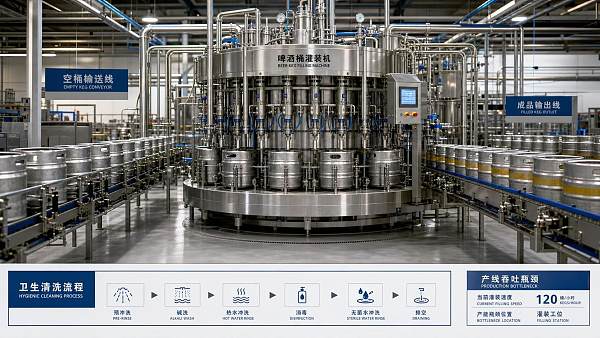
A beverage line can miss its output target even when the filler itself is not technically “down.” In many plants, the real problem starts when the keg station cannot keep pace with upstream brewing, blending, or bright tank release schedules. The machine still runs, but it runs too slowly for the production plan, requires too many interventions, or forces operators to queue cleaned kegs and finished product. At that point, the filling area stops being a simple packaging step and becomes the line constraint.
For project managers and engineering leads, that distinction matters. A throughput bottleneck at the keg filler affects tank utilization, labor planning, sanitation windows, dispatch timing, and product freshness management. It also tends to be misdiagnosed. Teams often blame “insufficient speed” when the root cause is actually changeover losses, poor keg presentation, unstable utilities, excessive foam, or cleaning routines that were never matched to the intended run profile.
Why the bottleneck often appears later than expected
Keg operations usually look adequate during early commissioning. Demand is still ramping up, SKUs are limited, and maintenance crews are highly attentive. The equipment may meet its nominal cycle target under controlled conditions, yet struggle once real production variability enters the picture.
That is when project teams discover that nameplate capacity and usable capacity are not the same thing. A filler that performs acceptably on long runs with a single keg format may become restrictive when the plant adds more package sizes, tighter hygiene controls, or shorter campaigns. If the machine was selected around theoretical hourly output without enough attention to cleaning time, gas management, valve reliability, and operator handling, the bottleneck tends to surface only after the rest of the facility has already scaled.
The issue is more pronounced in beverage plants where kegging is not the dominant package type but still serves important channels such as hospitality, export, contract fills, or seasonal product launches. In that setting, management may underestimate how much disruption a slow keg line can cause because the majority of volume still leaves in bottles or cans. Yet any package format tied to committed deliveries can become a critical path.
What a real throughput bottleneck looks like on the floor
Throughput problems are not limited to a simple count of kegs per hour. On the floor, they show up as a pattern:
- Bright beer or finished beverage waits too long for packaging release.
- Operators pause production repeatedly to correct coupler engagement, purge cycles, or fill level instability.
- Cleaning and sanitation consume a disproportionate share of shift time.
- Quality checks find oxygen pickup, inconsistent carbonation retention, or foam-related underfills.
- Empty keg handling and filled keg removal interfere with the machine’s productive time.
- Maintenance work happens in short reactive bursts instead of planned interventions.
When several of these conditions appear together, the filler is not just a machine with limited speed. It is the center of a process mismatch between hygiene requirements, packaging demand, and line support systems.
Hygiene losses can reduce output more than mechanical speed limits
The supplementary topic of hygiene and output checks is where many plants find the most useful answers. Keg filling is unusually sensitive to cleaning discipline because the package returns from the field. Even when incoming kegs have passed external inspection, the filler must still manage internal sanitation, purge effectiveness, valve cleanliness, and the risk of cross-contamination between products or batches.
Project teams sometimes focus on the machine cycle while overlooking sanitation dwell time, rinse verification, and recovery from failed hygiene checks. In practice, hygiene control can define true output. If a plant shortens cleaning steps to chase volume, it may create microbiological risk, flavor carryover, or unstable shelf performance. If it overextends every sanitation sequence, it sacrifices capacity and labor efficiency. The right balance depends on product sensitivity, return-keg condition, and the plant’s quality release standards.
A useful review starts with time accounting. How much of the scheduled shift is spent on filling, on internal cleaning, on waiting for chemical preparation, on operator checks, and on rework after suspect kegs? Once that split is visible, managers can decide whether the remedy is higher-capacity equipment, a better keg acceptance process, utility improvements, or procedural changes.
Where engineering teams should check before replacing equipment
Replacing a machine is expensive, disruptive, and often unnecessary if the real constraint sits elsewhere. A structured check usually includes the following areas.
1. Keg condition and incoming variation
A keg line rarely behaves consistently if the incoming keg population is inconsistent. Damaged spears, worn seals, residual pressure variation, poor prior washing, and mixed formats all extend handling time and increase reject events. A plant that accepts wide variation without an effective pre-screening routine will see the filler absorb problems that should have been filtered out earlier.
If project managers are reviewing line expansion, they should ask whether the filler was specified for the keg condition actually seen in operation, not the cleaner ideal assumed during procurement.
2. Gas, pressure, and foam control
Beverage filling speed depends on stable product and gas conditions. Carbonated products are especially vulnerable to temperature drift, pressure inconsistency, and poor purge control. Foam generation slows the cycle, increases cleanup time, and can compromise fill accuracy. In many applications, what looks like a machine throughput issue is partly a utility-control problem.
Checks should include gas supply stability, regulator response, product temperature before filling, and whether line layouts create unnecessary pressure losses. It is difficult to sustain output when the machine is forced to compensate for unstable process conditions.
3. Cleaning sequence design
Not every sanitation delay is excessive by definition. The question is whether the sequence matches the contamination risk and production pattern. If every short stop triggers an overly conservative cleaning loop, availability falls quickly. If the cleaning logic is too narrow for the return-keg condition, the plant may lose even more time to investigation and rework.
Engineering reviews should compare actual stop categories with cleaning triggers. Some interruptions justify a complete cycle; others may only need a shorter verified routine. The answer is process-specific, but the classification matters.
4. Mechanical handling around the filler
Keg filling stations often become isolated islands with limited infeed and discharge buffering. Operators then spend time moving containers, resolving jams, and managing staging areas rather than keeping the equipment in a productive state. A machine with acceptable fill speed can still limit the line if surrounding conveyance, lift tables, inspection points, or pallet transfer are undersized.
Throughput should be reviewed as a cell, not just as a single machine.
When machine selection really is the issue
Sometimes the equipment itself is the limiting factor. This usually becomes clear when utilities are stable, operators are trained, incoming kegs are reasonably controlled, and the filler still cannot maintain the required cycle with acceptable hygiene performance.
At that stage, project teams should examine whether the installed configuration matches current production needs. The relevant questions are practical: number of heads, filling principle, purge and pressurization control, ease of cleaning, valve accessibility, spare parts standardization, and how quickly operators can recover from minor faults. In some mixed-format plants, teams also compare the keg station with adjacent filling assets to understand whether packaging flexibility has become too fragmented.
That is why some managers broaden the review beyond a dedicated keg filling machine and look at parallel filling architectures used elsewhere in the plant, including multi-head bottle systems, to benchmark hygiene access, operator workload, and output per square meter. The goal is not to treat different package formats as interchangeable, but to understand how machine layout and automation level influence practical capacity.
Signs that procurement specifications were too narrow
Many bottlenecks can be traced back to an incomplete user requirement specification. Procurement documents often define target hourly output and basic product type, but miss conditions that strongly affect real-life performance.
Warning signs include:
- No clear statement of expected run lengths and changeover frequency.
- No acceptance criteria for hygiene verification or cleaning duration.
- Little detail on keg return quality and format variation.
- Limited requirements for utility stability or integration with plant controls.
- No explicit downtime classification for factory or site acceptance testing.
- Insufficient spare parts and maintenance access review.
For project managers, this matters because a machine can technically meet procurement language while failing operational expectations. If throughput is central to the business case, the purchase specification has to describe the production context in which that throughput must be achieved.
A practical framework for output and hygiene checks
When a line starts to constrain production, teams need a common review method that combines output with sanitation performance. Treating those as separate topics usually hides the trade-off.
This type of review helps separate three different problems: a machine that is too small, a process that is poorly stabilized, and a hygiene regime that is mismatched to the operating pattern.
How the bottleneck changes project economics
Once a keg station becomes the pacing step, the cost is rarely limited to missed hourly output. Tanks may be tied up longer than planned. Labor becomes less predictable because crews stay near the line for recovery and quality checks. Maintenance windows shrink because the machine is always needed, yet reliability worsens because small faults are deferred. Dispatch planning becomes more fragile, especially for products packed to order.
For engineering leaders, that means capex decisions should not be made on filler speed alone. A faster machine that is difficult to clean or sensitive to keg variation may fail to improve net plant performance. A more balanced design with easier sanitation access, clearer fault diagnostics, and better integration into upstream and downstream handling may deliver more usable throughput even if its advertised cycle is not dramatically higher.
What to ask before approving an upgrade or replacement
Before committing to a new asset or a major retrofit, it helps to ask a narrower set of operational questions:
- Is the current loss mainly caused by hygiene routines, unstable process conditions, or actual fill-cycle limitations?
- Does the line need peak speed, or does it need better repeatability over mixed production schedules?
- How much incoming keg variation should the system tolerate without major intervention?
- Can adjacent handling equipment support any increase in filler capacity?
- What acceptance test would prove success under realistic conditions rather than ideal ones?
A keg line becomes a bottleneck when practical throughput falls below what the plant schedule requires, not simply when a brochure speed looks modest. The most effective response starts with output and hygiene checks together, because the constraint usually lives in their interaction. For project managers, that approach leads to better specifications, more realistic acceptance criteria, and fewer surprises after the rest of the plant has already moved on.
Recommended for You
 Digital SeaWhen Is a Straddle Monorail System a Good Fit for Urban Transit Corridors?Is a straddle monorail system right for your urban corridor? Explore capacity, space, station access, safety, and lifecycle costs to make a confident transit investment.By: Captain Kenji SatoOct 19, 2026
 Fabric LogicEU Textile Waste Reporting: Who Must Report and What Data Is Required?EU textile waste reporting explained: discover who must report, what data is required, and how to verify EPR, waste records, and shipment compliance across EU markets.By: Chloe DuboisOct 18, 2026
 Fabric LogicYarn Strength Benchmarks for Weaving: Setting Warp and Weft RequirementsSet yarn strength benchmarks for weaving with practical warp and weft criteria. Learn how tenacity, variability, and loom loads inform specifications that help reduce breaks and improve reliability.By: Chloe DuboisOct 17, 2026
 Fabric LogicEnergy-Saving Textile Machinery: How to Calculate Payback for Your MillEvaluate energy saving textile machinery with a practical payback formula, real-world cost factors, and a worked example. Discover how to verify savings and invest confidently in your mill.By: Chloe DuboisOct 16, 2026
 Digital SeaETSC Adoption in Europe: Policy Drivers, Costs, and Implementation BarriersExplore ETSC adoption Europe-wide: uncover policy drivers, installed costs, and implementation barriers to evaluate solar thermal investments and identify projects with stronger returns.By: Captain Kenji SatoOct 15, 2026
 Digital SeaChoosing Semiconductor Solutions for Industrial Controls: Key Design CriteriaChoose semiconductor solutions for industrial controls with confidence. Explore key criteria for timing, accuracy, power, safety, and lifecycle support to make smarter design decisions.By: Captain Kenji SatoOct 14, 2026
 Aseptic FillingWhen Should Compliance Checks Start for Aseptic Filling Procurement?How early should compliance checks start in procurement planning? Learn why aseptic filling reviews should begin before supplier shortlisting to reduce risks, rework, and costly delays.By: Marcus SterlingOct 13, 2026
 Smart MetersHow Do You Assess Market Demand Before Sourcing New Smart Meters?How do I assess market demand before sourcing a new industrial product? Discover how to validate smart meter demand, check technical fit, and reduce inventory risk before committing to bulk orders.By: Dr. Elena VoltOct 13, 2026
 GIS SwitchgearWhat Should You Compare Besides Price When Selecting GIS Switchgear?What should I compare besides price when selecting an industrial product? Explore GIS switchgear ratings, IEC compliance, maintenance and lifecycle costs to make a confident procurement decision.By: Dr. Elena VoltOct 13, 2026
 Optical SensorsHow Do You Choose Optical Sensors for Harsh Industrial Environments?How do I choose components for harsh industrial environments? Discover how to select optical sensors for dust, heat, vibration, and washdown—and prevent costly missed detections.By: Dr. Hideo TanakaOct 13, 2026
 Marine WinchesWhich Operating Conditions Can Change Marine Winch Selection?Which industrial application conditions can change product selection? Explore how loads, sea state, duty cycle and power shape marine winch selection to make a smarter investment.By: Captain Kenji SatoOct 13, 2026
 Digital SeaChoosing a Seismic Survey Equipment Distributor: Lead Times and Spare PartsChoosing a seismic survey equipment distributor? Learn how to verify lead times, secure critical spare parts, and compare support to reduce downtime and buy with confidence.By: Captain Kenji SatoOct 13, 2026
 Digital SeaHow to Use Industrial Benchmarking Data to Evaluate Supplier Risk and CapabilityIndustrial benchmarking data for supplier evaluation helps buyers assess capability, compliance, capacity, and delivery risk. Learn how to make smarter, evidence-based sourcing decisions.By: Captain Kenji SatoOct 12, 2026
 Fabric LogicFashion Supply Chain Cost Trends: What Is Driving Margins in 2026?Fashion supply chain cost trends for 2026: discover how materials, freight, labor, compliance, and inventory are reshaping margins—and the strategies leaders need to protect profitability.By: Chloe DuboisOct 11, 2026
 Lumen VisionHow Smart Street Lighting Cuts Energy Use Without Compromising Road SafetySmart street lighting reduces energy use while protecting road safety through adaptive controls, reliable monitoring, and risk-based lighting design. Learn the key strategies.By: Dr. Hideo TanakaOct 10, 2026
 Digital SeaDouble Platinum Spark Plugs: When Their Longer Service Life Justifies the CostDouble platinum spark plugs offer longer service life, stable gaps, and lower labor costs. Learn when their premium price is worth it for your vehicle.By: Captain Kenji SatoOct 08, 2026
 Sorting RobotsHow to Benchmark Linear Guide Load Ratings for High-Cycle Automation AxesLinear guide load rating benchmarks for high-cycle automation axes: compare loads, moments, stiffness, lubrication, and life calculations to select reliable guides.By: Marcus SterlingOct 07, 2026
 Digital SeaWhich Rail Data Transparency Metrics Improve Capacity Planning and Service Reliability?Rail data transparency metrics reveal usable capacity, dwell, recovery, and asset risks—helping rail leaders plan more reliable, resilient services.By: Captain Kenji SatoOct 06, 2026
 Digital SeaHow to Select a Marine Piston Air Compressor for High-Demand Shipboard ServiceMarine piston air compressor selection guide for high-demand shipboard service—compare capacity, redundancy, air quality, maintenance, and compliance requirements.By: Captain Kenji SatoOct 05, 2026
 Grid ResilienceIEC 61850 Monitoring Latency: How to Set Performance Limits for Protection SystemsIEC 61850 monitoring latency explained: learn how to set, test, and verify end-to-end performance limits that protect critical GOOSE and Sampled Values systems.By: Dr. Elena VoltOct 04, 2026
 Digital SeaHow to Select Bulldozers by Blade Type, Ground Conditions, and Earthmoving OutputBulldozers selection made practical: compare blade types, track setups, ground conditions, and cycle output to choose the right dozer for lower costs and reliable earthmoving.By: Captain Kenji SatoOct 03, 2026
 Dyeing MachinesHow Sustainable Dyeing Cuts Water Use and Chemical Risk in Textile ProductionSustainable dyeing cuts water use and chemical risk through smarter liquor control, efficient rinsing, safer inputs, and repeatable textile quality.By: Chloe DuboisOct 02, 2026
 Optical SensorsSingle-Mode Fiber Loss in Railway Networks: Causes, Budgets, and Test MethodsSingle mode railway fiber loss explained: identify causes, calculate realistic loss budgets, and apply OTDR and insertion-loss tests for reliable rail networks.By: Dr. Hideo TanakaOct 01, 2026
 Digital SeaIntegrated Transit Hub Planning: How to Balance Passenger Flow and Future CapacityIntegrated transit hub planning strategies for balancing passenger flow, resilient operations, phased delivery, and future capacity—explore practical insights for smarter hubs.By: Captain Kenji SatoSep 30, 2026
 Digital SeaWhat to Evaluate When Selecting a MaaS Ticketing Platform for Multimodal NetworksMaaS ticketing platform selection guide: evaluate interoperability, fare control, settlement, resilience, privacy, and scalability for multimodal networks.By: Captain Kenji SatoSep 29, 2026
 Digital SeaWhat Does Train Control Center Software Cost? Budgeting for Integration and SupportTrain control center software cost explained: compare integration, cybersecurity, commissioning, and long-term support to build a realistic rail operations budget.By: Captain Kenji SatoSep 28, 2026
 Digital SeaWhat to Evaluate in Thermite Rail Welding Equipment for Field Track RepairsThermite rail welding equipment: evaluate compatibility, preheating, alignment, safety, and supplier support for reliable field track repairs.By: Captain Kenji SatoSep 27, 2026
 Aseptic FillingISO 22000 Food Safety Certification: What Food Manufacturers Must PrepareISO 22000 food safety certification: discover the essential steps manufacturers need to build a robust FSMS, control hazards, and prepare confidently for audit success.By: Marcus SterlingSep 26, 2026
 UHV TransformersWhat Makes an Electrification Factory Ready for High-Voltage Equipment Production?Electrification factory readiness for high-voltage equipment: discover the essential standards, testing, traceability, safety, and workforce controls that drive reliable production.By: Dr. Elena VoltSep 25, 2026
 Digital SeaRail Signal Visibility: Sighting Distance, Contrast, and Verification RequirementsRail signal visibility: learn how sighting distance, contrast, weather, and verification controls help ensure safe, compliant signal recognition.By: Captain Kenji SatoSep 24, 2026
![]() GIS SwitchgearHow Do You Compare GIS Switchgear Suppliers When Certifications Differ?How do I compare industrial suppliers when certifications are not equivalent? Learn how to assess GIS switchgear test evidence, compliance scope, traceability, and project risk.By: Dr. Elena VoltSep 24, 2026
GIS SwitchgearHow Do You Compare GIS Switchgear Suppliers When Certifications Differ?How do I compare industrial suppliers when certifications are not equivalent? Learn how to assess GIS switchgear test evidence, compliance scope, traceability, and project risk.By: Dr. Elena VoltSep 24, 2026