BDI: 1,842 ▼ 1.2%
COTTON NO.2: 84.12 ▲ 0.4%
LME COPPER: 8,432.50 ▲ 2.1%
FOOD SAFETY INDEX: 94.2 ARCHIVE_SECURED
OPTICAL INDEX: 11,204.09 STABLE
BDI: 1,842 ▼ 1.2%

SECTOR INDEX
V.24.08 ARCHIVE
Hot Articles
- Kongsberg Maritime Unveils Arctic Hunter Unmanned Surface VesselKongsberg Maritime's Arctic Hunter unmanned surface vessel is proposed for the Royal Navy's Type 92 programme. Explore its technology and procurement implications.
- How Accurate Is AI in Food Quality Control? Metrics and Testing MethodsExplore AI in food quality control accuracy, from recall and false negatives to validation methods. Learn how to assess real-world inspection reliability.
- GE Vernova Selected for 6 GW HVDC Link in IndiaGE Vernova will design a 6 GW HVDC link for PGCIL, connecting Rajasthan and South Kalamb to support India's clean energy transition. Discover the project.
Choosing Semiconductor Solutions for Industrial Controls: Key Design Criteria


The strongest semiconductor choice for an industrial controller is not necessarily the device with the highest clock speed, lowest on-resistance, or lowest purchase price. It is the combination of processing, power, sensing, and interface components that meets control deadlines and measurement requirements under the intended electrical, thermal, and fault conditions.
Selection should therefore begin with measurable acceptance limits: maximum response time, allowable measurement error, operating temperature, disturbance immunity, safe-state behavior, and required service life. These limits expose differences that headline specifications conceal. A processor with ample average throughput can still miss a control deadline; a high-resolution converter can still produce unreliable measurements; an industrial-temperature component can still overheat inside a sealed enclosure.
Define the control boundary before comparing devices
A semiconductor shortlist is only meaningful once the controller’s responsibilities are clear. A compact textile-machine controller handling synchronized motion has different timing requirements from a food-processing controller managing slower temperature loops. A grid-connected measurement unit may place greater emphasis on isolation, disturbance tolerance, and timestamp accuracy. Selecting components against a generic “industrial” requirement obscures these differences.
Specify the complete path from physical input to commanded output. Include sensor conditioning, analog conversion, data transfer, computation, network communication, and actuator response. The processor’s execution time is only one part of this path; conversion delays, filter settling, network scheduling, and output-update timing can consume much of the available budget.
Separate mandatory limits from desirable features. An extra communication port is negotiable; failure to meet a safety reaction time is not. This distinction prevents weighted scoring from allowing attractive but nonessential capabilities to compensate for a disqualifying weakness.
Evaluate processing performance through worst-case timing
Clock frequency and benchmark scores provide limited evidence for real-time control. Cache misses, shared-memory contention, direct memory access activity, interrupt nesting, and operating-system scheduling can all affect execution time. A multicore processor adds capacity, but shared resources can introduce timing variability unless workloads and memory access are deliberately partitioned.
A microcontroller is a strong candidate when tightly coupled timers, ADC triggers, motor-control peripherals, and predictable interrupt handling dominate the workload. A microprocessor becomes more compelling when the controller needs a complex user interface, extensive networking, or substantial application software. FPGA-based logic can support parallel processing and precisely scheduled interfaces, but introduces additional verification, development-tool, and specialist-maintenance requirements.
These are architectural choices rather than a performance ranking. A controller may use an application processor for supervisory functions and a separate microcontroller for time-critical loops. That separation is valuable only if communication failures, startup sequencing, and ownership of the outputs are explicitly defined.
Measure deadlines with representative software and competing activities enabled. Exercise network traffic, diagnostic logging, firmware-update preparation, and memory-intensive tasks while the control loop runs. Record maximum observed latency, not just averages, and combine test results with timing analysis appropriate to the application’s criticality. Testing alone cannot establish a bound for every possible execution path.
Also verify peripheral details early. PWM update synchronization, encoder handling, hardware timestamping, DMA trigger behavior, and ADC sampling coordination can eliminate software work—or create integration problems that a faster CPU cannot fix.
Treat measurement and interfaces as part of the control architecture
ADC resolution is not equivalent to usable measurement accuracy. Input noise, reference error, amplifier offset, temperature drift, source impedance, and converter settling all contribute to the result. Multiplexed channels require particular attention: switching between inputs can create settling errors, especially when channels have different voltages or high source impedance.
Build an error budget over the required temperature range and signal bandwidth. Determine which errors calibration can remove and which remain after calibration. Initial offset may be correctable; noise, changing interference, and temperature-dependent behavior require different controls. For feedback loops, assess digital-filter group delay alongside noise rejection because additional filtering changes the loop’s dynamic response.
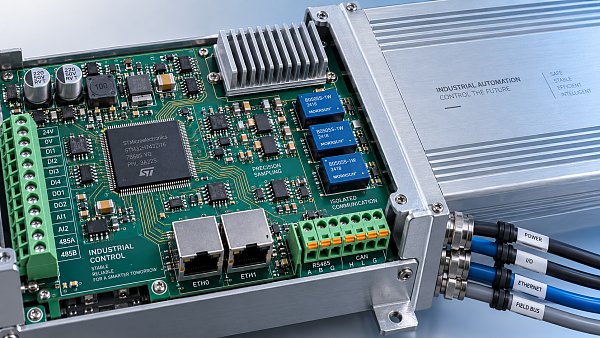
Interface selection needs the same system-level treatment. For RS-485, examine common-mode range, receiver fail-safe behavior, termination, biasing, and protection against the specified wiring faults. For CAN, confirm controller and transceiver compatibility, bit timing, and intended fault handling. Ethernet capability does not by itself establish real-time performance; the protocol stack, scheduling, synchronization, and network topology must support the required deadlines.
Galvanic isolation should follow the voltage environment and safety architecture, not a blanket preference for isolated components. Assess working voltage, transient exposure, insulation requirements, propagation delay, and common-mode transient immunity. The isolated power supply, PCB spacing, connectors, and barrier layout must support the same requirements as the isolator.
Check power devices against operating and fault conditions
Power-device selection starts with the actual voltage, current, switching frequency, load behavior, and cooling arrangement. Nominal bus voltage is insufficient: supply tolerance, regenerative energy, and switching overshoot determine the required voltage margin. Likewise, average load current does not describe startup, stall, short-circuit, or repetitive pulse stress.
For MOSFETs and IGBTs, calculate conduction and switching losses at realistic junction temperatures and gate-drive conditions. On-resistance specified at a lower temperature can understate hot operating losses. Switching-energy figures depend on the manufacturer’s test circuit, voltage, current, gate resistance, and temperature; comparisons require compatible conditions.
Silicon, silicon carbide, and gallium nitride should be compared at converter level. Wide-bandgap devices can enable faster switching or reduce particular losses, but their value depends on voltage class, operating frequency, magnetics, cooling, and electromagnetic compatibility. Faster edges can increase common-mode currents and place greater demands on layout and isolation. They are not an automatic upgrade for every actuator or supply.
The gate driver is part of the decision. Check undervoltage lockout, drive strength, dead-time control, fault detection, and shutdown behavior. For devices requiring rapid short-circuit protection, the combined detection and turn-off time must be compatible with the device’s specified withstand conditions. Review safe operating area against the intended waveform, including linear-mode operation where relevant; a headline current rating is not enough.
Qualify the assembled thermal and electrical design
An industrial temperature rating describes a specified component operating range, not a guarantee that the assembled controller will function throughout that range. Establish whether the rating refers to ambient, case, or junction temperature. Then evaluate enclosure temperature, nearby heat sources, airflow, mounting orientation, and power dissipation under the most demanding sustained workload.
Datasheet junction-to-ambient thermal resistance is useful only with attention to its test conditions. PCB copper, thermal vias, interface materials, and heatsinks can materially change thermal behavior. Use an application-relevant thermal model and confirm it through measurements. Include temperature-sensitive electrical parameters and examine transient heating during overloads rather than relying solely on steady-state estimates.
Electrical immunity is equally dependent on implementation. A protected input device cannot compensate for poor transient-current routing. A robust transceiver may still fail if external protection allows excessive residual voltage or if a disturbance shifts the local ground reference.
IEC 61131-2 provides equipment requirements and tests relevant to programmable controllers and associated peripherals within its scope. Applicable IEC 61000-4-series methods address disturbances such as electrostatic discharge, electrical fast transients, and surge. The appropriate test levels and performance criteria come from the relevant product standard and installation requirements—not from a component’s marketing description.
During evaluation, monitor more than permanent damage. Look for unintended output changes, corrupted measurements, communication interruption, processor resets, and recovery time. A controller that survives a disturbance but temporarily commands an unsafe output has not met its operational requirement.
Distinguish safety support from a safe system
Functional-safety features can simplify implementation, but no processor feature list establishes the safety integrity of a complete controller. IEC 61508 addresses functional safety of electrical, electronic, and programmable electronic safety-related systems. Machinery applications may instead follow an applicable sector framework, such as IEC 62061 or ISO 13849-1. Select the framework and required safety performance before comparing device claims.
Where a semiconductor supplier provides a safety manual, failure-rate information, or diagnostic guidance, examine the assumptions behind that material. Required external monitoring, diagnostic intervals, software responsibilities, and prohibited operating modes may materially affect the architecture. A lockstep core or memory error-correction feature is useful only within the fault model and coverage claimed for it.
Define what happens after each relevant failure. Outputs may need to de-energize, enter a controlled stop, or maintain a process-specific condition. An internal watchdog does not provide the same independence as a separate supervisor, particularly where shared clock, power, or silicon faults matter. Brownout, incomplete initialization, and loss of communication deserve explicit output-state definitions.
Cybersecurity requirements also affect component suitability. Secure boot, protected key storage, debug-access controls, and hardware cryptographic support can provide foundations, but secure operation also requires controlled provisioning, authenticated updates, recovery procedures, and maintainable software. Relevant IEC 62443 requirements should be mapped to the system or component’s actual role; hardware security features alone do not demonstrate compliance.
Check whether update operations can interfere with control deadlines and whether interrupted updates leave a recoverable device. The recovery mechanism must preserve authentication rather than becoming an alternative route for unauthorized firmware.
Account for integration effort and service-life constraints
The practical cost of semiconductor solutions extends beyond the bill of materials. Drivers, protocol stacks, development tools, licensing, diagnostic software, and validation effort can outweigh a modest unit-price advantage. Evaluate the maturity and availability of these resources, including the ability to reproduce builds after the original development team or tool environment has changed.
Review device errata before committing to the architecture. A limitation affecting a rarely used peripheral may be manageable; one affecting synchronized sampling, memory integrity, or a required communication mode can force a redesign. Supplier documentation quality and the clarity of workarounds are therefore selection inputs, not administrative details.
Long-term availability statements should be examined for scope and conditions. Identify product-change notification procedures, discontinuation terms, package dependencies, and the arrangements for authorized sourcing and traceability. A nominally equivalent replacement may require new firmware, PCB changes, thermal verification, EMC testing, or safety reassessment.
Where a second source is essential, qualify it against behavior as well as electrical ratings. Pin compatibility does not establish equivalent startup states, timing, fault response, or software compatibility. For complex processors, genuine drop-in alternatives may be limited; a planned migration path can be more credible than an untested substitute.
Make the final choice on evidence, not feature count
Advance candidates through application-specific gates: architectural fit, timing and measurement performance, thermal feasibility, disturbance behavior, safety and security support, and lifecycle acceptability. Reject devices that fail mandatory requirements before comparing integration effort or cost.
The decisive evaluation uses representative hardware and workloads. Preserve records of operating conditions, firmware versions, component revisions, observed failures, and corrective changes. Differences between an evaluation board and the intended production layout should remain visible in the qualification decision.
The preferred design is the one whose margins and limitations are understood: how much timing headroom remains, which conditions dominate measurement error, what triggers protective shutdown, how the controller recovers, and what a future component replacement would require. Those answers provide a firmer basis for selection than a longer feature list or a lower quoted price.
Recommended for You
 Digital SeaKongsberg Maritime Unveils Arctic Hunter Unmanned Surface VesselKongsberg Maritime's Arctic Hunter unmanned surface vessel is proposed for the Royal Navy's Type 92 programme. Explore its technology and procurement implications.By: Captain Kenji SatoNov 10, 2026
 Sorting RobotsHow Accurate Is AI in Food Quality Control? Metrics and Testing MethodsExplore AI in food quality control accuracy, from recall and false negatives to validation methods. Learn how to assess real-world inspection reliability.By: Marcus SterlingNov 10, 2026
 UHV TransformersGE Vernova Selected for 6 GW HVDC Link in IndiaGE Vernova will design a 6 GW HVDC link for PGCIL, connecting Rajasthan and South Kalamb to support India's clean energy transition. Discover the project.By: Dr. Elena VoltNov 09, 2026
 Grid ResilienceEurope's Grid Compliance Standards in 2026: Generator Connection RequirementsExplore new grid compliance standards 2026 Europe projects must address, from generator connection rules to testing and documentation. Prepare for approval.By: Dr. Elena VoltNov 09, 2026
 Technical FabricsNonwoven Bonding Cost Data: Comparing Thermal and Chemical ProcessesExplore nonwoven bonding cost data to compare thermal and chemical processes, assess usable yield, and choose the best-value option for your application.By: Chloe DuboisNov 08, 2026
 Fiber LasersIndustrial Lasers to 2035: Automotive Lightweighting and Precision Welding Drive DemandExplore the industrial laser market outlook to 2035 and discover how automotive lightweighting and precision welding could shape demand and procurement.By: Dr. Hideo TanakaNov 07, 2026
 Technical FabricsChoosing Geotextile Under Railway Ballast: Key Performance RequirementsChoosing geotextile under railway ballast? Explore essential filtration, drainage, strength and durability criteria to make a confident, project-specific selection.By: Chloe DuboisNov 07, 2026
 Digital SeaChoosing Rail Welding Equipment for Maintenance: Field Conditions and Weld TypesChoose rail welding equipment for maintenance with confidence. Compare welding methods, field constraints, inspection needs, and lifecycle costs.By: Captain Kenji SatoNov 06, 2026
 Digital SeaIndia Broadband Forum Urges Stronger Submarine Cable ResilienceIndia’s submarine cable resilience is in focus as the Broadband India Forum urges faster repairs, more vessels and stronger landing infrastructure.By: Captain Kenji SatoNov 06, 2026
 Digital SeaChoosing a Railway Network Switch Supplier: Reliability and Support CriteriaChoosing a railway network switch supplier? Compare reliability, standards evidence, cybersecurity, and lifecycle support to reduce project risk.By: Captain Kenji SatoNov 05, 2026
 Grid ResilienceUS Grid Equipment Import Ban Raises Cost and Implementation ConcernsThe US grid equipment import ban raises concerns over costs and delivery delays. Explore how unclear criteria could affect procurement and supply chains.By: Dr. Elena VoltNov 05, 2026
 Digital SeaRailway Coupler Price: How Type and Specifications Affect QuotesRailway coupler price depends on type, specifications, and order scope. Learn how to compare quotes, avoid hidden costs, and make a confident buying decision.By: Captain Kenji SatoNov 04, 2026
 Grid ResilienceGlobal Smart Grid Companies Raise $3 Billion in First Nine Months of 2026Global smart grid companies raised $3 billion in the first nine months of 2026. Explore the funding breakdown and potential implications for buyers and suppliers.By: Dr. Elena VoltNov 04, 2026
 Digital SeaChoosing Wholesale Pet Toys: How to Evaluate Suppliers and Minimum OrdersWholesale pet toys: learn how to assess suppliers, compare minimum orders and landed costs, and reduce inventory risk before you buy.By: Captain Kenji SatoNov 03, 2026
 Digital SeaSustainable Packaging Design: How to Choose Materials and Reduce WasteDiscover how sustainable packaging design helps reduce waste, protect products, and control costs with practical material choices and proven testing strategies.By: Captain Kenji SatoNov 02, 2026
 Technical FabricsUSMCA's First Joint Review Puts Textile Supply Chain Rules in FocusUSMCA's first joint review puts textile supply chain rules in focus. Explore potential impacts on origin compliance, sourcing and tariff treatment.By: Chloe DuboisNov 02, 2026
 Digital SeaManufacturing KPI Benchmarking: How to Compare Production PerformanceBenchmarking KPI manufacturing performance? Learn how to compare OEE, quality and downtime, identify meaningful gaps, and turn insights into practical improvements.By: Captain Kenji SatoNov 01, 2026
 Smart MetersCCI Approves Adani Energy Solutions' ₹305 Billion Acquisition of IntelliSmartCCI approves Adani Energy Solutions' ₹305 billion acquisition of IntelliSmart. Discover what the deal could mean for India's smart meter market.By: Dr. Elena VoltNov 01, 2026
 Digital SeaChoosing a Coin Laundry Machinery OEM: What Buyers Should EvaluateChoosing a coin laundry machinery OEM? Compare machine specifications, payment integration, lifecycle costs, and support to make a confident buying decision.By: Captain Kenji SatoOct 31, 2026
 Grid ResilienceUS Energy Department Announces $237 Million Grid SCALED Funding ProgramExplore the DOE's $237 million Grid SCALED funding program and its goals to strengthen grid equipment supply chains, lower electricity costs, and improve resilience.By: Dr. Elena VoltOct 31, 2026
 UHV TransformersA Decade of UHV Power in Shandong: Province Leads in Station NumbersShandong UHV power leads China in station numbers. Explore a decade of grid development and its implications for electricity supply and business planning.By: Dr. Elena VoltOct 30, 2026
 Digital SeaChoosing a Composite Train Body Panel Manufacturer: Fire Safety and Quality ChecksChoosing a composite train body panels manufacturer? Learn how to verify fire test evidence, audit production quality, and avoid costly approval gaps before you buy.By: Captain Kenji SatoOct 29, 2026
 Subsea ROV/AUVOcean Infinity Deploys Six AUVs Together Beyond 5,000 MetresOcean Infinity reportedly deployed six HUGIN AUVs beyond 5,200 metres. Explore what concurrent deepwater missions could mean for seabed surveys and procurement.By: Captain Kenji SatoOct 29, 2026
 Grid ResilienceRenewable Energy Grid Balancing: How Storage and Demand Response Work TogetherExplore renewable energy grid balancing with storage and demand response. Learn how coordinated controls manage shortfalls, absorb surplus power, and improve grid reliability.By: Dr. Elena VoltOct 28, 2026
 Subsea ROV/AUVSeaber Introduces 13 kg RAVEN AUV to Target Mine Countermeasure CostsSeaber’s 13 kg RAVEN AUV targets lower mine countermeasure costs with two mission configurations. Explore its potential value for naval operations and procurement.By: Captain Kenji SatoOct 28, 2026
 Digital SeaBallast Water Management Rules: IMO vs. USCG Compliance RequirementsBallast water management rules explained: compare IMO and USCG approvals, operating limits, and records. Get practical checks to reduce compliance risks and costly port delays.By: Captain Kenji SatoOct 27, 2026
 Subsea ROV/AUVEni Signs Main Cronos Contracts, Moving Gas Project into ExecutionEni’s Cronos gas project enters execution as major contracts are signed. Explore the Cyprus development, Egypt processing plans and key milestones toward first gas in 2028.By: Captain Kenji SatoOct 27, 2026
 Digital SeaBenefits of Refurbished Semiconductor Equipment: When Do Savings Justify the Risk?Explore the benefits of refurbished semiconductor equipment. Learn how to weigh savings against process risks, qualification costs, and support gaps before investing.By: Captain Kenji SatoOct 26, 2026
 Digital SeaSemiconductor Equipment Overhaul: Diagnosing Persistent Process DriftSemiconductor equipment overhaul leaving process drift unresolved? Discover how to pinpoint vacuum, sensor, thermal, and conditioning issues to restore stability and reduce repeat service calls.By: Captain Kenji SatoOct 26, 2026
 Digital SeaSemiconductor Equipment Refurbishment Process: Cleaning to QualificationExplore the semiconductor equipment refurbishment process, from precision cleaning to qualification. Learn how measurable testing helps verify production readiness and reduce risk.By: Captain Kenji SatoOct 26, 2026
 Digital SeaBidding for Offshore Decommissioning Projects: Scope and Liability ChecksBidding for offshore decommissioning projects? Discover key scope, liability, and insurance checks to avoid hidden costs, protect margins, and bid with confidence.By: Captain Kenji SatoOct 26, 2026