BDI: 1,842 ▼ 1.2%
COTTON NO.2: 84.12 ▲ 0.4%
LME COPPER: 8,432.50 ▲ 2.1%
FOOD SAFETY INDEX: 94.2 ARCHIVE_SECURED
OPTICAL INDEX: 11,204.09 STABLE
BDI: 1,842 ▼ 1.2%

SECTOR INDEX
V.24.08 ARCHIVE
Hot Articles
- When Is a Straddle Monorail System a Good Fit for Urban Transit Corridors?Is a straddle monorail system right for your urban corridor? Explore capacity, space, station access, safety, and lifecycle costs to make a confident transit investment.
- EU Textile Waste Reporting: Who Must Report and What Data Is Required?EU textile waste reporting explained: discover who must report, what data is required, and how to verify EPR, waste records, and shipment compliance across EU markets.
- Yarn Strength Benchmarks for Weaving: Setting Warp and Weft RequirementsSet yarn strength benchmarks for weaving with practical warp and weft criteria. Learn how tenacity, variability, and loom loads inform specifications that help reduce breaks and improve reliability.
Which Operating Conditions Can Change Marine Winch Selection?


Marine winch selection changes when operating conditions alter the load, the required control, or the equipment’s ability to keep working. Sea state, vessel motion, duty cycle, saltwater exposure, temperature, available power, and deck geometry can all make two winches with the same rated pull behave very differently in service.
The practical answer to “Which industrial application conditions can change product selection?” is to identify what the equipment must do during its most demanding operating phase. For a marine winch, that might mean recovering a load through waves, holding a mooring line, paying out under tension, or repeatedly handling equipment throughout a shift. Each task places different demands on the drive, brake, drum, controls, and supporting structure.
Start with the load profile, including where it acts on the drum
A rated pulling capacity is useful only when its measurement conditions are clear. Winch line pull depends on available drum torque and the effective drum radius. As rope builds up in successive layers, the radius increases; for the same torque, available line pull decreases. Line speed also changes with drum radius when rotational speed remains constant.
This matters when a winch must retrieve a substantial load with a nearly full drum. A first-layer rating does not establish that the winch can deliver the same pull on the outer layers. Compare the required pull and speed at the layers actually used, alongside rope capacity and the space needed for orderly spooling.
The load itself also needs definition. A suspended object’s weight does not describe every force encountered during recovery. Acceleration, water resistance, vessel motion, and snagging can change line tension. Submerged equipment may benefit from buoyancy, yet still create significant resistance as it moves through water.
Separate normal working tension, expected transient loads, and abnormal events. Increasing motor size alone does not address every load case: the rope, gearbox, brake, drum, foundation, and control response must suit the intended service together.
Sea state changes both capacity and control requirements
Vessel heave, roll, and pitch change the relative position between the winch and its load. A line can become slack and then tighten abruptly, producing a transient force that a steady pull calculation does not capture. Offshore lifting, towing, and subsea deployment therefore need an assessment of vessel movement and load behavior.
The relevant question is how much motion the operation can tolerate. If equipment must remain at a controlled depth or approach a landing point gently, a conventional winch with adequate pull may still provide insufficient motion control. Heave compensation may be appropriate when relative movement would otherwise disrupt the task or overload the line.
Active heave compensation uses powered control to adjust line movement in response to measured motion. Its usefulness depends on available speed, acceleration, power, sensors, and control tuning. Selecting the feature by name is insufficient; the system must operate within a defined motion and load envelope.
Constant-tension control serves a different purpose. It adjusts line movement to maintain tension within a specified range. It can help with certain towing or handling operations, but it does not automatically keep a suspended load at a fixed position. The required behavior should determine the control function.
Define an operating limit as part of selection. A winch may suit sheltered-water work while requiring restricted operation in exposed conditions. Those limits should reflect the combined capability of the vessel, winch, rope system, and handling arrangement.
Holding, lowering, and controlled payout require different brake behavior
Pulling capacity, brake holding capacity, and controlled payout capability are separate specifications. A winch that can haul a load may need a different arrangement to hold it securely or lower it smoothly. Holding capacity must also be considered at the relevant rope layer because drum radius changes the torque applied by line tension.
A parking or holding brake is not automatically suitable for repeated dynamic braking. During lowering or payout, energy must be absorbed or returned through an appropriate system. Depending on the design, this may involve hydraulic control, an electric drive, braking resistors, or a brake rated for the required dynamic service.
Failure behavior deserves the same attention as normal operation. Loss of electrical power, hydraulic pressure, or a control signal should lead to a defined response. A suspended load may require secure holding, while a towing or mooring application may require a carefully engineered release or rendering function under specified conditions.
Rendering means allowing line to pay out when tension reaches a defined level. Whether that function belongs in the winch depends on the application and system design. It should be specified deliberately, including how it interacts with overload protection and emergency controls.
Duty cycle can make thermal capacity the deciding factor
Occasional positioning and continuous recovery may require similar peak pull but very different equipment. Repeated starts, long hauling periods, frequent reversals, and prolonged operation at low speed can generate heat in motors, drives, hydraulic oil, gearboxes, and brakes.
A useful duty description includes how long the winch pulls, the tension and speed during that period, how often it stops, and whether it lowers under load. “Intermittent operation” is too vague if one supplier assumes long cooling periods and another assumes frequent cycles.
For hydraulic systems, consider oil flow, pressure, reservoir capacity, filtration, and cooling together. A power unit that reaches the required pressure briefly may be unable to support sustained operation without excessive oil temperature. For electric systems, examine the motor and drive’s thermal capability, including cooling during prolonged low-speed work.
Simultaneous pull and speed also matter. A specification may list maximum pull and maximum speed achieved under different conditions. Ask for the operating curve or duty data showing the combinations available throughout the working cycle.
Exposure determines what protection is actually needed
A sheltered winch and an exposed foredeck winch face different conditions. Salt spray, standing water, washdown, abrasive contamination, and prolonged dampness affect electrical enclosures, bearings, seals, coatings, connectors, and exposed brake components.
Enclosure protection addresses resistance to ingress under defined conditions. It does not establish corrosion resistance for the complete assembly. Marine suitability also depends on coating preparation, material compatibility, drainage, seal arrangements, and access for maintenance.
A deck winch exposed to spray should not be treated as suitable for immersion. If temporary immersion or underwater service is part of the operating requirement, the design must address that exposure explicitly, including pressure effects and water entry paths.
Temperature adds another constraint. Cold conditions can change lubricant viscosity, hydraulic response, seal behavior, and starting performance. High ambient temperature can reduce thermal margin, especially around machinery spaces or under enclosed covers. Specify storage, startup, and operating temperatures separately where they differ.
Where flammable atmospheres may occur, electrical equipment and potential ignition sources introduce additional selection requirements. The location’s hazardous-area designation needs to be established before the motor, controls, and associated equipment are chosen.
Available power can change the preferred drive
Hydraulic and electric marine winches can both suit demanding applications. The choice depends partly on the vessel’s existing infrastructure and the performance needed. A hydraulic winch requires suitable pressure and flow at the point of use, including during simultaneous operation of other consumers.
Long pipe runs, restrictions, and shared circuits can affect response and available performance. Hydraulic system selection should also account for leaks, fluid cleanliness, cooling, and maintenance access. The presence of a hydraulic power unit does not by itself establish compatibility.
Electric winches depend on supply voltage, frequency where relevant, generator capacity, and drive compatibility. Starting, acceleration, and braking can create demands that differ from steady running. Regenerative operation also needs an electrical system designed to accept or dissipate the returned energy.
Compare the complete installation. A compact winch can still require substantial space for a power unit, cooling equipment, drive cabinet, or braking components. Local support and available spare parts can influence whether the arrangement remains practical during service.
Deck geometry and rope handling can overturn an otherwise suitable choice
The rope’s approach to the drum affects spooling quality. Excessive fleet angle—the angle between the incoming line and its intended path onto the drum—can encourage uneven winding, flange contact, and accelerated wear. Drum position, fairlead position, and the distance between them need to be considered together.
Rope type also influences selection. Wire rope and synthetic rope differ in bending behavior, crushing resistance, elongation, and handling requirements. Drum geometry, surface condition, termination, and winding tension should suit the selected rope. Changing rope material after selecting the winch can require changes elsewhere in the system.
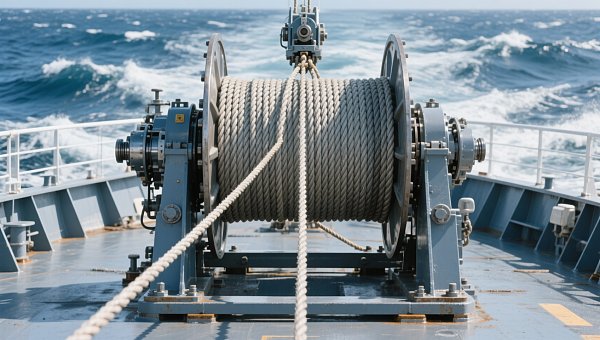
A deck arrangement drawing should show the winch, fairleads, rope path, operating position, and maintenance clearances. This makes it easier to identify interference, poor access, and line leads that cannot be corrected by changing the winch alone.
The foundation must carry the relevant forces and moments into the vessel structure. Space and equipment weight are only part of installation suitability. Accessibility also matters: a layout that prevents inspection of the brake or replacement of a seal can turn routine maintenance into a major interruption.
Application requirements decide which specifications deserve priority
The label “marine winch” covers equipment with substantially different duties. Establish whether the task involves mooring, towing, anchoring, lifting, or subsea handling before comparing models. Applicable vessel, flag, classification, and project requirements should then be translated into concrete design, documentation, inspection, and testing needs.
A general standards reference does not establish suitability for a particular duty. Useful documentation connects the proposed equipment to the intended application and its acceptance criteria. Where lifting people is involved, that intended use must be addressed explicitly; ordinary equipment-handling capability does not establish suitability for personnel lifting.
Build the enquiry around operating conditions
Before requesting quotations, prepare one operating description that every supplier can use. Include normal and transient line loads, required pull and speed at working drum layers, rope details, duty cycle, vessel motion, exposure, temperature, available power, and installation geometry.
Describe required behavior during holding, payout, overload, and loss of power. Include control locations, visibility, emergency functions, and interfaces with vessel systems. These details turn a capacity enquiry into a specification that can be compared meaningfully.
During technical review, ask each supplier to identify the conditions under which its proposed winch achieves the required performance. Evaluate any operating restrictions alongside the equipment specification. The most useful selection is one whose documented operating envelope matches the task, including the demanding phases that a headline pulling capacity leaves unexplained.
Recommended for You
 Digital SeaWhen Is a Straddle Monorail System a Good Fit for Urban Transit Corridors?Is a straddle monorail system right for your urban corridor? Explore capacity, space, station access, safety, and lifecycle costs to make a confident transit investment.By: Captain Kenji SatoOct 19, 2026
 Fabric LogicEU Textile Waste Reporting: Who Must Report and What Data Is Required?EU textile waste reporting explained: discover who must report, what data is required, and how to verify EPR, waste records, and shipment compliance across EU markets.By: Chloe DuboisOct 18, 2026
 Fabric LogicYarn Strength Benchmarks for Weaving: Setting Warp and Weft RequirementsSet yarn strength benchmarks for weaving with practical warp and weft criteria. Learn how tenacity, variability, and loom loads inform specifications that help reduce breaks and improve reliability.By: Chloe DuboisOct 17, 2026
 Fabric LogicEnergy-Saving Textile Machinery: How to Calculate Payback for Your MillEvaluate energy saving textile machinery with a practical payback formula, real-world cost factors, and a worked example. Discover how to verify savings and invest confidently in your mill.By: Chloe DuboisOct 16, 2026
 Digital SeaETSC Adoption in Europe: Policy Drivers, Costs, and Implementation BarriersExplore ETSC adoption Europe-wide: uncover policy drivers, installed costs, and implementation barriers to evaluate solar thermal investments and identify projects with stronger returns.By: Captain Kenji SatoOct 15, 2026
 Digital SeaChoosing Semiconductor Solutions for Industrial Controls: Key Design CriteriaChoose semiconductor solutions for industrial controls with confidence. Explore key criteria for timing, accuracy, power, safety, and lifecycle support to make smarter design decisions.By: Captain Kenji SatoOct 14, 2026
 Aseptic FillingWhen Should Compliance Checks Start for Aseptic Filling Procurement?How early should compliance checks start in procurement planning? Learn why aseptic filling reviews should begin before supplier shortlisting to reduce risks, rework, and costly delays.By: Marcus SterlingOct 13, 2026
 Smart MetersHow Do You Assess Market Demand Before Sourcing New Smart Meters?How do I assess market demand before sourcing a new industrial product? Discover how to validate smart meter demand, check technical fit, and reduce inventory risk before committing to bulk orders.By: Dr. Elena VoltOct 13, 2026
 GIS SwitchgearWhat Should You Compare Besides Price When Selecting GIS Switchgear?What should I compare besides price when selecting an industrial product? Explore GIS switchgear ratings, IEC compliance, maintenance and lifecycle costs to make a confident procurement decision.By: Dr. Elena VoltOct 13, 2026
 Optical SensorsHow Do You Choose Optical Sensors for Harsh Industrial Environments?How do I choose components for harsh industrial environments? Discover how to select optical sensors for dust, heat, vibration, and washdown—and prevent costly missed detections.By: Dr. Hideo TanakaOct 13, 2026
 Marine WinchesWhich Operating Conditions Can Change Marine Winch Selection?Which industrial application conditions can change product selection? Explore how loads, sea state, duty cycle and power shape marine winch selection to make a smarter investment.By: Captain Kenji SatoOct 13, 2026
 Digital SeaChoosing a Seismic Survey Equipment Distributor: Lead Times and Spare PartsChoosing a seismic survey equipment distributor? Learn how to verify lead times, secure critical spare parts, and compare support to reduce downtime and buy with confidence.By: Captain Kenji SatoOct 13, 2026
 Digital SeaHow to Use Industrial Benchmarking Data to Evaluate Supplier Risk and CapabilityIndustrial benchmarking data for supplier evaluation helps buyers assess capability, compliance, capacity, and delivery risk. Learn how to make smarter, evidence-based sourcing decisions.By: Captain Kenji SatoOct 12, 2026
 Fabric LogicFashion Supply Chain Cost Trends: What Is Driving Margins in 2026?Fashion supply chain cost trends for 2026: discover how materials, freight, labor, compliance, and inventory are reshaping margins—and the strategies leaders need to protect profitability.By: Chloe DuboisOct 11, 2026
 Lumen VisionHow Smart Street Lighting Cuts Energy Use Without Compromising Road SafetySmart street lighting reduces energy use while protecting road safety through adaptive controls, reliable monitoring, and risk-based lighting design. Learn the key strategies.By: Dr. Hideo TanakaOct 10, 2026
 Digital SeaDouble Platinum Spark Plugs: When Their Longer Service Life Justifies the CostDouble platinum spark plugs offer longer service life, stable gaps, and lower labor costs. Learn when their premium price is worth it for your vehicle.By: Captain Kenji SatoOct 08, 2026
 Sorting RobotsHow to Benchmark Linear Guide Load Ratings for High-Cycle Automation AxesLinear guide load rating benchmarks for high-cycle automation axes: compare loads, moments, stiffness, lubrication, and life calculations to select reliable guides.By: Marcus SterlingOct 07, 2026
 Digital SeaWhich Rail Data Transparency Metrics Improve Capacity Planning and Service Reliability?Rail data transparency metrics reveal usable capacity, dwell, recovery, and asset risks—helping rail leaders plan more reliable, resilient services.By: Captain Kenji SatoOct 06, 2026
 Digital SeaHow to Select a Marine Piston Air Compressor for High-Demand Shipboard ServiceMarine piston air compressor selection guide for high-demand shipboard service—compare capacity, redundancy, air quality, maintenance, and compliance requirements.By: Captain Kenji SatoOct 05, 2026
 Grid ResilienceIEC 61850 Monitoring Latency: How to Set Performance Limits for Protection SystemsIEC 61850 monitoring latency explained: learn how to set, test, and verify end-to-end performance limits that protect critical GOOSE and Sampled Values systems.By: Dr. Elena VoltOct 04, 2026
 Digital SeaHow to Select Bulldozers by Blade Type, Ground Conditions, and Earthmoving OutputBulldozers selection made practical: compare blade types, track setups, ground conditions, and cycle output to choose the right dozer for lower costs and reliable earthmoving.By: Captain Kenji SatoOct 03, 2026
 Dyeing MachinesHow Sustainable Dyeing Cuts Water Use and Chemical Risk in Textile ProductionSustainable dyeing cuts water use and chemical risk through smarter liquor control, efficient rinsing, safer inputs, and repeatable textile quality.By: Chloe DuboisOct 02, 2026
 Optical SensorsSingle-Mode Fiber Loss in Railway Networks: Causes, Budgets, and Test MethodsSingle mode railway fiber loss explained: identify causes, calculate realistic loss budgets, and apply OTDR and insertion-loss tests for reliable rail networks.By: Dr. Hideo TanakaOct 01, 2026
 Digital SeaIntegrated Transit Hub Planning: How to Balance Passenger Flow and Future CapacityIntegrated transit hub planning strategies for balancing passenger flow, resilient operations, phased delivery, and future capacity—explore practical insights for smarter hubs.By: Captain Kenji SatoSep 30, 2026
 Digital SeaWhat to Evaluate When Selecting a MaaS Ticketing Platform for Multimodal NetworksMaaS ticketing platform selection guide: evaluate interoperability, fare control, settlement, resilience, privacy, and scalability for multimodal networks.By: Captain Kenji SatoSep 29, 2026
 Digital SeaWhat Does Train Control Center Software Cost? Budgeting for Integration and SupportTrain control center software cost explained: compare integration, cybersecurity, commissioning, and long-term support to build a realistic rail operations budget.By: Captain Kenji SatoSep 28, 2026
 Digital SeaWhat to Evaluate in Thermite Rail Welding Equipment for Field Track RepairsThermite rail welding equipment: evaluate compatibility, preheating, alignment, safety, and supplier support for reliable field track repairs.By: Captain Kenji SatoSep 27, 2026
 Aseptic FillingISO 22000 Food Safety Certification: What Food Manufacturers Must PrepareISO 22000 food safety certification: discover the essential steps manufacturers need to build a robust FSMS, control hazards, and prepare confidently for audit success.By: Marcus SterlingSep 26, 2026
 UHV TransformersWhat Makes an Electrification Factory Ready for High-Voltage Equipment Production?Electrification factory readiness for high-voltage equipment: discover the essential standards, testing, traceability, safety, and workforce controls that drive reliable production.By: Dr. Elena VoltSep 25, 2026
 Digital SeaRail Signal Visibility: Sighting Distance, Contrast, and Verification RequirementsRail signal visibility: learn how sighting distance, contrast, weather, and verification controls help ensure safe, compliant signal recognition.By: Captain Kenji SatoSep 24, 2026
![]() GIS SwitchgearHow Do You Compare GIS Switchgear Suppliers When Certifications Differ?How do I compare industrial suppliers when certifications are not equivalent? Learn how to assess GIS switchgear test evidence, compliance scope, traceability, and project risk.By: Dr. Elena VoltSep 24, 2026