BDI: 1,842 ▼ 1.2%
COTTON NO.2: 84.12 ▲ 0.4%
LME COPPER: 8,432.50 ▲ 2.1%
FOOD SAFETY INDEX: 94.2 ARCHIVE_SECURED
OPTICAL INDEX: 11,204.09 STABLE
BDI: 1,842 ▼ 1.2%

SECTOR INDEX
V.24.08 ARCHIVE
Hot Articles
- How Does a Ballast Cleaner Screening System Separate Track Ballast?Discover how a ballast cleaner screening system separates reusable stone from fines, what affects performance, and how to assess the results.
- Pakistan to Seek World Bank and ADB Funding for Smart MetersPakistan seeks World Bank and ADB funding for smart meters on distribution transformers. Explore the plan to tackle power theft and improve grid efficiency.
- What Is Precision Medicine and How Does It Guide Treatment?Discover how precision medicine uses biomarkers and genetic insights to guide treatment, where it can help, and what to ask before testing.
How Smart Street Lighting Cuts Energy Use Without Compromising Road Safety


A street-lighting upgrade can look straightforward on a budget sheet: replace older luminaires with LEDs, add controls, and expect lower electricity use. The difficult part appears after installation, when a dimming schedule that saves energy also leaves a wet intersection harder to read, a pedestrian route feels unevenly lit, or maintenance teams cannot tell whether a reported outage is a failed driver, a communications issue, or a control setting.
Smart street lighting cuts energy use without compromising road safety when the system is designed around required visibility first and adaptive operation second. LEDs reduce baseline demand, while sensors, dimming profiles, and remote management reduce unnecessary operating hours and output. However, controls must respect the lighting levels, uniformity, glare limits, and reliability needed for each road environment. A safe project does not simply dim every light after a fixed hour; it matches light output to road function, activity, weather-related risk, and the performance limits of the installed equipment.
Start with the lighting task, not the control technology
Road safety depends on more than how bright a road appears from a distance. Drivers need enough visual information to identify lane markings, crossing points, road edges, obstacles, cyclists, and vulnerable pedestrians in time to respond. At junctions, roundabouts, transit stops, and crossings, the lighting task becomes more demanding because users are making decisions, changing direction, or entering conflict areas.
That is why the first project question should be: what must users be able to see here, and under what conditions? The answer will differ across a high-speed road, a neighborhood collector street, a service lane, a waterfront path, and an industrial access road. Applying one wattage, one pole spacing assumption, or one overnight dimming rule across all these areas can create avoidable safety gaps.
A practical assessment divides the network into operating zones. Each zone should be reviewed for:
- road classification, posted speed, lane arrangement, and intersection density;
- pedestrian and cycling activity, including likely movement outside peak periods;
- crossings, bus stops, school approaches, parking access points, and other conflict locations;
- existing pole positions, mounting height, arm geometry, and obstruction from trees or signs;
- surface reflectance and wet-weather visibility concerns;
- nearby properties, where spill light or glare may become an issue;
- maintenance access, electrical cabinet condition, and communications coverage.
This zoning process prevents a common mistake: treating reduced traffic volume as proof that reduced lighting is safe. Traffic counts matter, but a low-volume road can still have a crossing, sharp bend, freight entrance, or irregular pedestrian activity that warrants a more conservative operating profile.
Where the energy reduction actually comes from
The energy-saving potential of smart street lighting usually comes from several layers working together. The LED luminaire is only the first layer. It generally provides a more efficient light source and allows more precise optical distribution than legacy equipment, but substantial gains can be lost if every fitting is operated at maximum output throughout the night.
Adaptive control adds the second layer. A central management system or local controller can apply schedules, reduce output during low-demand periods, restore higher output before predictable activity peaks, and report operating status. Motion or traffic sensing can add another layer in locations where activity is intermittent, such as paths, parking areas, service roads, or low-use public spaces.
Not every location needs the same control method. A time-based schedule may be appropriate where usage patterns are stable and the road function is simple. Sensor-led response can be useful where activity is irregular, but only if the sensor field, response time, communication logic, and minimum background level have been properly tested. On a busy arterial road, frequent output changes may provide little practical benefit and may distract drivers if transitions are too abrupt.
The strongest energy strategy is often a layered one: select efficient luminaires, establish a safe base profile, then use remote scheduling and carefully selected sensing to avoid running at unnecessary output. It is less risky than relying on aggressive dimming to compensate for poor luminaire selection or an oversized design.
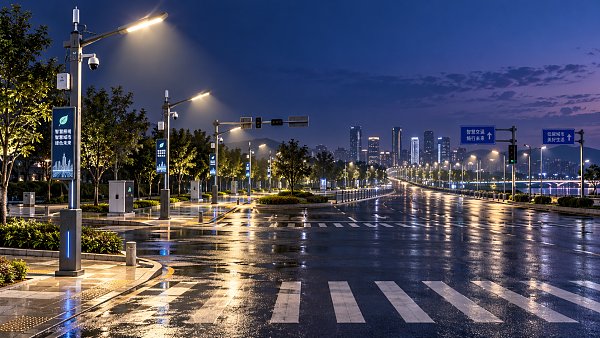
Use photometric design to protect visibility during dimming
Rated wattage alone does not tell a project manager whether a luminaire will provide safe road lighting. The optical distribution determines where the light lands. A lower-power luminaire with an appropriate roadway optic may deliver better useful illumination than a higher-power fitting that sends light beyond the carriageway or produces high glare.
Before approving equipment and dimming settings, require a lighting calculation for representative zones. The calculation should reflect actual mounting heights, pole spacing, setbacks, outreach arms, road width, lane configuration, and surface assumptions. It should evaluate the intended normal operating level and each proposed reduced-output state.
The review should focus on the metrics required by the applicable authority or project specification, rather than selecting a single number in isolation. Depending on the location and governing requirements, these may include maintained luminance or illuminance, overall and longitudinal uniformity, threshold increment or other glare indicators, surround ratio, and spill-light control. A design that satisfies average light output but performs poorly in uniformity can leave alternating bright and dark zones that make hazards harder to identify.
Do not confuse initial output with maintained performance
A new installation often looks brighter than it will after normal operation. Light output declines over time, optical surfaces accumulate dirt, and electrical components can drift or fail. Good design considers maintenance factors, expected cleaning intervals, ambient conditions, and component replacement strategy. It should also account for the fact that a dimming profile reduces output intentionally. A zone designed with minimal margin at full output may no longer meet its required performance when dimmed.
This is especially important for retrofit projects. Existing pole spacing may have been set for a different lamp type and a different optical system. Simply installing LED replacements with lower nominal power can create dark intervals between poles or insufficient vertical illumination at crossings. Field verification after installation is therefore part of acceptance, not a discretionary extra.
Set adaptive profiles around risk windows
Fixed overnight dimming is attractive because it is easy to configure and forecast. Yet safety risk does not always follow a neat midnight-to-dawn curve. Shift changes, late transit arrivals, seasonal events, deliveries, weather, and local nightlife can create activity outside the expected pattern.
A more durable approach is to define operating profiles for each zone and identify the conditions that justify changing them. For example, a local road may operate at a moderate reduced level late at night, while a crossing on that road remains at a higher setting. A shared path may retain a visible background level and increase output as users approach. An intersection group may be held at its normal level during rain, maintenance work, or a planned event if the control system and operational procedures support that response.
Transitions matter. Abrupt changes can be uncomfortable and may make users question whether the system is malfunctioning. Fade times should be selected so that drivers, cyclists, and pedestrians have usable visibility throughout the transition. Sensors should trigger before a person enters the darker area, not after they are already within it. In linked systems, neighboring luminaires may need to brighten together to create a continuous approach path rather than a moving island of light.
Design for faults, not just normal operation
Remote monitoring is one of the most useful parts of a smart lighting deployment, but only when alarms lead to clear maintenance action. A dashboard that reports large volumes of low-priority communication events can obscure a genuine outage in a critical area. Project requirements should distinguish between luminaire failure, feeder problems, control-node communication loss, abnormal energy consumption, cabinet faults, and sensor errors.
Each failure type needs a defined response. A communications fault does not necessarily mean the luminaire is dark; it may continue operating under a local fallback schedule. Conversely, a controller that is online does not prove that light output meets the intended setting. The system architecture should specify what happens when network connectivity, GPS timing, sensor input, or central software is unavailable.
For safety-sensitive zones, establish a fail-safe operating state before commissioning. In many cases, the safe default is a pre-agreed local lighting level rather than complete shutdown or an excessively low dimmed state. The appropriate choice depends on the local design, electrical architecture, and governing requirements, but it must be documented and tested rather than assumed.
Commissioning should test the exceptions
Daytime configuration checks are not enough. Night inspections should verify actual light distribution, dimming transitions, sensor activation, glare, dark spots, and the relationship between adjacent luminaires. Test conditions should include the scheduled profile, a manual override, loss of communications where practical, and recovery after power interruption.
Maintenance teams also need usable asset records: pole identifier, luminaire model, driver type, controller type, firmware or configuration version where relevant, electrical circuit, optical distribution, and installed aiming position. Without disciplined records, a replacement fitting or controller can introduce a different dimming response into a carefully tuned area.
Manage the project in stages instead of making network-wide assumptions
When a municipality or asset owner has a large inventory, a pilot can reveal implementation issues that desktop design cannot. The purpose is not to claim a universal outcome from a small area. It is to validate assumptions before they are multiplied across the network: installation tolerances, communications coverage, field configuration workflow, sensor behavior, resident concerns, and maintenance response.
Choose pilot areas that represent the difficult conditions likely to affect the broader program. A simple straight road with unobstructed poles may not reveal problems that appear on tree-lined streets, mixed-use corridors, wet pavements, or locations with frequent pedestrian crossings. During the pilot, document the final settings, changes made after night inspections, faults encountered, and the reasons for any exceptions.
After rollout, performance review should compare actual operating hours, dimming states, fault patterns, and maintenance workload against the approved design assumptions. Energy data is valuable, but it should not be reviewed in isolation. A sudden reduction in consumption may indicate successful dimming, a configuration error, or a group of non-operating lights. Operational data and night-time inspection findings need to be interpreted together.
Questions that often affect the final design
Can all streetlights be dimmed to the same percentage?
No. A single percentage ignores differences in road function, pole geometry, pedestrian activity, and required lighting performance. Grouping similar locations can simplify management, but critical areas such as crossings and intersections often need separate settings.
Are motion sensors appropriate on public roads?
They can be appropriate in selected low-use environments, particularly where activity is intermittent. Their suitability depends on detection reliability, approach distance, local minimum lighting levels, and whether changing light output could distract road users. They should not be treated as an automatic substitute for a compliant base lighting design.
What should be checked before reducing output further?
Review current field performance at night, confirm that maintained lighting requirements remain satisfied, inspect complaint and incident patterns where those records are available, and verify that the proposed profile will not affect crossings, transit activity, maintenance work, or seasonal operating conditions.
The central discipline is simple: use controls to remove wasted light, not to remove the visibility people depend on. When lighting classes, optics, maintenance factors, control logic, fallback behavior, and field verification are handled as one engineering decision, smart street lighting becomes a practical way to reduce energy demand while preserving a safer and more predictable night-time road environment.
Recommended for You
 Digital SeaHow Does a Ballast Cleaner Screening System Separate Track Ballast?Discover how a ballast cleaner screening system separates reusable stone from fines, what affects performance, and how to assess the results.By: Captain Kenji SatoNov 14, 2026
 Smart MetersPakistan to Seek World Bank and ADB Funding for Smart MetersPakistan seeks World Bank and ADB funding for smart meters on distribution transformers. Explore the plan to tackle power theft and improve grid efficiency.By: Dr. Elena VoltNov 13, 2026
 Digital SeaWhat Is Precision Medicine and How Does It Guide Treatment?Discover how precision medicine uses biomarkers and genetic insights to guide treatment, where it can help, and what to ask before testing.By: Captain Kenji SatoNov 13, 2026
 Grid Resilience2026 CSEE Annual Meeting Opens with Focus on AI and Power SystemsThe 2026 CSEE Annual Meeting explores AI, low-carbon power systems and ultra-high-voltage transmission. Discover why these discussions matter.By: Dr. Elena VoltNov 12, 2026
 Digital SeaShip Radar Detection Range: How Far Can It See and What Limits It?Ship radar detection range depends on more than the display scale. Discover how antenna height, weather, target size, and settings affect what radar can see.By: Captain Kenji SatoNov 12, 2026
 UHV TransformersGE Vernova to Invest $34.5 Million in Louisiana Transformer Plant ExpansionGE Vernova plans a $34.5 million transformer plant expansion in Louisiana. Explore its potential impact on North American supply and procurement.By: Dr. Elena VoltNov 11, 2026
 Digital SeaMetro Station Noise Criteria: Limits and Measurement MethodsExplore metro station noise criteria, applicable limits and measurement methods. Learn how to select metrics and assess compliance with confidence.By: Captain Kenji SatoNov 11, 2026
 Digital SeaKongsberg Maritime Unveils Arctic Hunter Unmanned Surface VesselKongsberg Maritime's Arctic Hunter unmanned surface vessel is proposed for the Royal Navy's Type 92 programme. Explore its technology and procurement implications.By: Captain Kenji SatoNov 10, 2026
 Sorting RobotsHow Accurate Is AI in Food Quality Control? Metrics and Testing MethodsExplore AI in food quality control accuracy, from recall and false negatives to validation methods. Learn how to assess real-world inspection reliability.By: Marcus SterlingNov 10, 2026
 UHV TransformersGE Vernova Selected for 6 GW HVDC Link in IndiaGE Vernova will design a 6 GW HVDC link for PGCIL, connecting Rajasthan and South Kalamb to support India's clean energy transition. Discover the project.By: Dr. Elena VoltNov 09, 2026
 Grid ResilienceEurope's Grid Compliance Standards in 2026: Generator Connection RequirementsExplore new grid compliance standards 2026 Europe projects must address, from generator connection rules to testing and documentation. Prepare for approval.By: Dr. Elena VoltNov 09, 2026
 Technical FabricsNonwoven Bonding Cost Data: Comparing Thermal and Chemical ProcessesExplore nonwoven bonding cost data to compare thermal and chemical processes, assess usable yield, and choose the best-value option for your application.By: Chloe DuboisNov 08, 2026
 Fiber LasersIndustrial Lasers to 2035: Automotive Lightweighting and Precision Welding Drive DemandExplore the industrial laser market outlook to 2035 and discover how automotive lightweighting and precision welding could shape demand and procurement.By: Dr. Hideo TanakaNov 07, 2026
 Technical FabricsChoosing Geotextile Under Railway Ballast: Key Performance RequirementsChoosing geotextile under railway ballast? Explore essential filtration, drainage, strength and durability criteria to make a confident, project-specific selection.By: Chloe DuboisNov 07, 2026
 Digital SeaChoosing Rail Welding Equipment for Maintenance: Field Conditions and Weld TypesChoose rail welding equipment for maintenance with confidence. Compare welding methods, field constraints, inspection needs, and lifecycle costs.By: Captain Kenji SatoNov 06, 2026
 Digital SeaIndia Broadband Forum Urges Stronger Submarine Cable ResilienceIndia’s submarine cable resilience is in focus as the Broadband India Forum urges faster repairs, more vessels and stronger landing infrastructure.By: Captain Kenji SatoNov 06, 2026
 Digital SeaChoosing a Railway Network Switch Supplier: Reliability and Support CriteriaChoosing a railway network switch supplier? Compare reliability, standards evidence, cybersecurity, and lifecycle support to reduce project risk.By: Captain Kenji SatoNov 05, 2026
 Grid ResilienceUS Grid Equipment Import Ban Raises Cost and Implementation ConcernsThe US grid equipment import ban raises concerns over costs and delivery delays. Explore how unclear criteria could affect procurement and supply chains.By: Dr. Elena VoltNov 05, 2026
 Digital SeaRailway Coupler Price: How Type and Specifications Affect QuotesRailway coupler price depends on type, specifications, and order scope. Learn how to compare quotes, avoid hidden costs, and make a confident buying decision.By: Captain Kenji SatoNov 04, 2026
 Grid ResilienceGlobal Smart Grid Companies Raise $3 Billion in First Nine Months of 2026Global smart grid companies raised $3 billion in the first nine months of 2026. Explore the funding breakdown and potential implications for buyers and suppliers.By: Dr. Elena VoltNov 04, 2026
 Digital SeaChoosing Wholesale Pet Toys: How to Evaluate Suppliers and Minimum OrdersWholesale pet toys: learn how to assess suppliers, compare minimum orders and landed costs, and reduce inventory risk before you buy.By: Captain Kenji SatoNov 03, 2026
 Digital SeaSustainable Packaging Design: How to Choose Materials and Reduce WasteDiscover how sustainable packaging design helps reduce waste, protect products, and control costs with practical material choices and proven testing strategies.By: Captain Kenji SatoNov 02, 2026
 Technical FabricsUSMCA's First Joint Review Puts Textile Supply Chain Rules in FocusUSMCA's first joint review puts textile supply chain rules in focus. Explore potential impacts on origin compliance, sourcing and tariff treatment.By: Chloe DuboisNov 02, 2026
 Digital SeaManufacturing KPI Benchmarking: How to Compare Production PerformanceBenchmarking KPI manufacturing performance? Learn how to compare OEE, quality and downtime, identify meaningful gaps, and turn insights into practical improvements.By: Captain Kenji SatoNov 01, 2026
 Smart MetersCCI Approves Adani Energy Solutions' ₹305 Billion Acquisition of IntelliSmartCCI approves Adani Energy Solutions' ₹305 billion acquisition of IntelliSmart. Discover what the deal could mean for India's smart meter market.By: Dr. Elena VoltNov 01, 2026
 Digital SeaChoosing a Coin Laundry Machinery OEM: What Buyers Should EvaluateChoosing a coin laundry machinery OEM? Compare machine specifications, payment integration, lifecycle costs, and support to make a confident buying decision.By: Captain Kenji SatoOct 31, 2026
 Grid ResilienceUS Energy Department Announces $237 Million Grid SCALED Funding ProgramExplore the DOE's $237 million Grid SCALED funding program and its goals to strengthen grid equipment supply chains, lower electricity costs, and improve resilience.By: Dr. Elena VoltOct 31, 2026
 UHV TransformersA Decade of UHV Power in Shandong: Province Leads in Station NumbersShandong UHV power leads China in station numbers. Explore a decade of grid development and its implications for electricity supply and business planning.By: Dr. Elena VoltOct 30, 2026
 Digital SeaChoosing a Composite Train Body Panel Manufacturer: Fire Safety and Quality ChecksChoosing a composite train body panels manufacturer? Learn how to verify fire test evidence, audit production quality, and avoid costly approval gaps before you buy.By: Captain Kenji SatoOct 29, 2026
 Subsea ROV/AUVOcean Infinity Deploys Six AUVs Together Beyond 5,000 MetresOcean Infinity reportedly deployed six HUGIN AUVs beyond 5,200 metres. Explore what concurrent deepwater missions could mean for seabed surveys and procurement.By: Captain Kenji SatoOct 29, 2026
 Grid ResilienceRenewable Energy Grid Balancing: How Storage and Demand Response Work TogetherExplore renewable energy grid balancing with storage and demand response. Learn how coordinated controls manage shortfalls, absorb surplus power, and improve grid reliability.By: Dr. Elena VoltOct 28, 2026