BDI: 1,842 ▼ 1.2%
COTTON NO.2: 84.12 ▲ 0.4%
LME COPPER: 8,432.50 ▲ 2.1%
FOOD SAFETY INDEX: 94.2 ARCHIVE_SECURED
OPTICAL INDEX: 11,204.09 STABLE
BDI: 1,842 ▼ 1.2%

SECTOR INDEX
V.24.08 ARCHIVE
Hot Articles
- How Does a Ballast Cleaner Screening System Separate Track Ballast?Discover how a ballast cleaner screening system separates reusable stone from fines, what affects performance, and how to assess the results.
- Pakistan to Seek World Bank and ADB Funding for Smart MetersPakistan seeks World Bank and ADB funding for smart meters on distribution transformers. Explore the plan to tackle power theft and improve grid efficiency.
- What Is Precision Medicine and How Does It Guide Treatment?Discover how precision medicine uses biomarkers and genetic insights to guide treatment, where it can help, and what to ask before testing.
How Sustainable Dyeing Cuts Water Use and Chemical Risk in Textile Production


Water and chemical risk fall when dyeing is designed as a controlled material-and-liquor system rather than treated as a sequence of isolated wet processes. The practical objective is to put the required color into a defined substrate with the smallest feasible liquor volume, the least hazardous chemistry, and minimal correction work. That requires choices made before a dye machine is loaded: fiber composition, shade depth, dye class, preparation quality, batch size, water characteristics, and the route for treating or reusing spent liquor all affect the result.
A sustainable dyeing program therefore starts with process fit. A low-liquor machine does not automatically deliver low water use if the fabric needs repeated washing-off or if poor shade control causes re-dyeing. Likewise, replacing a restricted auxiliary with a nominally safer alternative does little when the substitute increases salt demand, leaves more color in the effluent, or destabilizes the dye bath. The strongest reductions come from preventing unnecessary inputs and rework at the same time.
Start with the dye-fiber relationship
Different fibers require different fixation mechanisms, and those mechanisms determine where water and chemical burdens arise. Cotton and other cellulosic fibers are often dyed with reactive dyes, which form a chemical bond with the fiber under alkaline conditions. The challenge is that some dye also reacts with water instead of the fiber. That hydrolyzed portion cannot provide durable color and must be removed during washing-off. Deep shades, uneven preparation, or poorly controlled alkalinity can increase the unfixed fraction and turn washing into the dominant water-consuming stage.
Polyester commonly uses disperse dyes at elevated temperature. This route generally avoids the large salt loads associated with many cotton reactive processes, but it introduces other control points: dispersion stability, heating profile, reduction clearing where required, and the removal of oligomers or surface deposits. Blended polyester-cotton fabric is more complex because a process designed for one component can compromise the other. A nominally water-saving one-bath route deserves validation against shade build-up, staining, fastness, and wastewater composition rather than being accepted on cycle count alone.
Protein fibers, polyamide, acrylic, regenerated cellulose, and coated textiles each bring distinct constraints. Acid dyes, basic dyes, sulfur dyes, vat dyes, pigments, and digital inks cannot be compared only by their color appearance or their stated concentration. Their fixation efficiency, auxiliaries, rinse demand, and downstream fastness requirements determine the true process load.
Water reduction is primarily a liquor-management problem
The liquor ratio describes the amount of dye liquor relative to textile mass. Lowering it reduces the volume that must be heated, pumped, treated, and discharged. Yet liquor ratio is not a universal efficiency score. A machine operating with a small bath can still consume excessive water through multiple overflow rinses, long cleaning cycles between shades, or failed first-pass dyeing. Water accounting needs to include preparation, dyeing, afterwashing, machine cleaning, laboratory trials, and any corrective processing.
Modern low-liquor dye machines reduce bath volume through their hydraulic design, fabric transport method, and circulation control. They work best when loading is within the machine's intended range and the fabric can move without creasing, rope marks, or tension damage. Very light constructions, highly elastic knitwear, delicate piles, and fabrics with unstable surface treatments may require a different transport arrangement from dense woven goods. A lower liquor ratio that creates fabric faults simply shifts water use into reprocessing and quality loss.
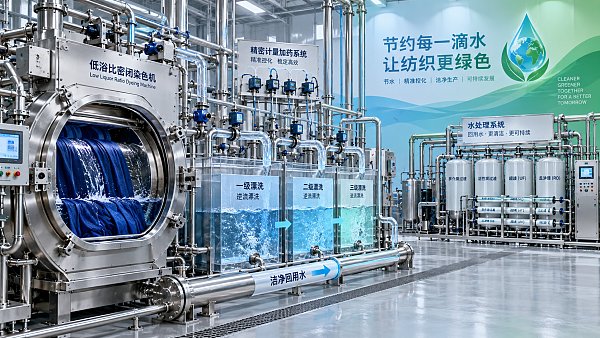
Rinsing deserves the same level of engineering as the dye bath. Counter-current rinsing uses cleaner water later in the sequence, when the fabric is already cleaner, while earlier stages use water that has previously served a later rinse. This arrangement can reduce fresh-water demand without accepting residual alkali, salt, surfactant, or loose dye on the fabric. Its effectiveness depends on conductivity, pH, color, and temperature being tracked at each stage. Reuse becomes unreliable when these indicators are ignored and a contaminated rinse stream is returned to a stage with tighter quality requirements.
Batch sequencing also matters. Running pale shades after deep shades without adequate cleaning risks contamination; excessive cleaning, however, wastes water and chemicals. A rational sequence groups compatible hues, dye classes, and substrate types while retaining defined cleaning verification for high-risk transitions. Optical white, pastel shades, and high-brightness colors are especially sensitive to carryover. The right response is not a single fixed cleaning time but a release criterion based on machine condition and the next product's tolerance.
Preparation quality determines how much correction work follows
Scouring, bleaching, desizing, and neutralization establish absorbency and chemical consistency before coloration. Residual size, oils, waxes, peroxide, metal ions, or uneven wetting can cause patchy dye uptake. The visible defect may appear in the dye house, while the cause lies upstream in fabric preparation or water supply. Adding more dye or leveling agent can conceal the underlying problem in one batch and amplify it in the next.
For cellulosic fabric, residual peroxide after bleaching can alter reactive dye behavior. Inadequate neutralization can distort pH during fixation, while excessive chemical neutralization raises salt and organic load. For polyester, incomplete removal of spin finishes or heat-set contaminants can reduce dye levelness and create deposits in circulation paths. A preparation release standard based on absorbency, pH, residual chemistry, and fabric uniformity makes dye recipes more repeatable and reduces the temptation to compensate at the machine.
Water quality is another frequent source of variation. Hardness minerals may interfere with dispersants, soaps, sequestrants, and selected dye systems. Iron or copper contamination can shift shade, degrade certain auxiliaries, or promote oxidation effects. Recycled water can be valuable for washing, cooling, or selected process stages, but its conductivity, alkalinity, hardness, color, and residual organics must match the intended use. “Recycled” is not a sufficient quality category; fitness depends on the specific bath and the tolerance of the product being dyed.
Chemical risk is controlled through function, dosage, and release pathway
Replacing hazardous inputs requires more than reviewing a supplier declaration. Each chemical in a recipe has a function: wetting, dispersing, sequestering, buffering, leveling, fixing, soaping, defoaming, or cleaning. The relevant question is whether that function can be achieved at the required quality level with a chemistry that creates less worker exposure, lower persistence, reduced toxicity concerns, or easier wastewater treatment.
Problems arise when substitution is evaluated only at purchase stage. An alternative surfactant may meet a restricted-substance requirement yet foam excessively in high-speed circulation. A different sequestering agent may alter dye uptake in hard water. A lower-hazard reducing agent may require revised temperature control or washing conditions. Process trials need to examine shade, levelness, rub and wash fastness, bath stability, machine cleanliness, effluent behavior, and operator handling conditions together.
Automation improves chemical control when it prevents dosing drift rather than merely replacing manual valves. Metered addition, recipe locking, bath temperature records, pH measurement, conductivity monitoring, and alarms for abnormal circulation create a usable record of why a batch behaved as it did. This is particularly valuable when identical recipes produce different shades across machines or shifts. The record can distinguish a material variation from a dosing error, a sensor failure, or a change in incoming water.
Choose lower-impact routes without separating quality from efficiency
Exhaust dyeing remains appropriate for many fabric types and batch sizes, especially where flexibility across color and construction is needed. Its environmental performance improves when liquor ratio, dye fixation, rinse architecture, and recovery options are managed as one system. Continuous dyeing can reduce water use for stable, high-volume runs because padding applies a controlled amount of liquor to the fabric. It also demands stable fabric preparation, precise pick-up control, reliable drying and fixation, and disciplined color management. A short run with frequent color changes may generate disproportionate cleaning and start-up loss on a continuous line.
Foam, spray, and digital application methods reduce the amount of water carried with colorant by applying chemistry more selectively. Their suitability depends on fabric surface, required penetration, color depth, pattern definition, and finishing route. A surface-oriented application may look satisfactory on the face side yet fail when cross-section penetration or abrasion performance matters. Pigment systems can avoid some conventional washing steps, but hand feel, binder durability, fabric stiffness, curing energy, and formaldehyde-related chemistry choices require close review.
Dope dyeing, where colorant is introduced before synthetic fiber formation, can avoid later aqueous dyeing for suitable synthetic products. It is less responsive to rapid shade changes and small custom lots, so it does not replace piece dyeing across every product mix. The correct comparison includes inventory complexity, color approval lead time, recycled content variability, and the limited ability to correct color after extrusion.
Measure the points where apparent savings disappear
A reliable assessment separates water withdrawal from water discharge, and it distinguishes fresh water from internally reused water. It also records water per kilogram of saleable textile rather than per batch alone. A batch rejected for shade variation consumes resources but may vanish from a simple machine-water report. The same principle applies to chemical use: track active chemistry per successful output, then investigate large deviations by fiber lot, color family, machine, and process route.
Color matching must be integrated into this measurement. Laboratory recipes developed at a different liquor ratio, water quality, or heating rate may not transfer directly to bulk production. Small differences in substrate moisture, yarn lot, knit density, or optical brightener content can change shade perception. When color correction is treated as a normal production allowance, sustainable gains erode quickly. Better lab-to-bulk transfer requires representative substrate, controlled measurement conditions, retained sample history, and clear tolerances for color difference and fastness.
Wastewater treatment performance is an operational signal, not simply an end-of-pipe obligation. A sudden increase in color, conductivity, chemical oxygen demand, foam, or sludge production can indicate a recipe change, incomplete fixation, incorrect dosing, or a failed rinse-reuse boundary. Connecting those observations to production records makes it possible to correct the source rather than continually increase treatment intensity.
Build the change around controlled trials
Process changes are most durable when introduced through defined trials rather than broad recipe replacement. Select a representative fabric, shade range, and machine route. Establish the current resource profile and quality baseline, then alter one interacting set of conditions at a time, such as rinse sequence and reuse quality limits, or dye formulation and fixation profile. Compare results using the same substrate and testing methods. A successful trial needs to demonstrate repeatability across normal production variation, not only a favorable single run.
Documentation should capture the technical reason for each approved change: permitted water source, dosing sequence, operating window, quality-release criteria, cleaning requirement, and action when monitoring values move outside range. That detail prevents a low-impact recipe from becoming a high-rework process after a shift change, a new fiber lot, or a different machine loading.
Sustainable dyeing becomes credible when lower water use and lower chemical risk remain visible in everyday process control: cleaner first-pass color, fewer unnecessary rinse stages, inputs chosen for their full process effect, and reuse limited by measured quality rather than assumption.
Recommended for You
 Digital SeaHow Does a Ballast Cleaner Screening System Separate Track Ballast?Discover how a ballast cleaner screening system separates reusable stone from fines, what affects performance, and how to assess the results.By: Captain Kenji SatoNov 14, 2026
 Smart MetersPakistan to Seek World Bank and ADB Funding for Smart MetersPakistan seeks World Bank and ADB funding for smart meters on distribution transformers. Explore the plan to tackle power theft and improve grid efficiency.By: Dr. Elena VoltNov 13, 2026
 Digital SeaWhat Is Precision Medicine and How Does It Guide Treatment?Discover how precision medicine uses biomarkers and genetic insights to guide treatment, where it can help, and what to ask before testing.By: Captain Kenji SatoNov 13, 2026
 Grid Resilience2026 CSEE Annual Meeting Opens with Focus on AI and Power SystemsThe 2026 CSEE Annual Meeting explores AI, low-carbon power systems and ultra-high-voltage transmission. Discover why these discussions matter.By: Dr. Elena VoltNov 12, 2026
 Digital SeaShip Radar Detection Range: How Far Can It See and What Limits It?Ship radar detection range depends on more than the display scale. Discover how antenna height, weather, target size, and settings affect what radar can see.By: Captain Kenji SatoNov 12, 2026
 UHV TransformersGE Vernova to Invest $34.5 Million in Louisiana Transformer Plant ExpansionGE Vernova plans a $34.5 million transformer plant expansion in Louisiana. Explore its potential impact on North American supply and procurement.By: Dr. Elena VoltNov 11, 2026
 Digital SeaMetro Station Noise Criteria: Limits and Measurement MethodsExplore metro station noise criteria, applicable limits and measurement methods. Learn how to select metrics and assess compliance with confidence.By: Captain Kenji SatoNov 11, 2026
 Digital SeaKongsberg Maritime Unveils Arctic Hunter Unmanned Surface VesselKongsberg Maritime's Arctic Hunter unmanned surface vessel is proposed for the Royal Navy's Type 92 programme. Explore its technology and procurement implications.By: Captain Kenji SatoNov 10, 2026
 Sorting RobotsHow Accurate Is AI in Food Quality Control? Metrics and Testing MethodsExplore AI in food quality control accuracy, from recall and false negatives to validation methods. Learn how to assess real-world inspection reliability.By: Marcus SterlingNov 10, 2026
 UHV TransformersGE Vernova Selected for 6 GW HVDC Link in IndiaGE Vernova will design a 6 GW HVDC link for PGCIL, connecting Rajasthan and South Kalamb to support India's clean energy transition. Discover the project.By: Dr. Elena VoltNov 09, 2026
 Grid ResilienceEurope's Grid Compliance Standards in 2026: Generator Connection RequirementsExplore new grid compliance standards 2026 Europe projects must address, from generator connection rules to testing and documentation. Prepare for approval.By: Dr. Elena VoltNov 09, 2026
 Technical FabricsNonwoven Bonding Cost Data: Comparing Thermal and Chemical ProcessesExplore nonwoven bonding cost data to compare thermal and chemical processes, assess usable yield, and choose the best-value option for your application.By: Chloe DuboisNov 08, 2026
 Fiber LasersIndustrial Lasers to 2035: Automotive Lightweighting and Precision Welding Drive DemandExplore the industrial laser market outlook to 2035 and discover how automotive lightweighting and precision welding could shape demand and procurement.By: Dr. Hideo TanakaNov 07, 2026
 Technical FabricsChoosing Geotextile Under Railway Ballast: Key Performance RequirementsChoosing geotextile under railway ballast? Explore essential filtration, drainage, strength and durability criteria to make a confident, project-specific selection.By: Chloe DuboisNov 07, 2026
 Digital SeaChoosing Rail Welding Equipment for Maintenance: Field Conditions and Weld TypesChoose rail welding equipment for maintenance with confidence. Compare welding methods, field constraints, inspection needs, and lifecycle costs.By: Captain Kenji SatoNov 06, 2026
 Digital SeaIndia Broadband Forum Urges Stronger Submarine Cable ResilienceIndia’s submarine cable resilience is in focus as the Broadband India Forum urges faster repairs, more vessels and stronger landing infrastructure.By: Captain Kenji SatoNov 06, 2026
 Digital SeaChoosing a Railway Network Switch Supplier: Reliability and Support CriteriaChoosing a railway network switch supplier? Compare reliability, standards evidence, cybersecurity, and lifecycle support to reduce project risk.By: Captain Kenji SatoNov 05, 2026
 Grid ResilienceUS Grid Equipment Import Ban Raises Cost and Implementation ConcernsThe US grid equipment import ban raises concerns over costs and delivery delays. Explore how unclear criteria could affect procurement and supply chains.By: Dr. Elena VoltNov 05, 2026
 Digital SeaRailway Coupler Price: How Type and Specifications Affect QuotesRailway coupler price depends on type, specifications, and order scope. Learn how to compare quotes, avoid hidden costs, and make a confident buying decision.By: Captain Kenji SatoNov 04, 2026
 Grid ResilienceGlobal Smart Grid Companies Raise $3 Billion in First Nine Months of 2026Global smart grid companies raised $3 billion in the first nine months of 2026. Explore the funding breakdown and potential implications for buyers and suppliers.By: Dr. Elena VoltNov 04, 2026
 Digital SeaChoosing Wholesale Pet Toys: How to Evaluate Suppliers and Minimum OrdersWholesale pet toys: learn how to assess suppliers, compare minimum orders and landed costs, and reduce inventory risk before you buy.By: Captain Kenji SatoNov 03, 2026
 Digital SeaSustainable Packaging Design: How to Choose Materials and Reduce WasteDiscover how sustainable packaging design helps reduce waste, protect products, and control costs with practical material choices and proven testing strategies.By: Captain Kenji SatoNov 02, 2026
 Technical FabricsUSMCA's First Joint Review Puts Textile Supply Chain Rules in FocusUSMCA's first joint review puts textile supply chain rules in focus. Explore potential impacts on origin compliance, sourcing and tariff treatment.By: Chloe DuboisNov 02, 2026
 Digital SeaManufacturing KPI Benchmarking: How to Compare Production PerformanceBenchmarking KPI manufacturing performance? Learn how to compare OEE, quality and downtime, identify meaningful gaps, and turn insights into practical improvements.By: Captain Kenji SatoNov 01, 2026
 Smart MetersCCI Approves Adani Energy Solutions' ₹305 Billion Acquisition of IntelliSmartCCI approves Adani Energy Solutions' ₹305 billion acquisition of IntelliSmart. Discover what the deal could mean for India's smart meter market.By: Dr. Elena VoltNov 01, 2026
 Digital SeaChoosing a Coin Laundry Machinery OEM: What Buyers Should EvaluateChoosing a coin laundry machinery OEM? Compare machine specifications, payment integration, lifecycle costs, and support to make a confident buying decision.By: Captain Kenji SatoOct 31, 2026
 Grid ResilienceUS Energy Department Announces $237 Million Grid SCALED Funding ProgramExplore the DOE's $237 million Grid SCALED funding program and its goals to strengthen grid equipment supply chains, lower electricity costs, and improve resilience.By: Dr. Elena VoltOct 31, 2026
 UHV TransformersA Decade of UHV Power in Shandong: Province Leads in Station NumbersShandong UHV power leads China in station numbers. Explore a decade of grid development and its implications for electricity supply and business planning.By: Dr. Elena VoltOct 30, 2026
 Digital SeaChoosing a Composite Train Body Panel Manufacturer: Fire Safety and Quality ChecksChoosing a composite train body panels manufacturer? Learn how to verify fire test evidence, audit production quality, and avoid costly approval gaps before you buy.By: Captain Kenji SatoOct 29, 2026
 Subsea ROV/AUVOcean Infinity Deploys Six AUVs Together Beyond 5,000 MetresOcean Infinity reportedly deployed six HUGIN AUVs beyond 5,200 metres. Explore what concurrent deepwater missions could mean for seabed surveys and procurement.By: Captain Kenji SatoOct 29, 2026
 Grid ResilienceRenewable Energy Grid Balancing: How Storage and Demand Response Work TogetherExplore renewable energy grid balancing with storage and demand response. Learn how coordinated controls manage shortfalls, absorb surplus power, and improve grid reliability.By: Dr. Elena VoltOct 28, 2026