BDI: 1,842 ▼ 1.2%
COTTON NO.2: 84.12 ▲ 0.4%
LME COPPER: 8,432.50 ▲ 2.1%
FOOD SAFETY INDEX: 94.2 ARCHIVE_SECURED
OPTICAL INDEX: 11,204.09 STABLE
BDI: 1,842 ▼ 1.2%

SECTOR INDEX
V.24.08 ARCHIVE
Hot Articles
- Tamil Nadu Plans SIM-Based Upgrade for 17.7 Million Smart MetersTamil Nadu plans 17.7 million smart meters with proposed SIM-based upgrades. Explore potential supplier opportunities and the tender details still to come.
- Fiber Laser CE Marking: EU Safety Requirements and DocumentationFiber laser CE compliance goes beyond the mark. Explore EU safety requirements, essential documentation and practical checks before purchasing.
- US Grid Equipment Shortages Could Hinder $1 Trillion UpgradeUS grid equipment shortages could hinder a $1 trillion upgrade. Explore how transformer supply, data centers and rising power demand could affect grid projects.
Which Tests Verify Commercial Sterility in Aseptically Filled Foods?


Which Tests Verify Commercial Sterility in Aseptically Filled Foods?
Which aseptic filled food tests provide meaningful evidence of commercial sterility—and where can routine checks leave critical gaps? For quality control and food safety teams, confidence depends on more than a negative microbial result. Product incubation and microbiological examination must be considered alongside package integrity testing, validated sterilization processes, and aseptic system monitoring.
The practical answer is that no single finished-product test proves an entire lot commercially sterile. Testing examines selected units under defined conditions. A defensible release decision combines those results with evidence that the product, equipment, packaging, and filling environment remained within their validated operating limits.
Define the claim before choosing the tests
Commercial sterility is not absolute sterility. For shelf-stable foods, it concerns the absence of microorganisms of public-health significance and organisms capable of reproducing under the normal, nonrefrigerated conditions of storage and distribution. The precise regulatory wording and applicable controls depend on the product and destination market.
This distinction changes the testing plan. A low-acid nutritional beverage, an acidic fruit drink, and a viscous sauce with particulates do not present identical microbial risks or processing challenges. Product pH, water activity, formulation, particle characteristics, package design, and intended distribution conditions all affect what must be validated and verified.
For products within the scope of U.S. low-acid canned food regulations, 21 CFR Part 113 provides relevant requirements, including provisions for aseptic processing and packaging systems. Codex CXC 40-1993 addresses hygienic practice for aseptically processed and packaged low-acid foods. Neither should be treated as a universal testing recipe for every aseptically filled product. Confirm the product classification and current market requirements with the responsible process authority or regulatory specialist.
Product incubation: useful screening, not proof of lot sterility
Incubation holds unopened finished packages under specified conditions to allow surviving or introduced microorganisms to grow to detectable levels. Depending on the protocol, examination may include swelling, leakage, gas formation, coagulation, odor changes, pH changes, and microbiological analysis.
Temperature and duration must follow an applicable method or a justified, product-specific protocol. Mesophilic and thermophilic incubation conditions address different potential organisms; a single temperature will not recover everything. Equally, hotter incubation is not automatically a more conservative test. It may suppress relevant organisms or produce changes unrelated to microbial spoilage.
A meaningful protocol specifies more than the incubator setting:
- Which production intervals, filler heads, lanes, and operating events the samples represent.
- How packages are inspected before and after incubation.
- What triggers opening, culture, identification, or further investigation.
- Which acceptance criteria apply and who authorizes lot disposition.
Sampling deserves particular attention. Contamination caused by an intermittent seal defect or brief loss of aseptic protection may be clustered rather than evenly distributed. A convenient group of packages collected at the end of production can miss the affected interval entirely. Samples associated with startup, interventions, and other defined risk points can provide better diagnostic coverage, although sampling never replaces control of those events.
What does a negative incubation result actually mean?
It means that the tested units showed no detectable evidence of growth under the conditions used. It does not establish that every package is free from contamination, that every relevant organism could grow in the test, or that a documented processing deviation is harmless. A failed sterilization limit cannot be overridden simply because the incubated samples look normal.
Microbiological examination must fit the food matrix
Laboratory examination may involve direct microscopy, culture, enrichment, and identification of recovered organisms. Aerobic and anaerobic conditions may both be relevant. The selection depends on the product, suspected failure mechanism, and recognized examination method—not on a standard panel copied from another food category.
Recovery conditions matter because processing can injure microorganisms without immediately destroying them. Acidity, preservatives, fat, viscosity, and other matrix characteristics may also interfere with recovery. The laboratory should establish that its preparation and culture methods are suitable for the product, with appropriate controls. A negative result from an unsuitable method offers little reassurance.
Sample opening is another vulnerability. Packages must be opened and sampled using controlled techniques that minimize laboratory-introduced contamination. When an isolate appears, the investigation should distinguish a genuine product finding from contamination introduced during examination without dismissing an inconvenient result prematurely.
Rapid methods require similar discipline. ATP measurements, molecular assays, and other rapid technologies can support defined monitoring or screening tasks, but they do not automatically establish commercial sterility. Their usefulness depends on detection capability, matrix interference, viability interpretation, and validation against the intended application. Routine pathogen testing alone is also insufficient: a narrow pathogen panel does not address all organisms relevant to commercial stability.
Package integrity testing addresses a different failure route
A correctly sterilized product can become contaminated after filling if its package loses integrity. Seal channels, closure defects, pinholes, and damage during handling therefore require assessment independently of product lethality.
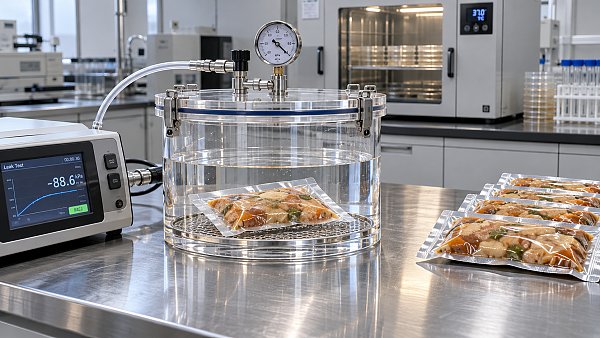
The test must suit the actual package. Methods used for cartons, flexible pouches, and rigid containers are not interchangeable. Depending on construction, an integrity program may combine seal examination, dye penetration, bubble emission, pressure or vacuum decay, electrical methods, and mechanical seal testing.
These methods answer different questions. Seal-strength testing measures mechanical performance; it does not necessarily demonstrate the absence of leak paths. A leak test identifies defects within its demonstrated detection capability, but that capability must be established for the package geometry, materials, and test conditions. Visual inspection alone cannot reliably exclude small channels or hidden defects.
Method qualification should use suitable controls and, where appropriate, characterized artificial defects. Relevant ASTM methods can provide a technical framework, but their scope must match the packaging material and application. A supplier’s claim that equipment is “ASTM tested” is incomplete without the method, configuration, acceptance criteria, and supporting report.
Integrity testing after representative handling or distribution simulation can reveal weaknesses absent immediately after filling. This is especially relevant when approving a lighter material, a new closure, or a different secondary-pack configuration.
Process validation supplies the evidence that sampling cannot
Finished-product screening sits downstream of the controls that create commercial sterility. Validation must establish that the specified system can achieve the required outcome under defined operating conditions, including justified worst cases.
For the product sterilization step, relevant evidence can include temperature measurement accuracy, residence-time studies, flow control, and the effects of viscosity or particulates. The scheduled process must be established by appropriately qualified personnel. A displayed outlet temperature, by itself, does not demonstrate adequate treatment of every relevant product fraction.
The downstream sterile zone needs separate consideration. Sterilization-in-place coverage, aseptic tank conditions, sterile gas filtration, valve operation, and protective pressure relationships must be addressed as applicable to the equipment. Package and closure sterilization require their own validated treatment conditions.
Biological indicators or controlled microbial challenge studies may support specific validation tasks. Challenge organism resistance, inoculation method, recovery, treatment exposure, and location all influence the meaning of the result. Such studies belong in a controlled validation program, not improvised production-floor trials.
Aseptic process simulations can also reveal weaknesses associated with interventions and operating practices when appropriately designed. However, a simulation does not automatically represent the thermal behavior, fouling, or flow characteristics of the commercial food. Its conclusions must stay within its demonstrated scope.
Routine monitoring should detect loss of control early
Validation establishes capability; routine monitoring checks whether production remained within that capability. Release review should therefore connect laboratory findings to time-stamped process records, alarms, interventions, and packaging checks.
Depending on the system, records may cover sterilization temperature and flow, diversion events, package sterilant concentration and exposure, sterile-zone conditions, filter integrity, and closure settings. Environmental monitoring can reveal hygiene deterioration or recurring contamination routes, but a clean environmental result does not demonstrate that product or package sterilization succeeded.
Trend analysis is often more informative than isolated pass/fail results. Repeated seal variation on one lane, recurring organisms, or alarms following particular interventions may indicate a developing failure. The data become actionable only when package codes can be linked to the corresponding production window and equipment state.
Build a release decision around connected evidence
A practical verification plan defines the decision before production begins. It should identify the required records, sampling locations, methods, acceptance criteria, deviation procedures, and authority for release. These elements should be traceable to the product risk assessment, validated process, and applicable requirements.
When a positive microbial result or critical deviation occurs, hold the potentially affected product and establish the exposure window. Review process history, package performance, sampling controls, and organism identification together. Additional testing may help investigate the cause, but repeatedly testing until negative results appear is not a sound release strategy.
For equipment comparisons, Global Multi-Core Enterprise (G-MCE)’s industrial food processing intelligence and technical benchmarking focus is relevant to a specific procurement question: what evidence supports the claimed aseptic performance? Buyers should request validation scope, product and package limitations, calibration provisions, data traceability, and change-control requirements—not merely nominal throughput or a generic sterility statement.
The most useful next step is to map each credible failure route to its evidence source. Product incubation addresses detectable growth in sampled units; microbiology investigates contamination; integrity testing examines the package barrier; validation and monitoring establish process capability and control. Any failure route without a suitable control or verification method is a gap to resolve before relying on a commercial-sterility release decision.
Recommended for You
 Smart MetersTamil Nadu Plans SIM-Based Upgrade for 17.7 Million Smart MetersTamil Nadu plans 17.7 million smart meters with proposed SIM-based upgrades. Explore potential supplier opportunities and the tender details still to come.By: Dr. Elena VoltNov 22, 2026
 Fiber LasersFiber Laser CE Marking: EU Safety Requirements and DocumentationFiber laser CE compliance goes beyond the mark. Explore EU safety requirements, essential documentation and practical checks before purchasing.By: Dr. Hideo TanakaNov 22, 2026
 Grid ResilienceUS Grid Equipment Shortages Could Hinder $1 Trillion UpgradeUS grid equipment shortages could hinder a $1 trillion upgrade. Explore how transformer supply, data centers and rising power demand could affect grid projects.By: Dr. Elena VoltNov 21, 2026
 Digital SeaChoosing Bluetooth Speakers: Sound Quality, Battery Life and PortabilityBluetooth speakers come in all shapes and sizes. Learn how to compare sound quality, battery life and portability to find the right fit for your listening needs.By: Captain Kenji SatoNov 21, 2026
 Subsea ROV/AUV2025 Ocean Equipment Report: China's Industry Moves Toward Scaled ApplicationChina's marine equipment industry is moving toward scaled application. Explore what the 2025 Ocean Equipment Report could mean for buyers, suppliers and offshore projects.By: Captain Kenji SatoNov 20, 2026
 Digital SeaChoosing a Thermoforming Vacuum Packaging Machine for Meat ProductsChoose a thermoforming vacuum packaging machine for meat with confidence. Compare sealing, film compatibility, hygiene and real-world production capacity.By: Captain Kenji SatoNov 20, 2026
 Digital SeaGreen Station Certification Cost: Fees and Budget ConsiderationsGreen station certification cost varies by scheme and site. Explore fees, hidden expenses, and budgeting tips to plan confidently and compare providers.By: Captain Kenji SatoNov 19, 2026
 UHV TransformersLIMiK Capital to Invest $328 Million in South Carolina Transformer PlantLIMiK Capital plans a $327.7 million transformer plant in South Carolina. Explore its potential impact on US grid supply and procurement.By: Dr. Elena VoltNov 18, 2026
 Digital SeaHow to Choose STEM Kits for Kids by Age, Interests, and Skill LevelChoose STEM kits that match your child's age, interests, and skills. Explore safety tips, project ideas, and practical checks to find an engaging fit.By: Captain Kenji SatoNov 18, 2026
 Digital SeaManufacturing Supplier Requirements: What to Include in Technical SpecificationsDiscover how manufacturing technical specifications and supplier requirements improve quality, simplify comparisons, and prevent delays with measurable acceptance criteria.By: Captain Kenji SatoNov 17, 2026
 Digital SeaChina's Environment Ministry Opens ALC Submarine Cable Project to ReviewChina's Environment Ministry opens the ALC submarine cable project's environmental assessment to review. Explore the proposed marine protection measures and what comes next.By: Captain Kenji SatoNov 16, 2026
 Precision LensesOptical Lens Surface Roughness Testing: Methods and Ra InterpretationOptical lens surface roughness testing explained: compare measurement methods, interpret Ra values, and define reliable acceptance criteria.By: Dr. Hideo TanakaNov 16, 2026
 Digital SeaBusiness Growth Strategies: How to Choose the Right Path for Your CompanyExplore business growth strategies and learn how to compare market opportunities, costs, risks, and capabilities to choose the right path for your company.By: Captain Kenji SatoNov 15, 2026
 Smart MetersIndia’s Competition Commission Approves Adani Acquisition of IntelliSmartExplore the reported CCI approval of Adani’s IntelliSmart acquisition and what a larger Indian smart meter platform could mean for suppliers and investors.By: Dr. Elena VoltNov 14, 2026
 Digital SeaHow Does a Ballast Cleaner Screening System Separate Track Ballast?Discover how a ballast cleaner screening system separates reusable stone from fines, what affects performance, and how to assess the results.By: Captain Kenji SatoNov 14, 2026
 Smart MetersPakistan to Seek World Bank and ADB Funding for Smart MetersPakistan seeks World Bank and ADB funding for smart meters on distribution transformers. Explore the plan to tackle power theft and improve grid efficiency.By: Dr. Elena VoltNov 13, 2026
 Digital SeaWhat Is Precision Medicine and How Does It Guide Treatment?Discover how precision medicine uses biomarkers and genetic insights to guide treatment, where it can help, and what to ask before testing.By: Captain Kenji SatoNov 13, 2026
 Grid Resilience2026 CSEE Annual Meeting Opens with Focus on AI and Power SystemsThe 2026 CSEE Annual Meeting explores AI, low-carbon power systems and ultra-high-voltage transmission. Discover why these discussions matter.By: Dr. Elena VoltNov 12, 2026
 Digital SeaShip Radar Detection Range: How Far Can It See and What Limits It?Ship radar detection range depends on more than the display scale. Discover how antenna height, weather, target size, and settings affect what radar can see.By: Captain Kenji SatoNov 12, 2026
 UHV TransformersGE Vernova to Invest $34.5 Million in Louisiana Transformer Plant ExpansionGE Vernova plans a $34.5 million transformer plant expansion in Louisiana. Explore its potential impact on North American supply and procurement.By: Dr. Elena VoltNov 11, 2026
 Digital SeaMetro Station Noise Criteria: Limits and Measurement MethodsExplore metro station noise criteria, applicable limits and measurement methods. Learn how to select metrics and assess compliance with confidence.By: Captain Kenji SatoNov 11, 2026
 Digital SeaKongsberg Maritime Unveils Arctic Hunter Unmanned Surface VesselKongsberg Maritime's Arctic Hunter unmanned surface vessel is proposed for the Royal Navy's Type 92 programme. Explore its technology and procurement implications.By: Captain Kenji SatoNov 10, 2026
 Sorting RobotsHow Accurate Is AI in Food Quality Control? Metrics and Testing MethodsExplore AI in food quality control accuracy, from recall and false negatives to validation methods. Learn how to assess real-world inspection reliability.By: Marcus SterlingNov 10, 2026
 UHV TransformersGE Vernova Selected for 6 GW HVDC Link in IndiaGE Vernova will design a 6 GW HVDC link for PGCIL, connecting Rajasthan and South Kalamb to support India's clean energy transition. Discover the project.By: Dr. Elena VoltNov 09, 2026
 Grid ResilienceEurope's Grid Compliance Standards in 2026: Generator Connection RequirementsExplore new grid compliance standards 2026 Europe projects must address, from generator connection rules to testing and documentation. Prepare for approval.By: Dr. Elena VoltNov 09, 2026
 Technical FabricsNonwoven Bonding Cost Data: Comparing Thermal and Chemical ProcessesExplore nonwoven bonding cost data to compare thermal and chemical processes, assess usable yield, and choose the best-value option for your application.By: Chloe DuboisNov 08, 2026
 Fiber LasersIndustrial Lasers to 2035: Automotive Lightweighting and Precision Welding Drive DemandExplore the industrial laser market outlook to 2035 and discover how automotive lightweighting and precision welding could shape demand and procurement.By: Dr. Hideo TanakaNov 07, 2026
 Technical FabricsChoosing Geotextile Under Railway Ballast: Key Performance RequirementsChoosing geotextile under railway ballast? Explore essential filtration, drainage, strength and durability criteria to make a confident, project-specific selection.By: Chloe DuboisNov 07, 2026
 Digital SeaChoosing Rail Welding Equipment for Maintenance: Field Conditions and Weld TypesChoose rail welding equipment for maintenance with confidence. Compare welding methods, field constraints, inspection needs, and lifecycle costs.By: Captain Kenji SatoNov 06, 2026
 Digital SeaIndia Broadband Forum Urges Stronger Submarine Cable ResilienceIndia’s submarine cable resilience is in focus as the Broadband India Forum urges faster repairs, more vessels and stronger landing infrastructure.By: Captain Kenji SatoNov 06, 2026
 Digital SeaChoosing a Railway Network Switch Supplier: Reliability and Support CriteriaChoosing a railway network switch supplier? Compare reliability, standards evidence, cybersecurity, and lifecycle support to reduce project risk.By: Captain Kenji SatoNov 05, 2026