BDI: 1,842 ▼ 1.2%
COTTON NO.2: 84.12 ▲ 0.4%
LME COPPER: 8,432.50 ▲ 2.1%
FOOD SAFETY INDEX: 94.2 ARCHIVE_SECURED
OPTICAL INDEX: 11,204.09 STABLE
BDI: 1,842 ▼ 1.2%

SECTOR INDEX
V.24.08 ARCHIVE
Hot Articles
- Tamil Nadu Plans SIM-Based Upgrade for 17.7 Million Smart MetersTamil Nadu plans 17.7 million smart meters with proposed SIM-based upgrades. Explore potential supplier opportunities and the tender details still to come.
- Fiber Laser CE Marking: EU Safety Requirements and DocumentationFiber laser CE compliance goes beyond the mark. Explore EU safety requirements, essential documentation and practical checks before purchasing.
- US Grid Equipment Shortages Could Hinder $1 Trillion UpgradeUS grid equipment shortages could hinder a $1 trillion upgrade. Explore how transformer supply, data centers and rising power demand could affect grid projects.
Choosing Geotextile Under Railway Ballast: Key Performance Requirements


Selecting the right geotextile under railway ballast is critical to maintaining track stability and limiting subgrade deterioration under repeated train loads.
For technical evaluators, the decision involves more than tensile strength: separation efficiency, filtration, drainage, puncture resistance, and installation survivability all influence long-term performance.
This guide examines the key requirements and relevant test methods to help assess material suitability for railway applications.
The governing choice is project-specific: specify a geotextile against the actual soil, water conditions, aggregate, construction method, and applicable railway authority requirements.
No single strength value proves suitability. A product must retain soil while passing water, survive installation, and maintain those functions throughout its intended service life.
What must a geotextile do beneath railway ballast?
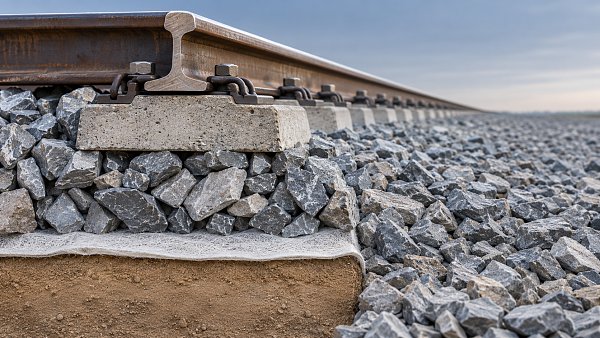
A geotextile is commonly placed between an aggregate layer and a prepared formation or subgrade. Its primary functions are often separation and filtration.
Separation limits the mixing of fine subgrade particles with coarser aggregate. This helps preserve the designed properties of the aggregate layer and reduces contamination.
Filtration allows water to move through the fabric while retaining soil particles. Effective filtration depends on compatibility with the adjacent soil, not permeability alone.
Some designs also rely on reinforcement or in-plane drainage, but these functions require explicit engineering verification. They should not be assumed from product classification.
Placement matters. A fabric beneath a sub-ballast layer encounters different aggregate and installation stresses from one placed directly against coarse, angular ballast.
Before comparing products, establish the layer arrangement, expected water flow, construction sequence, and failure mechanism the geotextile is intended to address.
How should soil retention and filtration be assessed?
Start with representative soil grading, including the proportion of fines and the particle sizes used in the project’s filtration criteria. Account for soil variability.
The geotextile’s opening size indicates the approximate particle size that can pass through its pores. Manufacturers commonly report apparent opening size or characteristic opening size.
ASTM D4751 measures apparent opening size using a dry-sieving procedure. EN ISO 12956 determines characteristic opening size using a different test approach.
These reported values are not automatically interchangeable. Compare products using the method and acceptance criteria specified by the governing railway authority or design standard.
Openings that are too large may allow excessive soil loss. Openings that are too small may increase clogging risk, particularly in fine or internally unstable soils.
Use the applicable soil-retention criterion to establish an acceptable opening size, then assess clogging and hydraulic behavior under the anticipated site conditions.
For difficult soils, laboratory testing with the actual soil and candidate geotextile can provide stronger evidence than a generic product data sheet.
Such testing is especially useful where silts, clays, dispersive soils, or soils with unstable particle distributions may behave poorly under repeated wetting and loading.
Construction-induced disturbance also matters. Fine particles mobilized during grading, rainfall, or equipment traffic can alter filtration behavior before the railway enters service.
How much permeability and drainage capacity are needed?
Cross-plane flow is water passing through the fabric thickness. The geotextile should pass the anticipated flow without causing an unacceptable hydraulic restriction.
ASTM D4491 measures water permeability and permittivity of geotextiles. EN ISO 11058 measures water permeability normal to the plane under its specified conditions.
Review the reported test method and units carefully. A laboratory water-flow value alone does not demonstrate that a soil-geotextile system will resist clogging.
Compare hydraulic performance with the surrounding soil and project drainage criteria, including a margin for potential reduction during construction and service.
In-plane flow is movement along the fabric. If the design depends on this function, evaluate transmissivity under representative confinement and hydraulic gradient.
ASTM D4716 and EN ISO 12958 address in-plane flow capacity under specified conditions. Test configurations and results should be reviewed against the intended application.
A conventional separation geotextile should not be treated as a substitute for a designed drainage layer, collector drain, or adequate formation crossfall.
Where groundwater, surface infiltration, or poor outlets can saturate the trackbed, resolve the drainage path as part of the overall track design.
Which mechanical properties matter during installation?
The critical mechanical challenge may occur before the first train runs, when angular aggregate is placed, spread, compacted, and trafficked by construction equipment.
Assess puncture resistance against aggregate size, angularity, layer thickness, drop height, and the condition of the supporting soil. Soft support can increase deformation.
Relevant tests include ASTM D6241 for static puncture resistance using a CBR plunger and EN ISO 12236 for static puncture testing.
ASTM D4833 measures index puncture resistance using a different procedure. Results from different puncture tests should not be compared as equivalent values.
Dynamic perforation testing, such as EN ISO 13433, offers another indication of resistance to impact from falling objects under specified laboratory conditions.
Tensile strength and elongation matter because the fabric must accommodate construction stresses without tearing or separating at overlaps and seams.
ASTM D4595 and EN ISO 10319 provide wide-width tensile test methods. Confirm the reported direction, test conditions, strength, and elongation when comparing products.
Tear resistance and seam strength may also govern where equipment turns, panels are joined, or installation details concentrate forces at fabric edges.
Index tests support screening, but they do not reproduce every site condition. Severe aggregate and placement conditions may justify project-specific installation damage trials.
Is reinforcement actually part of the design?
A geotextile can contribute to reinforcement in certain engineered systems, but separation-grade tensile strength alone does not establish a measurable track-support benefit.
Where reinforcement is claimed, require calculations or validated design evidence linking material stiffness, soil interaction, geometry, loading, and allowable deformation.
Evaluate stiffness at strains relevant to the design, rather than relying only on ultimate tensile strength at failure. The required response depends on the mechanism.
Consider installation damage, long-term loading, environmental exposure, and appropriate reduction factors when deriving design properties from tested material values.
Geogrids and composite systems may be appropriate alternatives where aggregate confinement or reinforcement is the primary objective. Their selection still requires project-specific verification.
Neither a geotextile nor a geogrid automatically repairs inadequate formation strength, unstable earthworks, or a drainage system that cannot discharge water.
How should durability and service life be evaluated?
Define the intended service life and identify relevant exposure: ultraviolet light before covering, chemical conditions, temperature, groundwater, and repeated loading after installation.
Polypropylene and polyester geotextiles are widely used, but polymer type alone is not a durability approval. Confirm suitability for the actual chemical environment.
Review manufacturer evidence and applicable durability procedures for the product and exposure conditions. Project specifications may require additional testing or independent certification.
Ultraviolet exposure limits are particularly important where rolls or installed fabric may remain uncovered. Follow the specified maximum exposure period and storage instructions.
Assess resistance to installation damage separately from long-term aging. A chemically durable fabric that is badly punctured during construction may not perform as intended.
For critical sites, ask suppliers to explain the evidence behind service-life claims, including test methods, assumptions, and the conditions under which results apply.
How can evaluators compare supplier submissions fairly?
Issue a common performance schedule covering the intended functions, test methods, acceptance values, sampling requirements, and whether values are minimums or typical results.
Require the product name, polymer, construction, manufacturing location, roll dimensions, and identification system. Changes to the proposed product should trigger technical review.
Check whether declared values represent minimum average roll values, characteristic values, or typical values. These statistical descriptions are not directly equivalent.
Request current, traceable test reports from competent laboratories and verify that the tested product matches the material proposed for delivery.
Distinguish manufacturer quality-control results from independent qualification testing. Confirm report dates, sample identification, test standards, and any deviations from specified procedures.
Compare opening size and hydraulic properties with the actual soil criteria first, then verify mechanical survivability and durability against construction and service conditions.
Mass per unit area can help identify a product, but it is not a reliable stand-alone proxy for filtration, puncture resistance, or service life.
Likewise, a higher tensile value does not compensate for incompatible openings, inadequate water flow, or a product that fails the required puncture criterion.
Evaluate total installed cost alongside technical compliance. Include overlaps, wastage, handling, inspection, and potential consequences of replacement under an operating railway.
What installation details should be checked on site?
Prepare the formation to the specified line and level, remove sharp protrusions, and address standing water or unstable areas before placing the fabric.
Lay panels without excessive folds and follow the approved orientation. Maintain the specified overlaps or seams, particularly where placement could separate adjacent panels.
Overlap requirements depend on soil conditions, loading, construction methods, and authority specifications. Confirm project values rather than applying a universal dimension.
Do not allow uncontrolled vehicle trafficking directly on exposed fabric. Place cover material using the approved method and maintain the specified protective thickness.
Inspect for tears, displaced overlaps, contamination, and damage before covering. Repair or replace affected sections according to the approved installation procedure.
Keep records of delivered roll identifiers, installation locations, weather exposure, inspection results, and repairs to support acceptance and future investigation.
Common selection errors and their consequences
Choosing by strength alone can leave the formation vulnerable to soil migration or clogging. Hydraulic compatibility and mechanical survival must be assessed together.
Using a clean-water permeability figure without considering soil behavior can conceal filtration problems. Soil-specific testing may be warranted where consequences are high.
Assuming all products with similar mass have similar performance can lead to unsuitable substitutions. Compare the specified properties using consistent test methods.
Ignoring aggregate placement can invalidate a laboratory-based selection. Construction equipment, drop height, and support conditions should inform survivability requirements.
Finally, relying on a fabric to solve systemic drainage or bearing-capacity problems can delay necessary earthworks and increase lifecycle costs.
Final assessment
The right geotextile under railway ballast is the one that meets the project’s soil-retention, hydraulic, mechanical, and durability requirements as a complete system.
Begin with site conditions and the governing railway specification, then verify supplier claims against consistent test methods and documented construction controls.
Where uncertainty remains, targeted soil-geotextile testing or an installation trial can provide evidence for a more defensible selection before full-scale procurement.
Recommended for You
 Smart MetersTamil Nadu Plans SIM-Based Upgrade for 17.7 Million Smart MetersTamil Nadu plans 17.7 million smart meters with proposed SIM-based upgrades. Explore potential supplier opportunities and the tender details still to come.By: Dr. Elena VoltNov 22, 2026
 Fiber LasersFiber Laser CE Marking: EU Safety Requirements and DocumentationFiber laser CE compliance goes beyond the mark. Explore EU safety requirements, essential documentation and practical checks before purchasing.By: Dr. Hideo TanakaNov 22, 2026
 Grid ResilienceUS Grid Equipment Shortages Could Hinder $1 Trillion UpgradeUS grid equipment shortages could hinder a $1 trillion upgrade. Explore how transformer supply, data centers and rising power demand could affect grid projects.By: Dr. Elena VoltNov 21, 2026
 Digital SeaChoosing Bluetooth Speakers: Sound Quality, Battery Life and PortabilityBluetooth speakers come in all shapes and sizes. Learn how to compare sound quality, battery life and portability to find the right fit for your listening needs.By: Captain Kenji SatoNov 21, 2026
 Subsea ROV/AUV2025 Ocean Equipment Report: China's Industry Moves Toward Scaled ApplicationChina's marine equipment industry is moving toward scaled application. Explore what the 2025 Ocean Equipment Report could mean for buyers, suppliers and offshore projects.By: Captain Kenji SatoNov 20, 2026
 Digital SeaChoosing a Thermoforming Vacuum Packaging Machine for Meat ProductsChoose a thermoforming vacuum packaging machine for meat with confidence. Compare sealing, film compatibility, hygiene and real-world production capacity.By: Captain Kenji SatoNov 20, 2026
 Digital SeaGreen Station Certification Cost: Fees and Budget ConsiderationsGreen station certification cost varies by scheme and site. Explore fees, hidden expenses, and budgeting tips to plan confidently and compare providers.By: Captain Kenji SatoNov 19, 2026
 UHV TransformersLIMiK Capital to Invest $328 Million in South Carolina Transformer PlantLIMiK Capital plans a $327.7 million transformer plant in South Carolina. Explore its potential impact on US grid supply and procurement.By: Dr. Elena VoltNov 18, 2026
 Digital SeaHow to Choose STEM Kits for Kids by Age, Interests, and Skill LevelChoose STEM kits that match your child's age, interests, and skills. Explore safety tips, project ideas, and practical checks to find an engaging fit.By: Captain Kenji SatoNov 18, 2026
 Digital SeaManufacturing Supplier Requirements: What to Include in Technical SpecificationsDiscover how manufacturing technical specifications and supplier requirements improve quality, simplify comparisons, and prevent delays with measurable acceptance criteria.By: Captain Kenji SatoNov 17, 2026
 Digital SeaChina's Environment Ministry Opens ALC Submarine Cable Project to ReviewChina's Environment Ministry opens the ALC submarine cable project's environmental assessment to review. Explore the proposed marine protection measures and what comes next.By: Captain Kenji SatoNov 16, 2026
 Precision LensesOptical Lens Surface Roughness Testing: Methods and Ra InterpretationOptical lens surface roughness testing explained: compare measurement methods, interpret Ra values, and define reliable acceptance criteria.By: Dr. Hideo TanakaNov 16, 2026
 Digital SeaBusiness Growth Strategies: How to Choose the Right Path for Your CompanyExplore business growth strategies and learn how to compare market opportunities, costs, risks, and capabilities to choose the right path for your company.By: Captain Kenji SatoNov 15, 2026
 Smart MetersIndia’s Competition Commission Approves Adani Acquisition of IntelliSmartExplore the reported CCI approval of Adani’s IntelliSmart acquisition and what a larger Indian smart meter platform could mean for suppliers and investors.By: Dr. Elena VoltNov 14, 2026
 Digital SeaHow Does a Ballast Cleaner Screening System Separate Track Ballast?Discover how a ballast cleaner screening system separates reusable stone from fines, what affects performance, and how to assess the results.By: Captain Kenji SatoNov 14, 2026
 Smart MetersPakistan to Seek World Bank and ADB Funding for Smart MetersPakistan seeks World Bank and ADB funding for smart meters on distribution transformers. Explore the plan to tackle power theft and improve grid efficiency.By: Dr. Elena VoltNov 13, 2026
 Digital SeaWhat Is Precision Medicine and How Does It Guide Treatment?Discover how precision medicine uses biomarkers and genetic insights to guide treatment, where it can help, and what to ask before testing.By: Captain Kenji SatoNov 13, 2026
 Grid Resilience2026 CSEE Annual Meeting Opens with Focus on AI and Power SystemsThe 2026 CSEE Annual Meeting explores AI, low-carbon power systems and ultra-high-voltage transmission. Discover why these discussions matter.By: Dr. Elena VoltNov 12, 2026
 Digital SeaShip Radar Detection Range: How Far Can It See and What Limits It?Ship radar detection range depends on more than the display scale. Discover how antenna height, weather, target size, and settings affect what radar can see.By: Captain Kenji SatoNov 12, 2026
 UHV TransformersGE Vernova to Invest $34.5 Million in Louisiana Transformer Plant ExpansionGE Vernova plans a $34.5 million transformer plant expansion in Louisiana. Explore its potential impact on North American supply and procurement.By: Dr. Elena VoltNov 11, 2026
 Digital SeaMetro Station Noise Criteria: Limits and Measurement MethodsExplore metro station noise criteria, applicable limits and measurement methods. Learn how to select metrics and assess compliance with confidence.By: Captain Kenji SatoNov 11, 2026
 Digital SeaKongsberg Maritime Unveils Arctic Hunter Unmanned Surface VesselKongsberg Maritime's Arctic Hunter unmanned surface vessel is proposed for the Royal Navy's Type 92 programme. Explore its technology and procurement implications.By: Captain Kenji SatoNov 10, 2026
 Sorting RobotsHow Accurate Is AI in Food Quality Control? Metrics and Testing MethodsExplore AI in food quality control accuracy, from recall and false negatives to validation methods. Learn how to assess real-world inspection reliability.By: Marcus SterlingNov 10, 2026
 UHV TransformersGE Vernova Selected for 6 GW HVDC Link in IndiaGE Vernova will design a 6 GW HVDC link for PGCIL, connecting Rajasthan and South Kalamb to support India's clean energy transition. Discover the project.By: Dr. Elena VoltNov 09, 2026
 Grid ResilienceEurope's Grid Compliance Standards in 2026: Generator Connection RequirementsExplore new grid compliance standards 2026 Europe projects must address, from generator connection rules to testing and documentation. Prepare for approval.By: Dr. Elena VoltNov 09, 2026
 Technical FabricsNonwoven Bonding Cost Data: Comparing Thermal and Chemical ProcessesExplore nonwoven bonding cost data to compare thermal and chemical processes, assess usable yield, and choose the best-value option for your application.By: Chloe DuboisNov 08, 2026
 Fiber LasersIndustrial Lasers to 2035: Automotive Lightweighting and Precision Welding Drive DemandExplore the industrial laser market outlook to 2035 and discover how automotive lightweighting and precision welding could shape demand and procurement.By: Dr. Hideo TanakaNov 07, 2026
 Technical FabricsChoosing Geotextile Under Railway Ballast: Key Performance RequirementsChoosing geotextile under railway ballast? Explore essential filtration, drainage, strength and durability criteria to make a confident, project-specific selection.By: Chloe DuboisNov 07, 2026
 Digital SeaChoosing Rail Welding Equipment for Maintenance: Field Conditions and Weld TypesChoose rail welding equipment for maintenance with confidence. Compare welding methods, field constraints, inspection needs, and lifecycle costs.By: Captain Kenji SatoNov 06, 2026
 Digital SeaIndia Broadband Forum Urges Stronger Submarine Cable ResilienceIndia’s submarine cable resilience is in focus as the Broadband India Forum urges faster repairs, more vessels and stronger landing infrastructure.By: Captain Kenji SatoNov 06, 2026
 Digital SeaChoosing a Railway Network Switch Supplier: Reliability and Support CriteriaChoosing a railway network switch supplier? Compare reliability, standards evidence, cybersecurity, and lifecycle support to reduce project risk.By: Captain Kenji SatoNov 05, 2026