BDI: 1,842 ▼ 1.2%
COTTON NO.2: 84.12 ▲ 0.4%
LME COPPER: 8,432.50 ▲ 2.1%
FOOD SAFETY INDEX: 94.2 ARCHIVE_SECURED
OPTICAL INDEX: 11,204.09 STABLE
BDI: 1,842 ▼ 1.2%

SECTOR INDEX
V.24.08 ARCHIVE
Hot Articles
- Tamil Nadu Plans SIM-Based Upgrade for 17.7 Million Smart MetersTamil Nadu plans 17.7 million smart meters with proposed SIM-based upgrades. Explore potential supplier opportunities and the tender details still to come.
- Fiber Laser CE Marking: EU Safety Requirements and DocumentationFiber laser CE compliance goes beyond the mark. Explore EU safety requirements, essential documentation and practical checks before purchasing.
- US Grid Equipment Shortages Could Hinder $1 Trillion UpgradeUS grid equipment shortages could hinder a $1 trillion upgrade. Explore how transformer supply, data centers and rising power demand could affect grid projects.
Water-Free Textile Printing: Fabric Compatibility and Pretreatment Limits


A polyester sample leaves the transfer press with sharp edges and strong color. A cotton sample printed through another “water-free” system looks equally convincing—until washing reveals fading, surface roughness, or poor wet-rub performance. Both demonstrations may be genuine. Neither establishes compatibility across a production fabric range.
For technical evaluators, water free textile printing is not a single technology or a universal fabric capability. Dye chemistry, fiber composition, surface finishes, pretreatment, and fixation determine whether a process will work. The useful purchasing question is not simply whether a machine avoids water, but whether the complete production route delivers acceptable quality without moving water consumption elsewhere.
Define the water-free claim before comparing equipment
Suppliers may use “water-free” to describe several different boundaries: no washing after printing, no aqueous dye bath, no water added at the printing stage, or no process water across the entire workflow. These claims are not interchangeable.
For example, dye-sublimation transfer normally requires no steaming or washing after transfer. However, transfer inks are commonly water-based, and fabric preparation may already have involved wet processing. Digital pigment printing can also eliminate post-print washing, yet its inks and pretreatment fluids are often aqueous.
A meaningful assessment therefore separates three questions:
- Application: Does ink delivery or pretreatment introduce water?
- Fixation: Does the design require dry heat, steam, pressure, or another fixation mechanism?
- Complete workflow: Are scouring, coating, washing, cleaning, and reprocessing included in the claim?
This distinction matters when comparing a print-only installation with an integrated textile facility. Buying prepared fabric can remove water use from the printer’s site without removing it from the supply chain. Neither operating model is inherently invalid; the reporting boundary simply needs to be explicit.
Fabric compatibility follows the fixation mechanism
Start with the mechanism that holds color on or within the textile. A process that works because dye diffuses into polyester cannot be assumed to work on cotton. A pigment system that binds color to a surface may accommodate more fibers, but its binder introduces different performance limits.
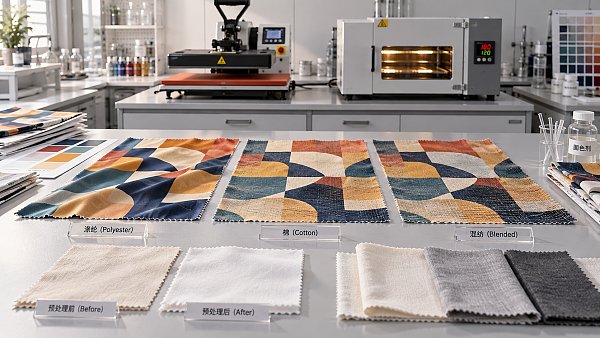
The table is a screening tool, not a fabric approval list. Two textiles with identical fiber percentages can behave differently because of construction, yarn characteristics, finishing chemistry, and thermal history.
Polyester: a strong candidate, with thermal limits
Dye-sublimation transfer is often the clearest starting point for polyester sportswear, flags, and selected display textiles. Under controlled heat, suitable disperse dyes move from the transfer paper into the polyester. Conventional transfer does not require a binder film to hold the image in place.
That advantage does not remove the need for trials. Lightweight knits may shrink or skew. Previously dyed polyester may show color migration during later heating. Textured surfaces can create uneven contact, while stretch fabrics containing elastane may respond poorly to an unsuitable heat cycle.
Evaluate dimensional stability and stretch recovery alongside image quality. A visually excellent print is not acceptable if pressing changes garment dimensions or damages fabric performance.
Cotton: broad pigment potential, not sublimation equivalence
Untreated cotton does not accept conventional sublimation dyes in the same way as polyester. A coating can create a receptive surface, but the result depends on that coating rather than cotton’s intrinsic dye affinity. Its durability, breathability, and feel require separate assessment.
Pigment printing is generally the more relevant low-water route for cotton because a binder anchors insoluble color particles to the textile. The trade-off is familiar to anyone evaluating a dark, heavily printed cotton sample: stronger coverage may come with a firmer surface.
Conventional reactive printing can produce desirable cotton coloration, but typically involves preparation, fixation, and wash-off. It should not be presented as inherently water-free merely because ink application is digital.
Blends: composition is only the first variable
On polyester/cotton blends, sublimation principally colors the polyester fraction. The cotton component remains largely uncolored, potentially producing a muted or heathered appearance. That may suit a design brief, but it is not equivalent to uniform coloration of both fibers.
Pigment systems can color the surface across mixed fibers, although differences in absorbency and surface chemistry still affect consistency. For polyester/elastane, cotton/elastane, and other stretch blends, assess binder flexibility, print cracking, and recovery after repeated extension—not just the initial color result.
Pretreatment expands capability, but does not erase material limits
Pretreatment is often the point where a broad compatibility claim becomes conditional. It can control ink spread, increase color strength, support white-ink coverage, or improve interaction between the ink and textile. It cannot make every fabric suitable for every printing chemistry.
Distinguish ordinary fabric preparation from a print-specific treatment. Scouring removes oils, waxes, and other contaminants. Print pretreatment modifies how deposited ink behaves. A fabric may need both, even when the printing machine itself uses no washing stage.
Several limits deserve particular attention:
- Existing finishes: Water-repellent treatments, silicone softeners, antistatic agents, and residual processing oils can interfere with wetting or binder adhesion.
- Application uniformity: Uneven treatment can produce mottling, shade variation, or inconsistent rubbing fastness.
- Add-on level: Excess treatment may create stiffness, residue, discoloration, or an undesirable surface feel.
- Drying and storage: Residual moisture and storage conditions can change print behavior between preparation and production.
- Functional performance: A treatment that improves printability may compromise moisture management, repellency, or another specified textile function.
Ask the supplier for a documented treatment window rather than a single successful recipe. It should identify approved fabric conditions, application quantity, drying requirements, storage limits, and relevant ink combinations. Any “pretreatment-free” claim should be tied to named substrates and performance criteria, not interpreted as universal compatibility.
Validate the production window, not the showroom sample
A selection trial should establish repeatability under realistic variation. Use intended production fabrics from more than one lot, including the finishes actually supplied. Test representative artwork: fine lines, pale shades, saturated areas, and dark coverage place different demands on the process.
Keep an untreated control where appropriate, and record pretreatment, ink loading, line speed, and fixation settings. For thermal systems, verify the temperature experienced by the textile rather than relying only on the machine setpoint. Residence time and actual fabric temperature together determine the effective heat exposure.
Make acceptance criteria application-specific
There is no universal pass grade for every printed textile. A decorative display, washable uniform, and stretch sports garment face different service conditions. Agree on limits before testing so a visually attractive sample does not quietly redefine the specification.
For laundering, methods such as ISO 105-C06 or AATCC TM61 can support controlled comparison, but the selected procedure must match the evaluation objective. Accelerated testing does not automatically reproduce every consumer washing condition.
With pigment prints, poor rubbing performance may indicate insufficient binder, unsuitable chemistry, excessive color loading, or incomplete curing. Increasing temperature is not a universal remedy: it can damage the substrate or alter shade. Troubleshooting should isolate variables rather than compensate for one defect by creating another.
Count water and operating costs at the same boundary
Once quality is acceptable, compare resource use per unit of saleable output. Nominal water savings per printed meter can be misleading if one route produces more rejects or needs additional preparation.
Request a process map covering incoming fabric preparation, pretreatment, printing, fixation, cleaning, and any washing. Distinguish direct water consumption from upstream embodied water where that broader information is available. Keep estimates separate from measured operating data.
The commercial comparison should also include transfer paper, treatment chemicals, ink, cleaning fluids, energy, ventilation, waste handling, maintenance, and rework. A wash-free process may still require substantial drying or curing energy. Solvent-based alternatives introduce their own emissions, fire-safety, and recovery considerations; avoiding water does not remove environmental responsibilities.
The most useful metric is cost and resource consumption per accepted square meter, calculated for a defined fabric and quality specification. This gives procurement and engineering teams a common basis for comparison without allowing low utility figures to conceal poor yield.
A practical selection rule
For predominantly polyester production, begin by assessing sublimation transfer against thermal stability, shade requirements, and downstream heat exposure. For cotton and mixed-fiber portfolios, investigate pigment systems while treating pretreatment, handle, and rubbing fastness as central selection criteria. For direct disperse or emerging nonaqueous routes, confirm the entire workflow before accepting a water-free description.
A defensible approval package should contain the fabric specification, treatment recipe, operating window, test methods, acceptance limits, and resource-use boundary. Missing information belongs in a validation plan—not behind a broad compatibility claim.
The strongest water free textile printing proposal is therefore not the one promising the widest substrate range. It is the one that explains where the process works, where preparation remains necessary, and which limitations have been demonstrated under production-relevant conditions.
Recommended for You
 Smart MetersTamil Nadu Plans SIM-Based Upgrade for 17.7 Million Smart MetersTamil Nadu plans 17.7 million smart meters with proposed SIM-based upgrades. Explore potential supplier opportunities and the tender details still to come.By: Dr. Elena VoltNov 22, 2026
 Fiber LasersFiber Laser CE Marking: EU Safety Requirements and DocumentationFiber laser CE compliance goes beyond the mark. Explore EU safety requirements, essential documentation and practical checks before purchasing.By: Dr. Hideo TanakaNov 22, 2026
 Grid ResilienceUS Grid Equipment Shortages Could Hinder $1 Trillion UpgradeUS grid equipment shortages could hinder a $1 trillion upgrade. Explore how transformer supply, data centers and rising power demand could affect grid projects.By: Dr. Elena VoltNov 21, 2026
 Digital SeaChoosing Bluetooth Speakers: Sound Quality, Battery Life and PortabilityBluetooth speakers come in all shapes and sizes. Learn how to compare sound quality, battery life and portability to find the right fit for your listening needs.By: Captain Kenji SatoNov 21, 2026
 Subsea ROV/AUV2025 Ocean Equipment Report: China's Industry Moves Toward Scaled ApplicationChina's marine equipment industry is moving toward scaled application. Explore what the 2025 Ocean Equipment Report could mean for buyers, suppliers and offshore projects.By: Captain Kenji SatoNov 20, 2026
 Digital SeaChoosing a Thermoforming Vacuum Packaging Machine for Meat ProductsChoose a thermoforming vacuum packaging machine for meat with confidence. Compare sealing, film compatibility, hygiene and real-world production capacity.By: Captain Kenji SatoNov 20, 2026
 Digital SeaGreen Station Certification Cost: Fees and Budget ConsiderationsGreen station certification cost varies by scheme and site. Explore fees, hidden expenses, and budgeting tips to plan confidently and compare providers.By: Captain Kenji SatoNov 19, 2026
 UHV TransformersLIMiK Capital to Invest $328 Million in South Carolina Transformer PlantLIMiK Capital plans a $327.7 million transformer plant in South Carolina. Explore its potential impact on US grid supply and procurement.By: Dr. Elena VoltNov 18, 2026
 Digital SeaHow to Choose STEM Kits for Kids by Age, Interests, and Skill LevelChoose STEM kits that match your child's age, interests, and skills. Explore safety tips, project ideas, and practical checks to find an engaging fit.By: Captain Kenji SatoNov 18, 2026
 Digital SeaManufacturing Supplier Requirements: What to Include in Technical SpecificationsDiscover how manufacturing technical specifications and supplier requirements improve quality, simplify comparisons, and prevent delays with measurable acceptance criteria.By: Captain Kenji SatoNov 17, 2026
 Digital SeaChina's Environment Ministry Opens ALC Submarine Cable Project to ReviewChina's Environment Ministry opens the ALC submarine cable project's environmental assessment to review. Explore the proposed marine protection measures and what comes next.By: Captain Kenji SatoNov 16, 2026
 Precision LensesOptical Lens Surface Roughness Testing: Methods and Ra InterpretationOptical lens surface roughness testing explained: compare measurement methods, interpret Ra values, and define reliable acceptance criteria.By: Dr. Hideo TanakaNov 16, 2026
 Digital SeaBusiness Growth Strategies: How to Choose the Right Path for Your CompanyExplore business growth strategies and learn how to compare market opportunities, costs, risks, and capabilities to choose the right path for your company.By: Captain Kenji SatoNov 15, 2026
 Smart MetersIndia’s Competition Commission Approves Adani Acquisition of IntelliSmartExplore the reported CCI approval of Adani’s IntelliSmart acquisition and what a larger Indian smart meter platform could mean for suppliers and investors.By: Dr. Elena VoltNov 14, 2026
 Digital SeaHow Does a Ballast Cleaner Screening System Separate Track Ballast?Discover how a ballast cleaner screening system separates reusable stone from fines, what affects performance, and how to assess the results.By: Captain Kenji SatoNov 14, 2026
 Smart MetersPakistan to Seek World Bank and ADB Funding for Smart MetersPakistan seeks World Bank and ADB funding for smart meters on distribution transformers. Explore the plan to tackle power theft and improve grid efficiency.By: Dr. Elena VoltNov 13, 2026
 Digital SeaWhat Is Precision Medicine and How Does It Guide Treatment?Discover how precision medicine uses biomarkers and genetic insights to guide treatment, where it can help, and what to ask before testing.By: Captain Kenji SatoNov 13, 2026
 Grid Resilience2026 CSEE Annual Meeting Opens with Focus on AI and Power SystemsThe 2026 CSEE Annual Meeting explores AI, low-carbon power systems and ultra-high-voltage transmission. Discover why these discussions matter.By: Dr. Elena VoltNov 12, 2026
 Digital SeaShip Radar Detection Range: How Far Can It See and What Limits It?Ship radar detection range depends on more than the display scale. Discover how antenna height, weather, target size, and settings affect what radar can see.By: Captain Kenji SatoNov 12, 2026
 UHV TransformersGE Vernova to Invest $34.5 Million in Louisiana Transformer Plant ExpansionGE Vernova plans a $34.5 million transformer plant expansion in Louisiana. Explore its potential impact on North American supply and procurement.By: Dr. Elena VoltNov 11, 2026
 Digital SeaMetro Station Noise Criteria: Limits and Measurement MethodsExplore metro station noise criteria, applicable limits and measurement methods. Learn how to select metrics and assess compliance with confidence.By: Captain Kenji SatoNov 11, 2026
 Digital SeaKongsberg Maritime Unveils Arctic Hunter Unmanned Surface VesselKongsberg Maritime's Arctic Hunter unmanned surface vessel is proposed for the Royal Navy's Type 92 programme. Explore its technology and procurement implications.By: Captain Kenji SatoNov 10, 2026
 Sorting RobotsHow Accurate Is AI in Food Quality Control? Metrics and Testing MethodsExplore AI in food quality control accuracy, from recall and false negatives to validation methods. Learn how to assess real-world inspection reliability.By: Marcus SterlingNov 10, 2026
 UHV TransformersGE Vernova Selected for 6 GW HVDC Link in IndiaGE Vernova will design a 6 GW HVDC link for PGCIL, connecting Rajasthan and South Kalamb to support India's clean energy transition. Discover the project.By: Dr. Elena VoltNov 09, 2026
 Grid ResilienceEurope's Grid Compliance Standards in 2026: Generator Connection RequirementsExplore new grid compliance standards 2026 Europe projects must address, from generator connection rules to testing and documentation. Prepare for approval.By: Dr. Elena VoltNov 09, 2026
 Technical FabricsNonwoven Bonding Cost Data: Comparing Thermal and Chemical ProcessesExplore nonwoven bonding cost data to compare thermal and chemical processes, assess usable yield, and choose the best-value option for your application.By: Chloe DuboisNov 08, 2026
 Fiber LasersIndustrial Lasers to 2035: Automotive Lightweighting and Precision Welding Drive DemandExplore the industrial laser market outlook to 2035 and discover how automotive lightweighting and precision welding could shape demand and procurement.By: Dr. Hideo TanakaNov 07, 2026
 Technical FabricsChoosing Geotextile Under Railway Ballast: Key Performance RequirementsChoosing geotextile under railway ballast? Explore essential filtration, drainage, strength and durability criteria to make a confident, project-specific selection.By: Chloe DuboisNov 07, 2026
 Digital SeaChoosing Rail Welding Equipment for Maintenance: Field Conditions and Weld TypesChoose rail welding equipment for maintenance with confidence. Compare welding methods, field constraints, inspection needs, and lifecycle costs.By: Captain Kenji SatoNov 06, 2026
 Digital SeaIndia Broadband Forum Urges Stronger Submarine Cable ResilienceIndia’s submarine cable resilience is in focus as the Broadband India Forum urges faster repairs, more vessels and stronger landing infrastructure.By: Captain Kenji SatoNov 06, 2026
 Digital SeaChoosing a Railway Network Switch Supplier: Reliability and Support CriteriaChoosing a railway network switch supplier? Compare reliability, standards evidence, cybersecurity, and lifecycle support to reduce project risk.By: Captain Kenji SatoNov 05, 2026