BDI: 1,842 ▼ 1.2%
COTTON NO.2: 84.12 ▲ 0.4%
LME COPPER: 8,432.50 ▲ 2.1%
FOOD SAFETY INDEX: 94.2 ARCHIVE_SECURED
OPTICAL INDEX: 11,204.09 STABLE
BDI: 1,842 ▼ 1.2%

SECTOR INDEX
V.24.08 ARCHIVE
Hot Articles
- Tamil Nadu Plans SIM-Based Upgrade for 17.7 Million Smart MetersTamil Nadu plans 17.7 million smart meters with proposed SIM-based upgrades. Explore potential supplier opportunities and the tender details still to come.
- Fiber Laser CE Marking: EU Safety Requirements and DocumentationFiber laser CE compliance goes beyond the mark. Explore EU safety requirements, essential documentation and practical checks before purchasing.
- US Grid Equipment Shortages Could Hinder $1 Trillion UpgradeUS grid equipment shortages could hinder a $1 trillion upgrade. Explore how transformer supply, data centers and rising power demand could affect grid projects.
Ballast Water Management Rules: IMO vs. USCG Compliance Requirements


A ballast water treatment system can carry an IMO type-approval certificate and still leave a vessel unprepared for a United States port call. For quality control and safety managers, that is the central challenge of ballast water management rules: similar discharge limits do not mean identical approval, operating, or documentation requirements.
The practical task is to connect three things: the vessel’s regulatory obligations, the exact treatment system installed, and evidence that the crew operates it within approved limits. A gap between any of these can lead to additional inspection, restricted discharge, or an operational delay. This guide compares IMO and USCG requirements and translates their differences into checks that support equipment evaluation, vessel audits, and voyage planning.
Two regulatory frameworks—not interchangeable approvals
The IMO framework comes from the International Convention for the Control and Management of Ships’ Ballast Water and Sediments, commonly called the BWM Convention. Flag administrations implement its requirements, while port State control authorities inspect visiting vessels for compliance. Applicability depends on the Convention’s provisions, including specific exclusions and exemptions.
The United States applies its own ballast water requirements, principally through US Coast Guard regulations in 33 CFR Part 151 and equipment approval requirements in 46 CFR Part 162. A vessel trading internationally may therefore need to satisfy both frameworks.
An IMO certificate does not automatically establish USCG acceptance. Likewise, a USCG-approved system does not remove the vessel’s obligations under its flag administration or the BWM Convention.
What the discharge standards actually require
IMO Regulation D-2 limits the concentration of viable organisms and specified indicator microbes in discharged ballast water. Its principal thresholds are:
- Fewer than 10 viable organisms per cubic metre measuring 50 micrometres or more in minimum dimension.
- Fewer than 10 viable organisms per millilitre measuring at least 10 micrometres but less than 50 micrometres in minimum dimension.
- Toxicogenic Vibrio cholerae O1 and O139 below 1 colony-forming unit per 100 millilitres, or below 1 colony-forming unit per gram of wet-weight zooplankton samples.
- Escherichia coli below 250 colony-forming units per 100 millilitres.
- Intestinal enterococci below 100 colony-forming units per 100 millilitres.
USCG discharge limits are numerically aligned with these principal thresholds, but regulatory terminology and accepted test methods matter. IMO provisions refer to viable organisms; US regulations use living organisms. Approval testing and accepted analytical methods can differ, particularly when assessing organisms affected by ultraviolet treatment. Similar numbers are therefore not proof of equivalent certification.
The IMO’s general D-2 implementation schedule reached its final deadline on 8 September 2024. For vessels subject to that schedule, ballast water exchange should not be treated as a routine substitute for D-2 compliance. Exemptions, exceptions, and contingency arrangements require separate consideration.
Where ballast water management rules diverge in practice
Type approval belongs to a specific system configuration
Under the IMO framework, current approvals are governed by the mandatory BWMS Code, subject to transitional provisions for qualifying older installations. Systems using active substances also require the relevant IMO active-substance approval process. That process does not replace type approval of the complete system.
USCG approval follows a separate process involving accepted independent laboratories and US testing requirements. When a manufacturer offers “dual-approved” equipment, procurement and quality teams should verify both certificates rather than rely on a product brochure.
Check the model designation, treatment capacity, treatment components, control-software version where specified, and certificate conditions. A certificate for a product family may not cover every skid arrangement, substituted component, or operating mode. Approval documents and their referenced manuals must match the installation aboard the vessel.
AMS acceptance is limited, not equivalent to USCG type approval
The USCG Alternative Management System, or AMS, route allowed certain foreign-approved systems to be used temporarily. It is not a permanent substitute for USCG type approval. Under the applicable regulations, qualifying AMS use is generally limited to five years after the vessel’s required compliance date.
For an existing installation, establish the vessel-specific basis and expiry of any AMS acceptance or extension. Do not assume that a manufacturer’s later USCG approval automatically converts an earlier installation into an approved configuration. Hardware changes, software updates, documentation, or other actions may be necessary.
US compliance is broader than the treatment unit
US regulations include management practices, reporting, and recordkeeping in addition to discharge requirements. Retaining ballast aboard or transferring it to an appropriate reception facility may provide a compliance route in suitable circumstances, but operational feasibility and applicable conditions must be checked.
Also review EPA vessel-discharge requirements and relevant state obligations. The Vessel Incidental Discharge Act establishes a transition involving EPA national standards and USCG implementation regulations. Because that transition affects which provisions apply, confirm the rules in force for the intended voyage rather than relying on an old Vessel General Permit checklist.
The certificate is only the start: verify the operating envelope
A system’s approval does not promise compliant discharge under every water condition. Its operating envelope may include limits for salinity, temperature, flow, ultraviolet transmittance, treatment intensity, holding time, or other parameters specified in the approval documentation.
This is where technical benchmarking becomes useful. Instead of comparing suppliers only by rated capacity, compare their documented limitations against the vessel’s actual trading pattern and ballast operations.
For UV systems, low ultraviolet transmittance can require flow reduction to maintain the required treatment dose. Electrochlorination systems may face low-salinity or low-temperature constraints and may need approved supporting arrangements. Active-substance systems can require holding periods and neutralization before discharge. Filter loading can also make a nominally adequate system difficult to operate in sediment-heavy ports.
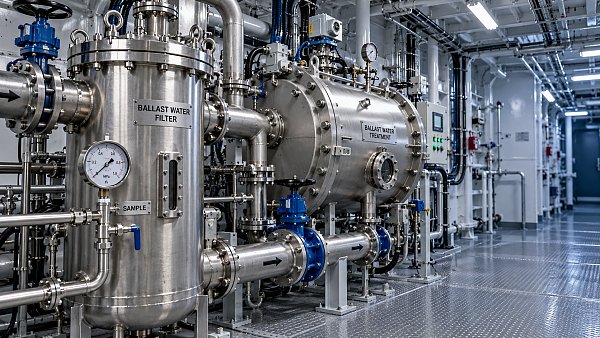
Consider a vessel loading ballast in turbid water before a short coastal passage. The decisive questions are not simply whether treatment starts and whether the display shows normal operation. Can the system maintain approved performance at the required flow? Is the passage long enough to meet any holding-time requirement? Can discharge proceed within residual-oxidant limits? These checks belong in voyage planning, not at the discharge valve.
Bypass is an exceptional event to document and manage—not an alternative treatment mode. A necessary safety action does not automatically authorize subsequent discharge of untreated ballast.
Build an inspection-ready evidence chain
Inspectors need to establish whether the approved system was available, correctly operated, and supported by credible records. A tidy certificate folder cannot resolve contradictory operational evidence.
Match vessel documents to installed equipment
Confirm that the Ballast Water Management Plan reflects the current installation, piping arrangements, sampling points, operating procedures, and contingency measures. Check the International Ballast Water Management Certificate where required, together with applicable approval certificates and installation documentation.
For IMO compliance, an installation survey includes commissioning testing under applicable requirements. This verifies the installed system’s biological performance; it is not another type-approval test. Retain the commissioning report and evidence that any deficiencies were resolved.
Reconcile records rather than merely filing them
Review ballast uptake, treatment, circulation where applicable, discharge, accidental releases, and exceptional operations against the required record-book format. Use the current IMO requirements and verify flag acceptance of any electronic record-book arrangement.
For US calls, verify ballast water reporting obligations to the National Ballast Information Clearinghouse, including applicable submission deadlines and corrections. A reporting form does not replace onboard operational records.
Cross-check tank volumes and times against pump logs, treatment-system data, alarm histories, and deck records. An unexplained mismatch may matter more during an inspection than a missing signature because it raises doubt about what actually happened.
Show that the crew can respond to abnormal conditions
A useful internal audit asks the operator to explain a recent alarm, identify the affected tanks, and show the approved response. Training should cover sensor faults, filter blockage, failed chemical dosing, low treatment intensity, neutralization problems, and loss of power—not just normal start-up.
Calibration records, maintenance history, consumables, and critical spares should support those procedures. Where sensors determine whether treatment stays within approval limits, overdue calibration is an operational compliance concern.
When treatment fails before a US port call
The most damaging response is often an improvised workaround made under schedule pressure. A safer approach preserves evidence and involves the responsible authorities early.
- Establish the facts. Identify affected tanks, water volumes, treatment status, alarms, and whether the fault compromises approved operation.
- Control the immediate risk. Follow the vessel’s safety procedures and approved management plan. Separate equipment troubleshooting from decisions about discharge authorization.
- Notify the appropriate parties. Inform company management, flag or recognized organization as applicable, and the relevant port authority or USCG Captain of the Port when required.
- Agree on an acceptable response. Possible arrangements may include retaining ballast, using a reception facility, repairing and treating through an approved procedure, or another specifically accepted measure.
- Preserve the evidence. Retain communications, system data, repair records, and the conditions attached to any authorized arrangement.
Ballast water exchange should not be assumed acceptable simply because it is physically possible. Its use depends on the applicable rules, vessel circumstances, safety considerations, and any required authority agreement.
A practical release check for quality and safety managers
Before approving a system purchase, retrofit acceptance, or voyage-readiness assessment, require clear answers to these questions:
- Which IMO, US federal, and destination-specific requirements apply to this vessel?
- Does the installed configuration match the relevant approval certificates?
- Can the system operate within approved limits throughout the planned route?
- Are commissioning, maintenance, calibration, and crew-familiarization records complete?
- Do treatment logs, ballast records, and regulatory reports tell the same operational story?
- Is there a workable contingency process with clear notification responsibilities?
Verify conclusions against the current BWM Convention instruments, flag instructions, USCG regulations and approval listings, and applicable EPA requirements. Supplier documentation is essential technical evidence, but it is not the final authority on regulatory applicability.
Effective ballast water compliance is not a choice between IMO and USCG rules. For vessels operating across both jurisdictions, it means maintaining two valid regulatory pathways around one real installation. The strongest control is a traceable connection between approval, equipment condition, operating decisions, and records—before the vessel reaches the next port.
Recommended for You
 Smart MetersTamil Nadu Plans SIM-Based Upgrade for 17.7 Million Smart MetersTamil Nadu plans 17.7 million smart meters with proposed SIM-based upgrades. Explore potential supplier opportunities and the tender details still to come.By: Dr. Elena VoltNov 22, 2026
 Fiber LasersFiber Laser CE Marking: EU Safety Requirements and DocumentationFiber laser CE compliance goes beyond the mark. Explore EU safety requirements, essential documentation and practical checks before purchasing.By: Dr. Hideo TanakaNov 22, 2026
 Grid ResilienceUS Grid Equipment Shortages Could Hinder $1 Trillion UpgradeUS grid equipment shortages could hinder a $1 trillion upgrade. Explore how transformer supply, data centers and rising power demand could affect grid projects.By: Dr. Elena VoltNov 21, 2026
 Digital SeaChoosing Bluetooth Speakers: Sound Quality, Battery Life and PortabilityBluetooth speakers come in all shapes and sizes. Learn how to compare sound quality, battery life and portability to find the right fit for your listening needs.By: Captain Kenji SatoNov 21, 2026
 Subsea ROV/AUV2025 Ocean Equipment Report: China's Industry Moves Toward Scaled ApplicationChina's marine equipment industry is moving toward scaled application. Explore what the 2025 Ocean Equipment Report could mean for buyers, suppliers and offshore projects.By: Captain Kenji SatoNov 20, 2026
 Digital SeaChoosing a Thermoforming Vacuum Packaging Machine for Meat ProductsChoose a thermoforming vacuum packaging machine for meat with confidence. Compare sealing, film compatibility, hygiene and real-world production capacity.By: Captain Kenji SatoNov 20, 2026
 Digital SeaGreen Station Certification Cost: Fees and Budget ConsiderationsGreen station certification cost varies by scheme and site. Explore fees, hidden expenses, and budgeting tips to plan confidently and compare providers.By: Captain Kenji SatoNov 19, 2026
 UHV TransformersLIMiK Capital to Invest $328 Million in South Carolina Transformer PlantLIMiK Capital plans a $327.7 million transformer plant in South Carolina. Explore its potential impact on US grid supply and procurement.By: Dr. Elena VoltNov 18, 2026
 Digital SeaHow to Choose STEM Kits for Kids by Age, Interests, and Skill LevelChoose STEM kits that match your child's age, interests, and skills. Explore safety tips, project ideas, and practical checks to find an engaging fit.By: Captain Kenji SatoNov 18, 2026
 Digital SeaManufacturing Supplier Requirements: What to Include in Technical SpecificationsDiscover how manufacturing technical specifications and supplier requirements improve quality, simplify comparisons, and prevent delays with measurable acceptance criteria.By: Captain Kenji SatoNov 17, 2026
 Digital SeaChina's Environment Ministry Opens ALC Submarine Cable Project to ReviewChina's Environment Ministry opens the ALC submarine cable project's environmental assessment to review. Explore the proposed marine protection measures and what comes next.By: Captain Kenji SatoNov 16, 2026
 Precision LensesOptical Lens Surface Roughness Testing: Methods and Ra InterpretationOptical lens surface roughness testing explained: compare measurement methods, interpret Ra values, and define reliable acceptance criteria.By: Dr. Hideo TanakaNov 16, 2026
 Digital SeaBusiness Growth Strategies: How to Choose the Right Path for Your CompanyExplore business growth strategies and learn how to compare market opportunities, costs, risks, and capabilities to choose the right path for your company.By: Captain Kenji SatoNov 15, 2026
 Smart MetersIndia’s Competition Commission Approves Adani Acquisition of IntelliSmartExplore the reported CCI approval of Adani’s IntelliSmart acquisition and what a larger Indian smart meter platform could mean for suppliers and investors.By: Dr. Elena VoltNov 14, 2026
 Digital SeaHow Does a Ballast Cleaner Screening System Separate Track Ballast?Discover how a ballast cleaner screening system separates reusable stone from fines, what affects performance, and how to assess the results.By: Captain Kenji SatoNov 14, 2026
 Smart MetersPakistan to Seek World Bank and ADB Funding for Smart MetersPakistan seeks World Bank and ADB funding for smart meters on distribution transformers. Explore the plan to tackle power theft and improve grid efficiency.By: Dr. Elena VoltNov 13, 2026
 Digital SeaWhat Is Precision Medicine and How Does It Guide Treatment?Discover how precision medicine uses biomarkers and genetic insights to guide treatment, where it can help, and what to ask before testing.By: Captain Kenji SatoNov 13, 2026
 Grid Resilience2026 CSEE Annual Meeting Opens with Focus on AI and Power SystemsThe 2026 CSEE Annual Meeting explores AI, low-carbon power systems and ultra-high-voltage transmission. Discover why these discussions matter.By: Dr. Elena VoltNov 12, 2026
 Digital SeaShip Radar Detection Range: How Far Can It See and What Limits It?Ship radar detection range depends on more than the display scale. Discover how antenna height, weather, target size, and settings affect what radar can see.By: Captain Kenji SatoNov 12, 2026
 UHV TransformersGE Vernova to Invest $34.5 Million in Louisiana Transformer Plant ExpansionGE Vernova plans a $34.5 million transformer plant expansion in Louisiana. Explore its potential impact on North American supply and procurement.By: Dr. Elena VoltNov 11, 2026
 Digital SeaMetro Station Noise Criteria: Limits and Measurement MethodsExplore metro station noise criteria, applicable limits and measurement methods. Learn how to select metrics and assess compliance with confidence.By: Captain Kenji SatoNov 11, 2026
 Digital SeaKongsberg Maritime Unveils Arctic Hunter Unmanned Surface VesselKongsberg Maritime's Arctic Hunter unmanned surface vessel is proposed for the Royal Navy's Type 92 programme. Explore its technology and procurement implications.By: Captain Kenji SatoNov 10, 2026
 Sorting RobotsHow Accurate Is AI in Food Quality Control? Metrics and Testing MethodsExplore AI in food quality control accuracy, from recall and false negatives to validation methods. Learn how to assess real-world inspection reliability.By: Marcus SterlingNov 10, 2026
 UHV TransformersGE Vernova Selected for 6 GW HVDC Link in IndiaGE Vernova will design a 6 GW HVDC link for PGCIL, connecting Rajasthan and South Kalamb to support India's clean energy transition. Discover the project.By: Dr. Elena VoltNov 09, 2026
 Grid ResilienceEurope's Grid Compliance Standards in 2026: Generator Connection RequirementsExplore new grid compliance standards 2026 Europe projects must address, from generator connection rules to testing and documentation. Prepare for approval.By: Dr. Elena VoltNov 09, 2026
 Technical FabricsNonwoven Bonding Cost Data: Comparing Thermal and Chemical ProcessesExplore nonwoven bonding cost data to compare thermal and chemical processes, assess usable yield, and choose the best-value option for your application.By: Chloe DuboisNov 08, 2026
 Fiber LasersIndustrial Lasers to 2035: Automotive Lightweighting and Precision Welding Drive DemandExplore the industrial laser market outlook to 2035 and discover how automotive lightweighting and precision welding could shape demand and procurement.By: Dr. Hideo TanakaNov 07, 2026
 Technical FabricsChoosing Geotextile Under Railway Ballast: Key Performance RequirementsChoosing geotextile under railway ballast? Explore essential filtration, drainage, strength and durability criteria to make a confident, project-specific selection.By: Chloe DuboisNov 07, 2026
 Digital SeaChoosing Rail Welding Equipment for Maintenance: Field Conditions and Weld TypesChoose rail welding equipment for maintenance with confidence. Compare welding methods, field constraints, inspection needs, and lifecycle costs.By: Captain Kenji SatoNov 06, 2026
 Digital SeaIndia Broadband Forum Urges Stronger Submarine Cable ResilienceIndia’s submarine cable resilience is in focus as the Broadband India Forum urges faster repairs, more vessels and stronger landing infrastructure.By: Captain Kenji SatoNov 06, 2026
 Digital SeaChoosing a Railway Network Switch Supplier: Reliability and Support CriteriaChoosing a railway network switch supplier? Compare reliability, standards evidence, cybersecurity, and lifecycle support to reduce project risk.By: Captain Kenji SatoNov 05, 2026