BDI: 1,842 ▼ 1.2%
COTTON NO.2: 84.12 ▲ 0.4%
LME COPPER: 8,432.50 ▲ 2.1%
FOOD SAFETY INDEX: 94.2 ARCHIVE_SECURED
OPTICAL INDEX: 11,204.09 STABLE
BDI: 1,842 ▼ 1.2%
SECTOR INDEX
V.24.08 ARCHIVE
Hot Articles
- When Is a Straddle Monorail System a Good Fit for Urban Transit Corridors?Is a straddle monorail system right for your urban corridor? Explore capacity, space, station access, safety, and lifecycle costs to make a confident transit investment.
- EU Textile Waste Reporting: Who Must Report and What Data Is Required?EU textile waste reporting explained: discover who must report, what data is required, and how to verify EPR, waste records, and shipment compliance across EU markets.
- Yarn Strength Benchmarks for Weaving: Setting Warp and Weft RequirementsSet yarn strength benchmarks for weaving with practical warp and weft criteria. Learn how tenacity, variability, and loom loads inform specifications that help reduce breaks and improve reliability.
What Switching Frequency Changes Inside a Traction Inverter


In electric drive systems, traction inverter switching frequency influences far more than just waveform control. It affects motor noise, thermal load, efficiency, EMI behavior, and even component lifespan. For operators and technical users, understanding what changes inside a traction inverter helps connect performance shifts with real-world operating conditions, maintenance needs, and system reliability.
Why does traction inverter switching frequency matter so much in daily operation?
At a basic level, traction inverter switching frequency is the rate at which power semiconductor devices inside the inverter turn on and off to shape voltage and current for the traction motor. That sounds like a control detail, but for users and operators it becomes a practical performance variable. When the switching frequency changes, the inverter does not simply “run faster” or “run slower.” Instead, the entire electrical and thermal behavior of the drive can shift.
A higher traction inverter switching frequency usually produces a smoother current waveform. That can reduce torque ripple, improve acoustic comfort, and help the motor feel more refined at low and medium speed. However, the tradeoff is increased switching loss inside IGBTs, MOSFETs, or SiC devices. Those extra losses become heat, and heat affects cooling demand, derating risk, and long-term reliability.
A lower switching frequency often reduces switching loss and may improve inverter efficiency under certain load conditions. Yet it can also increase harmonic content, motor vibration, audible whine, and stress on connected components. For operators, this means that a frequency setting or design choice can show up as noise, thermal alarms, reduced efficiency, or unexpected maintenance patterns rather than an obvious control-system label.
That is why traction inverter switching frequency gets attention in electric vehicles, rail systems, industrial mobility platforms, and heavy-duty electrified equipment. It sits at the intersection of comfort, power quality, energy use, and hardware durability.
What actually changes inside a traction inverter when switching frequency increases or decreases?
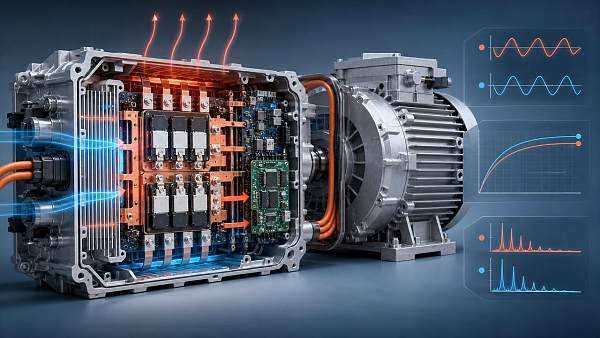
Inside the traction inverter, several things change at once. The first is semiconductor behavior. Every switching event creates turn-on and turn-off losses. As traction inverter switching frequency rises, the number of those events per second rises too. Even if conduction loss remains similar, total power loss can increase substantially because the device is switching more often.
The second change is thermal distribution. More switching loss means more heat in power modules, busbars, gate drivers, and nearby structures. Cooling plates and fans or liquid loops may need to work harder. If thermal design margin is limited, frequent high-load operation at elevated switching frequency can push junction temperatures higher, accelerating semiconductor aging and solder fatigue.
The third change is output waveform quality. Higher switching frequency generally improves PWM resolution and reduces low-order harmonic distortion seen by the motor. This can lower torque pulsation and improve control smoothness. In traction applications where start-stop behavior, low-speed control, and ride comfort matter, that can be valuable.
The fourth change is electromagnetic behavior. A traction inverter switching frequency adjustment can move EMI energy into different bands and change how strongly the cable, enclosure, grounding path, and motor system radiate or conduct noise. In practice, this may affect sensors, communication lines, and compliance with EMC requirements.
The fifth change is motor-side stress. Faster switching edges can increase dv/dt exposure at motor terminals, especially in long-cable installations. While waveform smoothing may improve one aspect of performance, insulation stress and bearing current risk may require closer review depending on topology and hardware design.
How does traction inverter switching frequency affect noise, smoothness, and efficiency in the real world?
This is often the question operators care about most, because the effects are visible and audible. When traction inverter switching frequency is low, the motor may produce a more noticeable tonal sound. In passenger-facing systems, that can become a comfort issue. In industrial traction equipment, it may not matter as much for passenger experience, but it can still signal a rougher harmonic profile.
As switching frequency increases, motor current becomes smoother and mechanical response can feel more controlled. That is particularly useful in low-speed creeping, precision positioning, hill starts, and repeated acceleration cycles. Operators may notice less vibration and fewer abrupt transitions. In systems where the traction motor works near sensitive loads or precision mechanical assemblies, smoother torque can also reduce secondary wear.
Efficiency, however, is more complicated than many people assume. A common mistake is believing that higher traction inverter switching frequency always means better performance overall. In reality, improved waveform quality may help motor-side efficiency in some operating zones, but inverter-side switching losses usually rise. The net result depends on duty cycle, cooling design, semiconductor material, DC bus voltage, and motor characteristics.
For example, an application that spends much of its time at partial load and low speed may benefit from smoother control and acceptable thermal margin at a higher switching frequency. A high-power traction system running sustained load for long periods may prioritize lower switching loss to protect thermal headroom. This is why practical evaluation should focus on the actual operating profile, not a single “best” frequency number.
Which users or operating scenarios are most sensitive to switching frequency changes?
Not every application reacts in the same way. Systems with strict acoustic expectations are usually highly sensitive. Passenger EVs, urban mobility platforms, and premium transport equipment often value lower audible noise and smoother motor feel, so traction inverter switching frequency becomes part of user experience, not just electrical design.
Heavy-load or continuous-duty platforms are sensitive for another reason: heat. Mining vehicles, logistics movers, rail traction units, port equipment, and industrial electric drivetrains may operate for long intervals at high current. In these cases, higher switching frequency can raise thermal stress enough to affect derating limits or cooling system utilization. Operators may see this as reduced peak availability during hot conditions.
Long-cable installations, electrically noisy environments, and systems with dense control electronics also deserve extra attention. Here, a traction inverter switching frequency change can alter EMI behavior and insulation stress in ways that are not obvious from dashboard performance alone. Maintenance teams may notice intermittent sensor faults, communication instability, or unexplained nuisance trips before anyone links the issue back to switching conditions.
Applications using advanced semiconductor materials such as silicon carbide can also behave differently. Because SiC devices support faster switching and lower losses than many conventional solutions, the acceptable traction inverter switching frequency window may expand. Even so, faster edges can increase EMI and dv/dt concerns, so “more capable device” does not mean “no need for system-level review.”
How can operators judge whether the current switching frequency is helping or hurting the system?
Operators do not always have direct access to inverter programming, but they can still identify patterns. Start by watching four areas together: thermal behavior, acoustic behavior, efficiency trend, and fault history. Looking at only one metric can be misleading.
If motor sound becomes sharper or more tonal while thermal performance improves, the system may be operating at a lower traction inverter switching frequency. If the vehicle or machine feels smoother but power electronics temperatures climb faster under comparable load, frequency may be higher or modulation behavior may have changed. If EMI-related issues increase after a software update or hardware replacement, frequency and switching edge characteristics should be reviewed alongside grounding and shielding.
The table below summarizes common observations and what they may suggest. It is not a substitute for engineering diagnosis, but it helps users connect symptoms to likely inverter behavior.
What are the most common misunderstandings about traction inverter switching frequency?
One major misunderstanding is that there is a universal ideal setting. In reality, the best traction inverter switching frequency depends on the motor, power stage, cooling system, cable length, EMC requirements, and duty profile. A value that works well in a light commercial EV may not be right for rail traction or industrial mobility equipment.
Another misconception is that higher frequency always means newer or better technology. It may indicate a design optimized for smoothness or acoustic control, but if the thermal budget is weak, the result can be increased losses and reduced long-term robustness. Performance must be judged at system level.
A third mistake is focusing only on the inverter and forgetting the motor and wiring. Changes in traction inverter switching frequency can influence insulation stress, common-mode current, and bearing current behavior. This becomes especially important in long harness layouts or harsh electromagnetic environments.
Some users also assume that if no fault code appears, no problem exists. But gradual thermal aging, solder fatigue, capacitor stress, or acoustic degradation may develop long before a clear alarm is triggered. Trend monitoring is more useful than waiting for a hard failure.
If you need to evaluate, procure, or optimize a traction inverter, what should you confirm first?
Start with the operating profile. Ask how much time the system spends at low speed, peak torque, cruising load, regenerative braking, and high ambient temperature. Without that duty-cycle picture, traction inverter switching frequency discussions stay too theoretical to guide a good decision.
Next, confirm what matters most in the application: efficiency, acoustic comfort, thermal margin, EMC stability, or hardware lifespan. These goals can compete with each other. A high switching frequency strategy might support smooth operation and lower torque ripple, while a lower one may better preserve thermal headroom in continuous-duty service.
Then review the power-device platform and cooling architecture. The practical range for traction inverter switching frequency depends heavily on whether the inverter uses IGBT, silicon MOSFET, or SiC technology, as well as the effectiveness of the cooling loop. It is also important to ask whether switching frequency is fixed, adaptive, or mode-dependent across the speed and load map.
Finally, verify supporting system details: motor insulation class, cable length, shielding quality, grounding design, filter strategy, and EMC compliance targets. These factors often determine whether a theoretically attractive switching strategy remains reliable in field use.
If you need to move from general understanding to a practical plan, the first conversations should focus on load profile, acceptable noise level, thermal limits, semiconductor type, EMC environment, maintenance expectations, and whether the application prioritizes peak performance or long-duration reliability. Clarifying those points early makes it much easier to judge the right traction inverter switching frequency direction, compare suppliers, and avoid costly mismatches in deployment.
Recommended for You
 Digital SeaWhen Is a Straddle Monorail System a Good Fit for Urban Transit Corridors?Is a straddle monorail system right for your urban corridor? Explore capacity, space, station access, safety, and lifecycle costs to make a confident transit investment.By: Captain Kenji SatoOct 19, 2026
 Fabric LogicEU Textile Waste Reporting: Who Must Report and What Data Is Required?EU textile waste reporting explained: discover who must report, what data is required, and how to verify EPR, waste records, and shipment compliance across EU markets.By: Chloe DuboisOct 18, 2026
 Fabric LogicYarn Strength Benchmarks for Weaving: Setting Warp and Weft RequirementsSet yarn strength benchmarks for weaving with practical warp and weft criteria. Learn how tenacity, variability, and loom loads inform specifications that help reduce breaks and improve reliability.By: Chloe DuboisOct 17, 2026
 Fabric LogicEnergy-Saving Textile Machinery: How to Calculate Payback for Your MillEvaluate energy saving textile machinery with a practical payback formula, real-world cost factors, and a worked example. Discover how to verify savings and invest confidently in your mill.By: Chloe DuboisOct 16, 2026
 Digital SeaETSC Adoption in Europe: Policy Drivers, Costs, and Implementation BarriersExplore ETSC adoption Europe-wide: uncover policy drivers, installed costs, and implementation barriers to evaluate solar thermal investments and identify projects with stronger returns.By: Captain Kenji SatoOct 15, 2026
 Digital SeaChoosing Semiconductor Solutions for Industrial Controls: Key Design CriteriaChoose semiconductor solutions for industrial controls with confidence. Explore key criteria for timing, accuracy, power, safety, and lifecycle support to make smarter design decisions.By: Captain Kenji SatoOct 14, 2026
 Aseptic FillingWhen Should Compliance Checks Start for Aseptic Filling Procurement?How early should compliance checks start in procurement planning? Learn why aseptic filling reviews should begin before supplier shortlisting to reduce risks, rework, and costly delays.By: Marcus SterlingOct 13, 2026
 Smart MetersHow Do You Assess Market Demand Before Sourcing New Smart Meters?How do I assess market demand before sourcing a new industrial product? Discover how to validate smart meter demand, check technical fit, and reduce inventory risk before committing to bulk orders.By: Dr. Elena VoltOct 13, 2026
 GIS SwitchgearWhat Should You Compare Besides Price When Selecting GIS Switchgear?What should I compare besides price when selecting an industrial product? Explore GIS switchgear ratings, IEC compliance, maintenance and lifecycle costs to make a confident procurement decision.By: Dr. Elena VoltOct 13, 2026
 Optical SensorsHow Do You Choose Optical Sensors for Harsh Industrial Environments?How do I choose components for harsh industrial environments? Discover how to select optical sensors for dust, heat, vibration, and washdown—and prevent costly missed detections.By: Dr. Hideo TanakaOct 13, 2026
 Marine WinchesWhich Operating Conditions Can Change Marine Winch Selection?Which industrial application conditions can change product selection? Explore how loads, sea state, duty cycle and power shape marine winch selection to make a smarter investment.By: Captain Kenji SatoOct 13, 2026
 Digital SeaChoosing a Seismic Survey Equipment Distributor: Lead Times and Spare PartsChoosing a seismic survey equipment distributor? Learn how to verify lead times, secure critical spare parts, and compare support to reduce downtime and buy with confidence.By: Captain Kenji SatoOct 13, 2026
 Digital SeaHow to Use Industrial Benchmarking Data to Evaluate Supplier Risk and CapabilityIndustrial benchmarking data for supplier evaluation helps buyers assess capability, compliance, capacity, and delivery risk. Learn how to make smarter, evidence-based sourcing decisions.By: Captain Kenji SatoOct 12, 2026
 Fabric LogicFashion Supply Chain Cost Trends: What Is Driving Margins in 2026?Fashion supply chain cost trends for 2026: discover how materials, freight, labor, compliance, and inventory are reshaping margins—and the strategies leaders need to protect profitability.By: Chloe DuboisOct 11, 2026
 Lumen VisionHow Smart Street Lighting Cuts Energy Use Without Compromising Road SafetySmart street lighting reduces energy use while protecting road safety through adaptive controls, reliable monitoring, and risk-based lighting design. Learn the key strategies.By: Dr. Hideo TanakaOct 10, 2026
 Digital SeaDouble Platinum Spark Plugs: When Their Longer Service Life Justifies the CostDouble platinum spark plugs offer longer service life, stable gaps, and lower labor costs. Learn when their premium price is worth it for your vehicle.By: Captain Kenji SatoOct 08, 2026
 Sorting RobotsHow to Benchmark Linear Guide Load Ratings for High-Cycle Automation AxesLinear guide load rating benchmarks for high-cycle automation axes: compare loads, moments, stiffness, lubrication, and life calculations to select reliable guides.By: Marcus SterlingOct 07, 2026
 Digital SeaWhich Rail Data Transparency Metrics Improve Capacity Planning and Service Reliability?Rail data transparency metrics reveal usable capacity, dwell, recovery, and asset risks—helping rail leaders plan more reliable, resilient services.By: Captain Kenji SatoOct 06, 2026
 Digital SeaHow to Select a Marine Piston Air Compressor for High-Demand Shipboard ServiceMarine piston air compressor selection guide for high-demand shipboard service—compare capacity, redundancy, air quality, maintenance, and compliance requirements.By: Captain Kenji SatoOct 05, 2026
 Grid ResilienceIEC 61850 Monitoring Latency: How to Set Performance Limits for Protection SystemsIEC 61850 monitoring latency explained: learn how to set, test, and verify end-to-end performance limits that protect critical GOOSE and Sampled Values systems.By: Dr. Elena VoltOct 04, 2026
 Digital SeaHow to Select Bulldozers by Blade Type, Ground Conditions, and Earthmoving OutputBulldozers selection made practical: compare blade types, track setups, ground conditions, and cycle output to choose the right dozer for lower costs and reliable earthmoving.By: Captain Kenji SatoOct 03, 2026
 Dyeing MachinesHow Sustainable Dyeing Cuts Water Use and Chemical Risk in Textile ProductionSustainable dyeing cuts water use and chemical risk through smarter liquor control, efficient rinsing, safer inputs, and repeatable textile quality.By: Chloe DuboisOct 02, 2026
 Optical SensorsSingle-Mode Fiber Loss in Railway Networks: Causes, Budgets, and Test MethodsSingle mode railway fiber loss explained: identify causes, calculate realistic loss budgets, and apply OTDR and insertion-loss tests for reliable rail networks.By: Dr. Hideo TanakaOct 01, 2026
 Digital SeaIntegrated Transit Hub Planning: How to Balance Passenger Flow and Future CapacityIntegrated transit hub planning strategies for balancing passenger flow, resilient operations, phased delivery, and future capacity—explore practical insights for smarter hubs.By: Captain Kenji SatoSep 30, 2026
 Digital SeaWhat to Evaluate When Selecting a MaaS Ticketing Platform for Multimodal NetworksMaaS ticketing platform selection guide: evaluate interoperability, fare control, settlement, resilience, privacy, and scalability for multimodal networks.By: Captain Kenji SatoSep 29, 2026
 Digital SeaWhat Does Train Control Center Software Cost? Budgeting for Integration and SupportTrain control center software cost explained: compare integration, cybersecurity, commissioning, and long-term support to build a realistic rail operations budget.By: Captain Kenji SatoSep 28, 2026
 Digital SeaWhat to Evaluate in Thermite Rail Welding Equipment for Field Track RepairsThermite rail welding equipment: evaluate compatibility, preheating, alignment, safety, and supplier support for reliable field track repairs.By: Captain Kenji SatoSep 27, 2026
 Aseptic FillingISO 22000 Food Safety Certification: What Food Manufacturers Must PrepareISO 22000 food safety certification: discover the essential steps manufacturers need to build a robust FSMS, control hazards, and prepare confidently for audit success.By: Marcus SterlingSep 26, 2026
 UHV TransformersWhat Makes an Electrification Factory Ready for High-Voltage Equipment Production?Electrification factory readiness for high-voltage equipment: discover the essential standards, testing, traceability, safety, and workforce controls that drive reliable production.By: Dr. Elena VoltSep 25, 2026
 Digital SeaRail Signal Visibility: Sighting Distance, Contrast, and Verification RequirementsRail signal visibility: learn how sighting distance, contrast, weather, and verification controls help ensure safe, compliant signal recognition.By: Captain Kenji SatoSep 24, 2026
![]() GIS SwitchgearHow Do You Compare GIS Switchgear Suppliers When Certifications Differ?How do I compare industrial suppliers when certifications are not equivalent? Learn how to assess GIS switchgear test evidence, compliance scope, traceability, and project risk.By: Dr. Elena VoltSep 24, 2026
GIS SwitchgearHow Do You Compare GIS Switchgear Suppliers When Certifications Differ?How do I compare industrial suppliers when certifications are not equivalent? Learn how to assess GIS switchgear test evidence, compliance scope, traceability, and project risk.By: Dr. Elena VoltSep 24, 2026