BDI: 1,842 ▼ 1.2%
COTTON NO.2: 84.12 ▲ 0.4%
LME COPPER: 8,432.50 ▲ 2.1%
FOOD SAFETY INDEX: 94.2 ARCHIVE_SECURED
OPTICAL INDEX: 11,204.09 STABLE
BDI: 1,842 ▼ 1.2%

SECTOR INDEX
V.24.08 ARCHIVE
Hot Articles
- Kongsberg Maritime Unveils Arctic Hunter Unmanned Surface VesselKongsberg Maritime's Arctic Hunter unmanned surface vessel is proposed for the Royal Navy's Type 92 programme. Explore its technology and procurement implications.
- How Accurate Is AI in Food Quality Control? Metrics and Testing MethodsExplore AI in food quality control accuracy, from recall and false negatives to validation methods. Learn how to assess real-world inspection reliability.
- GE Vernova Selected for 6 GW HVDC Link in IndiaGE Vernova will design a 6 GW HVDC link for PGCIL, connecting Rajasthan and South Kalamb to support India's clean energy transition. Discover the project.
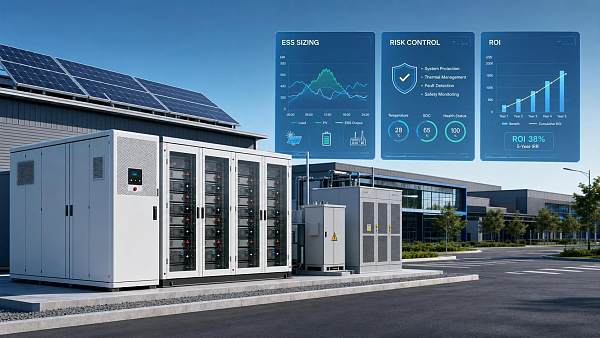
ESS in Commercial and Industrial Projects: Key Sizing Factors, Risks, and ROI


ESS in Commercial and Industrial Projects: Key Sizing Factors, Risks, and ROI
For commercial and industrial stakeholders, ESS decisions directly affect project economics, operational resilience, and long-term competitiveness.
This article examines how ESS sizing, risk control, and ROI logic connect in real project environments.
The goal is practical clarity.
A well-sized ESS can reduce peak demand charges, support backup power, improve power quality, and strengthen energy strategy.
Why ESS Sizing Matters in C&I Projects
An ESS is not simply a battery added to a facility.
It is a system decision that shapes operating cost, resilience, asset utilization, and compliance risk.
In practice, poor ESS sizing creates two common outcomes.
- The ESS is too small and misses the targeted savings window.
- The ESS is too large and ties up capital with weak utilization.
That is why energy capacity alone is not enough.
A serious ESS assessment must balance power rating, discharge duration, cycling behavior, and future operating conditions.
From a portfolio view, ESS value is strongest when technical sizing matches the business objective from day one.
The Main Factors That Determine ESS Size
Sizing an ESS starts with load behavior, not vendor preference.
The most reliable projects build around measured data, operating patterns, and tariff structure.
1. Load Profile and Peak Demand
This is usually the first sizing input.
A factory with short, sharp peaks needs different ESS behavior than a cold storage site with long evening demand.
Fifteen-minute interval data is often the minimum for useful modeling.
2. Power Versus Energy Requirement
ESS projects are often framed in kW and kWh, but the distinction matters.
Power covers how fast the ESS can respond.
Energy defines how long that support can continue.
Peak shaving may need high power for short periods.
Backup support usually needs longer duration.
3. Tariff Design and Revenue Logic
An ESS designed for time-of-use arbitrage will not match one designed for demand charge reduction.
Some sites benefit from both.
Others gain more from resilience or production continuity than from pure electricity savings.
4. Renewable Integration
When solar PV is involved, ESS sizing changes again.
The system may store excess midday generation, increase self-consumption, and reduce export curtailment.
This also means the dispatch model must reflect seasonal irradiance and weekend production patterns.
5. Expansion and Future Load Growth
A static ESS design can become inefficient quickly.
Facilities adding EV charging, electrified heat, or new production lines should model future demand before locking the ESS scope.
This is especially relevant in industrial parks and multi-tenant commercial assets.
Operational Risks That Can Undermine ESS Performance
A strong ESS business case can still fail in execution.
The most expensive problems usually come from assumptions that looked reasonable early on.
Battery Degradation Risk
Every ESS degrades over time.
High cycling frequency, ambient temperature, and aggressive depth of discharge can reduce usable capacity faster than expected.
A realistic model should include end-of-life capacity assumptions, not nameplate values only.
Safety and Compliance Risk
ESS safety cannot be treated as an add-on.
Thermal management, fire suppression, ventilation, and enclosure design affect insurance, permitting, and asset availability.
International alignment with IEC, UL, and local authority rules is essential.
Control Strategy Risk
A capable ESS still depends on software logic.
If the EMS dispatch strategy is weak, the ESS may miss price windows, charge at the wrong time, or protect the wrong load.
That often turns a bankable model into disappointing field performance.
Grid and Interconnection Risk
Some ESS delays come from utility approval, transformer constraints, or protection scheme revisions.
In actual business cases, these issues can change commissioning dates and payback timelines more than battery pricing does.
Early interconnection review is one of the simplest ways to protect ESS ROI.
How to Evaluate ESS ROI More Accurately
ESS ROI should never be reduced to one savings line.
The better approach is stacked value analysis.
That means testing all realistic benefits, then discounting them by operational constraints.
Core ROI Drivers
- Demand charge reduction from shaving peak intervals.
- Energy arbitrage under time-of-use tariffs.
- Higher solar self-consumption and lower curtailment.
- Backup value for critical processes and uptime protection.
- Deferred grid upgrade or transformer reinforcement.
Costs That Need Real Attention
Capital expense is only part of the picture.
A grounded ESS ROI model should include PCS, EMS, integration, civil works, permitting, maintenance, augmentation, and replacement planning.
Insurance premiums and financing terms also matter more than many early studies assume.
A Practical ROI View
When these factors are tested together, ESS ROI becomes much more credible for internal approval and external financing.
A Step-by-Step Framework for Better ESS Decisions
In multi-site or high-load projects, a structured decision process usually outperforms quick vendor-led sizing.
- Collect interval load data, tariff details, outage history, and expansion plans.
- Define the primary ESS objective before comparing hardware.
- Model multiple ESS sizes under best-case, base-case, and stress-case scenarios.
- Review safety codes, interconnection constraints, and site conditions early.
- Validate ROI with degradation, control strategy, and maintenance assumptions.
- Procure against measurable performance guarantees, not brochure claims.
This approach is particularly relevant for global industrial buyers managing energy exposure across different regulatory environments.
It also fits the broader G-MCE view that technical benchmarking and commercial intelligence should work together, not separately.
Final Takeaway for ESS Project Planning
The most successful ESS projects usually begin with a simple discipline.
Size the ESS around real operating behavior, then pressure-test the risk and ROI model before procurement.
That sounds obvious, yet many projects still start from equipment availability instead of project logic.
A disciplined ESS evaluation can reveal where the strongest value really sits.
Sometimes it is tariff savings.
Sometimes it is uptime protection, solar utilization, or deferred infrastructure cost.
The right next step is to benchmark load, risk, and value assumptions together, then move into ESS sizing with evidence instead of estimates.
Recommended for You
 Digital SeaKongsberg Maritime Unveils Arctic Hunter Unmanned Surface VesselKongsberg Maritime's Arctic Hunter unmanned surface vessel is proposed for the Royal Navy's Type 92 programme. Explore its technology and procurement implications.By: Captain Kenji SatoNov 10, 2026
 Sorting RobotsHow Accurate Is AI in Food Quality Control? Metrics and Testing MethodsExplore AI in food quality control accuracy, from recall and false negatives to validation methods. Learn how to assess real-world inspection reliability.By: Marcus SterlingNov 10, 2026
 UHV TransformersGE Vernova Selected for 6 GW HVDC Link in IndiaGE Vernova will design a 6 GW HVDC link for PGCIL, connecting Rajasthan and South Kalamb to support India's clean energy transition. Discover the project.By: Dr. Elena VoltNov 09, 2026
 Grid ResilienceEurope's Grid Compliance Standards in 2026: Generator Connection RequirementsExplore new grid compliance standards 2026 Europe projects must address, from generator connection rules to testing and documentation. Prepare for approval.By: Dr. Elena VoltNov 09, 2026
 Technical FabricsNonwoven Bonding Cost Data: Comparing Thermal and Chemical ProcessesExplore nonwoven bonding cost data to compare thermal and chemical processes, assess usable yield, and choose the best-value option for your application.By: Chloe DuboisNov 08, 2026
 Fiber LasersIndustrial Lasers to 2035: Automotive Lightweighting and Precision Welding Drive DemandExplore the industrial laser market outlook to 2035 and discover how automotive lightweighting and precision welding could shape demand and procurement.By: Dr. Hideo TanakaNov 07, 2026
 Technical FabricsChoosing Geotextile Under Railway Ballast: Key Performance RequirementsChoosing geotextile under railway ballast? Explore essential filtration, drainage, strength and durability criteria to make a confident, project-specific selection.By: Chloe DuboisNov 07, 2026
 Digital SeaChoosing Rail Welding Equipment for Maintenance: Field Conditions and Weld TypesChoose rail welding equipment for maintenance with confidence. Compare welding methods, field constraints, inspection needs, and lifecycle costs.By: Captain Kenji SatoNov 06, 2026
 Digital SeaIndia Broadband Forum Urges Stronger Submarine Cable ResilienceIndia’s submarine cable resilience is in focus as the Broadband India Forum urges faster repairs, more vessels and stronger landing infrastructure.By: Captain Kenji SatoNov 06, 2026
 Digital SeaChoosing a Railway Network Switch Supplier: Reliability and Support CriteriaChoosing a railway network switch supplier? Compare reliability, standards evidence, cybersecurity, and lifecycle support to reduce project risk.By: Captain Kenji SatoNov 05, 2026
 Grid ResilienceUS Grid Equipment Import Ban Raises Cost and Implementation ConcernsThe US grid equipment import ban raises concerns over costs and delivery delays. Explore how unclear criteria could affect procurement and supply chains.By: Dr. Elena VoltNov 05, 2026
 Digital SeaRailway Coupler Price: How Type and Specifications Affect QuotesRailway coupler price depends on type, specifications, and order scope. Learn how to compare quotes, avoid hidden costs, and make a confident buying decision.By: Captain Kenji SatoNov 04, 2026
 Grid ResilienceGlobal Smart Grid Companies Raise $3 Billion in First Nine Months of 2026Global smart grid companies raised $3 billion in the first nine months of 2026. Explore the funding breakdown and potential implications for buyers and suppliers.By: Dr. Elena VoltNov 04, 2026
 Digital SeaChoosing Wholesale Pet Toys: How to Evaluate Suppliers and Minimum OrdersWholesale pet toys: learn how to assess suppliers, compare minimum orders and landed costs, and reduce inventory risk before you buy.By: Captain Kenji SatoNov 03, 2026
 Digital SeaSustainable Packaging Design: How to Choose Materials and Reduce WasteDiscover how sustainable packaging design helps reduce waste, protect products, and control costs with practical material choices and proven testing strategies.By: Captain Kenji SatoNov 02, 2026
 Technical FabricsUSMCA's First Joint Review Puts Textile Supply Chain Rules in FocusUSMCA's first joint review puts textile supply chain rules in focus. Explore potential impacts on origin compliance, sourcing and tariff treatment.By: Chloe DuboisNov 02, 2026
 Digital SeaManufacturing KPI Benchmarking: How to Compare Production PerformanceBenchmarking KPI manufacturing performance? Learn how to compare OEE, quality and downtime, identify meaningful gaps, and turn insights into practical improvements.By: Captain Kenji SatoNov 01, 2026
 Smart MetersCCI Approves Adani Energy Solutions' ₹305 Billion Acquisition of IntelliSmartCCI approves Adani Energy Solutions' ₹305 billion acquisition of IntelliSmart. Discover what the deal could mean for India's smart meter market.By: Dr. Elena VoltNov 01, 2026
 Digital SeaChoosing a Coin Laundry Machinery OEM: What Buyers Should EvaluateChoosing a coin laundry machinery OEM? Compare machine specifications, payment integration, lifecycle costs, and support to make a confident buying decision.By: Captain Kenji SatoOct 31, 2026
 Grid ResilienceUS Energy Department Announces $237 Million Grid SCALED Funding ProgramExplore the DOE's $237 million Grid SCALED funding program and its goals to strengthen grid equipment supply chains, lower electricity costs, and improve resilience.By: Dr. Elena VoltOct 31, 2026
 UHV TransformersA Decade of UHV Power in Shandong: Province Leads in Station NumbersShandong UHV power leads China in station numbers. Explore a decade of grid development and its implications for electricity supply and business planning.By: Dr. Elena VoltOct 30, 2026
 Digital SeaChoosing a Composite Train Body Panel Manufacturer: Fire Safety and Quality ChecksChoosing a composite train body panels manufacturer? Learn how to verify fire test evidence, audit production quality, and avoid costly approval gaps before you buy.By: Captain Kenji SatoOct 29, 2026
 Subsea ROV/AUVOcean Infinity Deploys Six AUVs Together Beyond 5,000 MetresOcean Infinity reportedly deployed six HUGIN AUVs beyond 5,200 metres. Explore what concurrent deepwater missions could mean for seabed surveys and procurement.By: Captain Kenji SatoOct 29, 2026
 Grid ResilienceRenewable Energy Grid Balancing: How Storage and Demand Response Work TogetherExplore renewable energy grid balancing with storage and demand response. Learn how coordinated controls manage shortfalls, absorb surplus power, and improve grid reliability.By: Dr. Elena VoltOct 28, 2026
 Subsea ROV/AUVSeaber Introduces 13 kg RAVEN AUV to Target Mine Countermeasure CostsSeaber’s 13 kg RAVEN AUV targets lower mine countermeasure costs with two mission configurations. Explore its potential value for naval operations and procurement.By: Captain Kenji SatoOct 28, 2026
 Digital SeaBallast Water Management Rules: IMO vs. USCG Compliance RequirementsBallast water management rules explained: compare IMO and USCG approvals, operating limits, and records. Get practical checks to reduce compliance risks and costly port delays.By: Captain Kenji SatoOct 27, 2026
 Subsea ROV/AUVEni Signs Main Cronos Contracts, Moving Gas Project into ExecutionEni’s Cronos gas project enters execution as major contracts are signed. Explore the Cyprus development, Egypt processing plans and key milestones toward first gas in 2028.By: Captain Kenji SatoOct 27, 2026
 Digital SeaBenefits of Refurbished Semiconductor Equipment: When Do Savings Justify the Risk?Explore the benefits of refurbished semiconductor equipment. Learn how to weigh savings against process risks, qualification costs, and support gaps before investing.By: Captain Kenji SatoOct 26, 2026
 Digital SeaSemiconductor Equipment Overhaul: Diagnosing Persistent Process DriftSemiconductor equipment overhaul leaving process drift unresolved? Discover how to pinpoint vacuum, sensor, thermal, and conditioning issues to restore stability and reduce repeat service calls.By: Captain Kenji SatoOct 26, 2026
 Digital SeaSemiconductor Equipment Refurbishment Process: Cleaning to QualificationExplore the semiconductor equipment refurbishment process, from precision cleaning to qualification. Learn how measurable testing helps verify production readiness and reduce risk.By: Captain Kenji SatoOct 26, 2026
 Digital SeaBidding for Offshore Decommissioning Projects: Scope and Liability ChecksBidding for offshore decommissioning projects? Discover key scope, liability, and insurance checks to avoid hidden costs, protect margins, and bid with confidence.By: Captain Kenji SatoOct 26, 2026