Custom precision lenses justify their added cost when standard optics cannot meet critical requirements for imaging accuracy, spectral performance, environmental durability, or system integration.
For procurement teams sourcing private-label optical products, the investment also raises a practical question: What risks should I check before choosing a private label manufacturer?
The answer extends beyond unit pricing to tolerance verification, coating consistency, intellectual property protection, and production scalability. Customization should solve a measurable technical or commercial problem.
This guide helps procurement directors, engineering managers, and optical product owners compare performance gains, qualification expenses, supplier risks, and lifecycle costs before committing to custom optics.
Start with the requirement a standard lens cannot meet
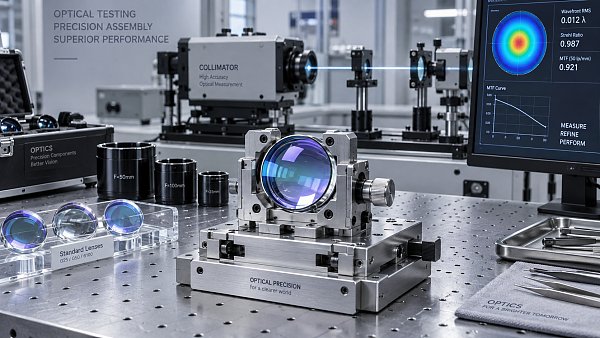
A custom lens is worthwhile when a documented limitation in available catalog optics prevents your product from achieving required performance, reliability, packaging, or production economics.
Start by defining that limitation in system terms. Examples include insufficient image contrast, excessive distortion, unacceptable laser focus variation, or transmission losses at the operating wavelength.
Translate each limitation into a measurable acceptance requirement. “Sharper images” is subjective; a specified modulation transfer function at defined field positions gives suppliers something testable.
For laser applications, specify wavelength, beam characteristics, focal requirements, and operating conditions. Damage resistance depends on exposure conditions, so an isolated threshold number is insufficient.
Check whether another catalog lens, a revised spacing arrangement, or a different mounting approach can satisfy the requirement before paying for an entirely new design.
Customization becomes easier to justify when those alternatives have been evaluated and the remaining performance gap affects customer acceptance, product differentiation, or avoidable operating costs.
Which applications create enough value to justify customization?
The strongest business cases connect optical improvements to measurable outcomes. Better specifications alone do not establish value unless they improve the performance customers actually need.
In machine vision, a tailored lens may improve edge resolution or reduce distortion enough to detect defects consistently, potentially lowering false rejects and missed defects.
However, gains depend on sensor selection, illumination, object positioning, and software. Validate the complete inspection system before attributing production improvements entirely to a new lens.
In spectroscopy and multispectral sensing, custom materials and coatings can improve transmission across required bands. Benefits may include stronger signals or reduced interference from unwanted wavelengths.
In compact instruments, a custom optical prescription or mechanical envelope may reduce assembly size. That matters when packaging constraints otherwise require expensive changes elsewhere in the product.
For harsh environments, suitable substrates, coatings, and mounting interfaces can support durability. Qualification must reflect actual temperature, humidity, vibration, contamination, and cleaning conditions throughout service.
Calculate the premium using total program cost
Comparing catalog and custom unit prices misses much of the decision. Custom programs can include optical design, tooling, coating development, prototypes, metrology, and qualification expenses.
Ask suppliers to separate nonrecurring engineering charges from recurring production prices. Clarify which charges cover development iterations and which trigger additional fees after design changes.
Your internal costs also matter: engineering reviews, sample evaluation, fixture development, supplier audits, incoming inspection, and inventory commitments all consume budget before commercial production begins.
Estimate benefits conservatively using validated improvements in assembly labor, scrap, calibration time, warranty expense, throughput, or contribution margin. Avoid counting the same improvement twice financially.
A practical break-even estimate divides incremental fixed costs by the net benefit per shipped unit. That benefit must already account for the recurring custom-lens premium.
For example, assume $24,000 in incremental development costs, an $8 lens premium, and $14 in verified savings per shipped unit. Net savings equal $6 per unit.
The estimated break-even volume is therefore 4,000 shipped units. This simplified calculation excludes financing, timing, taxes, and uncertainty; evaluate those separately before approving the program.
Use downside scenarios for lower demand, delayed launches, and reduced savings. A project that works only at optimistic volumes deserves closer scrutiny before tooling commitments.
What risks should I check before choosing a private label manufacturer?
For private-label optical products, branding adds another layer of accountability. Customers associate inconsistent optical performance with your company, even when a supplier manufactured the lenses.
Determine whether the supplier performs optical fabrication and coating internally, manages subcontractors, or primarily handles assembly. Each arrangement can work if responsibilities and controls remain clear.
Review capabilities against your actual specification, including substrate processing, centering, surface form, coating uniformity, and measurement capacity. Generic precision claims do not demonstrate production readiness.
Request relevant manufacturing evidence, such as representative inspection reports and process capability data where available. Confirm that measurement methods and conditions match the requirements being quoted.
Assess financial and operational resilience through lead-time history, material availability, capacity constraints, and continuity planning. A competitive price loses value when delivery failures interrupt production.
Verify which company controls drawings, tooling, coating recipes, and inspection records. Contract terms should establish ownership, permitted use, confidentiality, and access arrangements if the relationship ends.
- Technical risk: Can the manufacturer repeatedly meet your complete specification, rather than produce a single excellent sample?
- Subcontracting risk: Which critical operations occur elsewhere, and how are changes, quality requirements, and records controlled?
- Commercial risk: Are minimum orders, cancellation terms, price adjustments, and defect remedies clearly defined?
- Continuity risk: Can you transfer production using documentation and tooling you are entitled to access?
Specify what must be measured before accepting a quote
A quote becomes meaningful only when suppliers price the same requirements. Incomplete drawings allow different assumptions about tolerances, inspection coverage, coating performance, and acceptable defects.
Specify optical material, geometry, clear aperture, focal requirements, relevant tolerances, coating performance, and mechanical interfaces. Include operating wavelengths and environmental conditions that affect optical behavior.
Use recognized standards where applicable, but identify the relevant requirements and editions. Referencing ISO 10110 drawing conventions alone does not establish every necessary acceptance criterion.
Surface appearance, surface form, and transmitted wavefront performance describe different characteristics. Select requirements according to their effect on the application, rather than treating them as interchangeable.
For coatings, define spectral acceptance limits, incidence angles, polarization conditions when relevant, and durability requirements. Confirm whether measurements use finished lenses, witness samples, or both.
Identify how disagreements will be resolved when measurement results differ. Agree on methods, equipment suitability, uncertainty considerations, and any reference laboratory before acceptance becomes disputed.
Qualify production consistency, not just prototype performance
A successful prototype demonstrates feasibility, but it may receive unusually careful processing and inspection. Production approval requires evidence that routine manufacturing can reproduce acceptable results.
Build a qualification plan covering first articles, a representative pilot run, assembly trials, and relevant environmental testing. Acceptance criteria should be agreed before samples arrive.
Ask whether pilot units use the intended production equipment, materials, subcontractors, and process sequence. Differences should be disclosed because they can limit what qualification proves.
Review variation across units and lots, rather than relying only on average performance. Small changes in centering, coating response, or geometry can affect system consistency.
Establish traceability appropriate to product risk, including material identification, production lot records, and inspection results. Traceability helps isolate defects and supports corrective action after shipment.
Require notification and approval rules for changes affecting performance, including material substitutions, coating processes, manufacturing locations, and critical subcontractors. Define when changes require renewed qualification.
Control lead-time, inventory, and replacement exposure
Custom optics often require dedicated materials or process scheduling, which can increase replenishment time. Ask for realistic lead times covering raw material procurement and production.
Separate prototype lead time from repeat-order lead time. Also clarify how capacity reservations, minimum order quantities, and demand changes affect delivery commitments and pricing terms.
Inventory planning should reflect demand variability and supply uncertainty. Excess stock ties up cash, while insufficient buffers can stop assembly when replacement lenses are unavailable.
A second source may reduce dependence, but transferring a custom design still requires compatible documentation, access rights, process development, and qualification. Budget for that work.
For serviceable products, evaluate replacement availability over the expected support period. Last-time buys, storage conditions, packaging protection, and obsolescence notices should be addressed contractually where needed.
When should you keep standard optics?
Standard lenses remain attractive when they satisfy validated requirements and offer reliable availability. Their existing documentation and purchasing flexibility can simplify development and ongoing procurement.
They are often preferable during early product exploration, when specifications or expected volumes remain uncertain. Premature customization can create redesign costs before customer needs stabilize.
Keep catalog optics when the proposed improvements have little effect on system outcomes. A tighter tolerance has limited value if another component dominates overall performance.
Consider a partially customized option before commissioning a new prescription. Modified coatings, edge treatments, mounting features, or assemblies may solve the problem with lower development expense.
Ask suppliers which options preserve established manufacturing processes. Reduced development scope can improve economics, but any changed feature still needs verification against its intended function.
Approve custom precision lenses when the evidence supports the investment
Custom precision lenses are worth the added cost when they close a consequential performance gap and deliver benefits exceeding development, production, qualification, and supply risks.
Before approval, document the unmet requirement, compare practical alternatives, validate the expected benefit, and confirm that the supplier can repeatedly manufacture and verify acceptable lenses.
For private-label programs, include ownership rights, change control, traceability, and continuity arrangements in that decision. These protections help preserve product quality throughout the commercial relationship.
The strongest purchasing decision connects optical requirements to business results. If that connection remains unproven, continue qualification or retain standard optics until the evidence improves.