BDI: 1,842 ▼ 1.2%
COTTON NO.2: 84.12 ▲ 0.4%
LME COPPER: 8,432.50 ▲ 2.1%
FOOD SAFETY INDEX: 94.2 ARCHIVE_SECURED
OPTICAL INDEX: 11,204.09 STABLE
BDI: 1,842 ▼ 1.2%

SECTOR INDEX
V.24.08 ARCHIVE
Hot Articles
- How Does a Ballast Cleaner Screening System Separate Track Ballast?Discover how a ballast cleaner screening system separates reusable stone from fines, what affects performance, and how to assess the results.
- Pakistan to Seek World Bank and ADB Funding for Smart MetersPakistan seeks World Bank and ADB funding for smart meters on distribution transformers. Explore the plan to tackle power theft and improve grid efficiency.
- What Is Precision Medicine and How Does It Guide Treatment?Discover how precision medicine uses biomarkers and genetic insights to guide treatment, where it can help, and what to ask before testing.
F Theta Lens Europe Suppliers: How to Compare Lead Time, Coating Options, and MOQ


Why are f theta lens Europe suppliers compared so carefully?
Choosing among f theta lens Europe suppliers usually starts with price, but the decision rarely ends there.
In precision optics procurement, a low quote can become expensive when lead times slip, coatings mismatch the laser source, or MOQ terms lock capital into slow-moving stock.
That is why buyers often compare European sources through three filters together: delivery reliability, optical coating suitability, and order flexibility.
An f theta lens is not a generic accessory. It shapes field performance, spot consistency, scanning accuracy, and thermal behavior inside laser marking, engraving, welding, and sensing systems.
In practical terms, the supplier decision affects both machine uptime and downstream quality.
This matters even more in cross-sector sourcing models such as G-MCE, where optics decisions connect with wider manufacturing, infrastructure, and compliance workflows.
When technical benchmarking is tied to ISO, IEC, or ASTM-aligned evaluation habits, the lens supplier is judged as part of a broader risk system, not a standalone purchase.
So the better question is not simply which quote is lowest. It is which supplier profile fits the application, schedule, and sourcing strategy with the fewest surprises.
What should be confirmed before requesting quotes?
Many quote comparisons fail because the technical input is incomplete.
Before contacting f theta lens Europe suppliers, define the operating window clearly enough that each quotation covers the same scope.
The essential items usually include wavelength, focal length, scan field, entrance aperture, power density, lens material, and expected mounting interface.
If the application involves high-speed galvo systems, edge distortion tolerance and spot size consistency should also be stated early.
Coating requirements need special attention. A lens designed for 1064 nm may not perform correctly for 355 nm or 10.6 um systems, even when the mechanics appear compatible.
More common than people expect is a partially correct quote based on assumed wavelength.
Lead time should also be framed precisely. Ask whether the quoted timing covers finished goods, coating in progress, substrate availability, and final inspection.
MOQ questions should go beyond unit count. It helps to ask whether MOQ changes by coating type, custom housing, or private labeling.
A useful short checklist looks like this:
- Laser wavelength and power range
- Required field size and focal length
- Damage threshold and coating expectations
- Tolerance for delivery variance
- Forecast volume for 3, 6, and 12 months
- Need for test samples or pilot lots
Once those points are fixed, quote comparison becomes much cleaner.
How do lead time, coating options, and MOQ change the real cost?
This is where many sourcing decisions shift.
Among f theta lens Europe suppliers, the quoted unit price may differ by a moderate percentage, while total supply cost differs much more because of schedule behavior and ordering constraints.
Lead time matters first because optical components often sit on the critical path.
If a machine builder waits on one lens to complete integration, a delayed shipment can affect revenue recognition, installation windows, and service planning.
Coating options matter because they directly affect transmission efficiency, thermal load, reflection loss, and durability in specific environments.
A supplier with broader coating capability may reduce technical risk, even if the nominal price is higher.
MOQ affects both cash flow and flexibility. A high minimum can be manageable in stable production, but it becomes a burden during design revisions, customer-specific configurations, or uncertain demand.
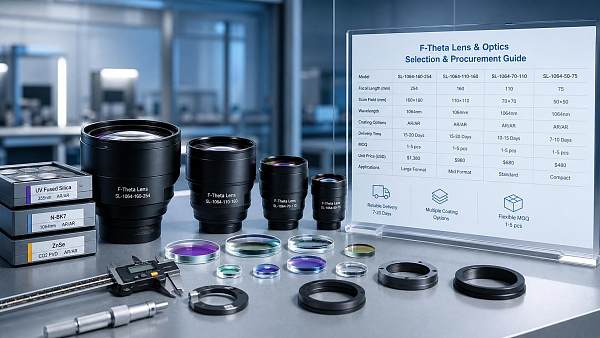
The table below helps compare the three factors in a practical way.
A supplier that performs well across these three items is often more competitive than one with the cheapest opening quote.
Are all European coating options really interchangeable?
Not at all, and this is one of the most expensive assumptions in optics sourcing.
F theta lens Europe suppliers may offer similar wording on datasheets, yet coating stacks, substrate preparation, and environmental durability can differ in meaningful ways.
For UV systems, coating stability and contamination sensitivity deserve extra scrutiny.
For fiber laser applications around 1064 nm, damage threshold and thermal handling usually become the priority.
CO2 systems introduce a different material and coating logic altogether.
In actual sourcing reviews, a better approach is to ask for performance evidence under the intended operating band rather than relying on broad labels such as “high transmission” or “industrial grade.”
Useful supporting data may include transmission curves, reflectance range, coating durability notes, scratch-dig specification, and any cleaning limitations.
This is where a benchmarking mindset helps. G-MCE’s cross-disciplinary model is relevant because it treats specification language, standards alignment, and supply resilience as one connected evaluation process.
That same discipline works well for precision optics.
If two suppliers appear close on paper, request clarification on these points:
- Designed wavelength versus usable wavelength range
- Transmission level at the required angle and field
- Resistance to thermal drift in long production cycles
- Cleaning and handling limits after installation
Those answers often reveal more than the headline quote.
When does MOQ become a risk instead of a discount advantage?
MOQ looks attractive when volume rebates are clear and demand is stable.
It becomes risky when the lens specification may change, customer programs are still qualifying, or multiple laser platforms share similar but not identical optical needs.
With some f theta lens Europe suppliers, standard models can be ordered in low quantities, while custom coatings or mechanical adaptations trigger higher minimums.
That split matters because many projects begin with mixed demand: a few pieces for validation, then a short production run, then larger repeat orders if the system performs as planned.
A rigid MOQ can distort the whole sourcing plan.
The more reliable way to judge MOQ is to compare it against forecast confidence.
If annual demand is still uncertain, negotiate sample quantity, pilot-lot pricing, and reorder protection before accepting a bulk threshold.
It also helps to ask whether the supplier can reserve substrate or coating capacity without forcing immediate full-volume purchase.
That kind of flexibility is often more valuable than a narrow unit-price reduction.
How can you compare f theta lens Europe suppliers without missing hidden risks?
A structured comparison works better than a simple quote spreadsheet.
Start by separating technical fit from commercial fit. A supplier must pass both.
On the technical side, check wavelength matching, optical design, coating evidence, field quality, and documentation depth.
On the commercial side, compare lead time credibility, MOQ flexibility, lot traceability, communication speed, and terms around replacement or nonconformance.
One practical method is to build a weighted scorecard.
- Technical conformity: 35%
- Lead time reliability: 25%
- Coating suitability: 20%
- MOQ and commercial flexibility: 15%
- After-sales responsiveness: 5%
The exact weighting can change, but the discipline is useful.
It prevents overreaction to one attractive price point.
Another helpful step is to ask each shortlisted supplier the same clarifying questions. Consistent questioning makes inconsistent answers easier to spot.
For teams using multi-market intelligence platforms, this mirrors the broader G-MCE approach: benchmark against common criteria, then decide with both technical and commercial evidence in view.
What is the smartest next step before placing an order?
Shortlist two or three f theta lens Europe suppliers and move from quote gathering to validation.
At that stage, the key is not collecting more brochures. It is confirming whether the lens, the coating, and the delivery promise all hold under your real operating assumptions.
Where possible, review sample availability, request documentation for coating performance, and verify how lead time changes between standard and custom configurations.
If the order may scale, discuss volume bands early instead of reopening negotiations after qualification.
The strongest sourcing decisions usually come from a simple discipline: define the optical requirement precisely, compare lead time with evidence, and treat MOQ as a planning variable rather than a discount headline.
That approach reduces surprise costs and makes supplier selection more resilient.
For anyone evaluating f theta lens Europe suppliers, the next useful move is to build a side-by-side checklist around coating fit, delivery variance, and minimum order flexibility before issuing the final purchase decision.
Recommended for You
 Digital SeaHow Does a Ballast Cleaner Screening System Separate Track Ballast?Discover how a ballast cleaner screening system separates reusable stone from fines, what affects performance, and how to assess the results.By: Captain Kenji SatoNov 14, 2026
 Smart MetersPakistan to Seek World Bank and ADB Funding for Smart MetersPakistan seeks World Bank and ADB funding for smart meters on distribution transformers. Explore the plan to tackle power theft and improve grid efficiency.By: Dr. Elena VoltNov 13, 2026
 Digital SeaWhat Is Precision Medicine and How Does It Guide Treatment?Discover how precision medicine uses biomarkers and genetic insights to guide treatment, where it can help, and what to ask before testing.By: Captain Kenji SatoNov 13, 2026
 Grid Resilience2026 CSEE Annual Meeting Opens with Focus on AI and Power SystemsThe 2026 CSEE Annual Meeting explores AI, low-carbon power systems and ultra-high-voltage transmission. Discover why these discussions matter.By: Dr. Elena VoltNov 12, 2026
 Digital SeaShip Radar Detection Range: How Far Can It See and What Limits It?Ship radar detection range depends on more than the display scale. Discover how antenna height, weather, target size, and settings affect what radar can see.By: Captain Kenji SatoNov 12, 2026
 UHV TransformersGE Vernova to Invest $34.5 Million in Louisiana Transformer Plant ExpansionGE Vernova plans a $34.5 million transformer plant expansion in Louisiana. Explore its potential impact on North American supply and procurement.By: Dr. Elena VoltNov 11, 2026
 Digital SeaMetro Station Noise Criteria: Limits and Measurement MethodsExplore metro station noise criteria, applicable limits and measurement methods. Learn how to select metrics and assess compliance with confidence.By: Captain Kenji SatoNov 11, 2026
 Digital SeaKongsberg Maritime Unveils Arctic Hunter Unmanned Surface VesselKongsberg Maritime's Arctic Hunter unmanned surface vessel is proposed for the Royal Navy's Type 92 programme. Explore its technology and procurement implications.By: Captain Kenji SatoNov 10, 2026
 Sorting RobotsHow Accurate Is AI in Food Quality Control? Metrics and Testing MethodsExplore AI in food quality control accuracy, from recall and false negatives to validation methods. Learn how to assess real-world inspection reliability.By: Marcus SterlingNov 10, 2026
 UHV TransformersGE Vernova Selected for 6 GW HVDC Link in IndiaGE Vernova will design a 6 GW HVDC link for PGCIL, connecting Rajasthan and South Kalamb to support India's clean energy transition. Discover the project.By: Dr. Elena VoltNov 09, 2026
 Grid ResilienceEurope's Grid Compliance Standards in 2026: Generator Connection RequirementsExplore new grid compliance standards 2026 Europe projects must address, from generator connection rules to testing and documentation. Prepare for approval.By: Dr. Elena VoltNov 09, 2026
 Technical FabricsNonwoven Bonding Cost Data: Comparing Thermal and Chemical ProcessesExplore nonwoven bonding cost data to compare thermal and chemical processes, assess usable yield, and choose the best-value option for your application.By: Chloe DuboisNov 08, 2026
 Fiber LasersIndustrial Lasers to 2035: Automotive Lightweighting and Precision Welding Drive DemandExplore the industrial laser market outlook to 2035 and discover how automotive lightweighting and precision welding could shape demand and procurement.By: Dr. Hideo TanakaNov 07, 2026
 Technical FabricsChoosing Geotextile Under Railway Ballast: Key Performance RequirementsChoosing geotextile under railway ballast? Explore essential filtration, drainage, strength and durability criteria to make a confident, project-specific selection.By: Chloe DuboisNov 07, 2026
 Digital SeaChoosing Rail Welding Equipment for Maintenance: Field Conditions and Weld TypesChoose rail welding equipment for maintenance with confidence. Compare welding methods, field constraints, inspection needs, and lifecycle costs.By: Captain Kenji SatoNov 06, 2026
 Digital SeaIndia Broadband Forum Urges Stronger Submarine Cable ResilienceIndia’s submarine cable resilience is in focus as the Broadband India Forum urges faster repairs, more vessels and stronger landing infrastructure.By: Captain Kenji SatoNov 06, 2026
 Digital SeaChoosing a Railway Network Switch Supplier: Reliability and Support CriteriaChoosing a railway network switch supplier? Compare reliability, standards evidence, cybersecurity, and lifecycle support to reduce project risk.By: Captain Kenji SatoNov 05, 2026
 Grid ResilienceUS Grid Equipment Import Ban Raises Cost and Implementation ConcernsThe US grid equipment import ban raises concerns over costs and delivery delays. Explore how unclear criteria could affect procurement and supply chains.By: Dr. Elena VoltNov 05, 2026
 Digital SeaRailway Coupler Price: How Type and Specifications Affect QuotesRailway coupler price depends on type, specifications, and order scope. Learn how to compare quotes, avoid hidden costs, and make a confident buying decision.By: Captain Kenji SatoNov 04, 2026
 Grid ResilienceGlobal Smart Grid Companies Raise $3 Billion in First Nine Months of 2026Global smart grid companies raised $3 billion in the first nine months of 2026. Explore the funding breakdown and potential implications for buyers and suppliers.By: Dr. Elena VoltNov 04, 2026
 Digital SeaChoosing Wholesale Pet Toys: How to Evaluate Suppliers and Minimum OrdersWholesale pet toys: learn how to assess suppliers, compare minimum orders and landed costs, and reduce inventory risk before you buy.By: Captain Kenji SatoNov 03, 2026
 Digital SeaSustainable Packaging Design: How to Choose Materials and Reduce WasteDiscover how sustainable packaging design helps reduce waste, protect products, and control costs with practical material choices and proven testing strategies.By: Captain Kenji SatoNov 02, 2026
 Technical FabricsUSMCA's First Joint Review Puts Textile Supply Chain Rules in FocusUSMCA's first joint review puts textile supply chain rules in focus. Explore potential impacts on origin compliance, sourcing and tariff treatment.By: Chloe DuboisNov 02, 2026
 Digital SeaManufacturing KPI Benchmarking: How to Compare Production PerformanceBenchmarking KPI manufacturing performance? Learn how to compare OEE, quality and downtime, identify meaningful gaps, and turn insights into practical improvements.By: Captain Kenji SatoNov 01, 2026
 Smart MetersCCI Approves Adani Energy Solutions' ₹305 Billion Acquisition of IntelliSmartCCI approves Adani Energy Solutions' ₹305 billion acquisition of IntelliSmart. Discover what the deal could mean for India's smart meter market.By: Dr. Elena VoltNov 01, 2026
 Digital SeaChoosing a Coin Laundry Machinery OEM: What Buyers Should EvaluateChoosing a coin laundry machinery OEM? Compare machine specifications, payment integration, lifecycle costs, and support to make a confident buying decision.By: Captain Kenji SatoOct 31, 2026
 Grid ResilienceUS Energy Department Announces $237 Million Grid SCALED Funding ProgramExplore the DOE's $237 million Grid SCALED funding program and its goals to strengthen grid equipment supply chains, lower electricity costs, and improve resilience.By: Dr. Elena VoltOct 31, 2026
 UHV TransformersA Decade of UHV Power in Shandong: Province Leads in Station NumbersShandong UHV power leads China in station numbers. Explore a decade of grid development and its implications for electricity supply and business planning.By: Dr. Elena VoltOct 30, 2026
 Digital SeaChoosing a Composite Train Body Panel Manufacturer: Fire Safety and Quality ChecksChoosing a composite train body panels manufacturer? Learn how to verify fire test evidence, audit production quality, and avoid costly approval gaps before you buy.By: Captain Kenji SatoOct 29, 2026
 Subsea ROV/AUVOcean Infinity Deploys Six AUVs Together Beyond 5,000 MetresOcean Infinity reportedly deployed six HUGIN AUVs beyond 5,200 metres. Explore what concurrent deepwater missions could mean for seabed surveys and procurement.By: Captain Kenji SatoOct 29, 2026
 Grid ResilienceRenewable Energy Grid Balancing: How Storage and Demand Response Work TogetherExplore renewable energy grid balancing with storage and demand response. Learn how coordinated controls manage shortfalls, absorb surplus power, and improve grid reliability.By: Dr. Elena VoltOct 28, 2026