BDI: 1,842 ▼ 1.2%
COTTON NO.2: 84.12 ▲ 0.4%
LME COPPER: 8,432.50 ▲ 2.1%
FOOD SAFETY INDEX: 94.2 ARCHIVE_SECURED
OPTICAL INDEX: 11,204.09 STABLE
BDI: 1,842 ▼ 1.2%

SECTOR INDEX
V.24.08 ARCHIVE
Hot Articles
- How Does a Ballast Cleaner Screening System Separate Track Ballast?Discover how a ballast cleaner screening system separates reusable stone from fines, what affects performance, and how to assess the results.
- Pakistan to Seek World Bank and ADB Funding for Smart MetersPakistan seeks World Bank and ADB funding for smart meters on distribution transformers. Explore the plan to tackle power theft and improve grid efficiency.
- What Is Precision Medicine and How Does It Guide Treatment?Discover how precision medicine uses biomarkers and genetic insights to guide treatment, where it can help, and what to ask before testing.
How to Evaluate 400G Transceiver Performance: Key Metrics for Speed, Reach, and Power


Evaluating 400G transceiver performance starts with a simple correction: line rate alone says very little about field readiness.
A module may meet a 400G label, yet still create risk through unstable lanes, limited reach, thermal strain, or weak interoperability.
That matters across industrial networks where optics support control, sensing, storage, and data exchange under tight uptime expectations.
Within G-MCE’s cross-sector benchmarking model, 400g transceiver performance is not viewed as an isolated networking issue.
It connects directly to infrastructure resilience, standards compliance, and the practical economics of high-value technical assets.
Why 400G performance deserves closer scrutiny
In many environments, 400G links now sit between demanding workloads, not just between generic switches.
They may carry machine-vision feeds, process data, edge analytics, or synchronization traffic across sites with different temperature, density, and latency constraints.
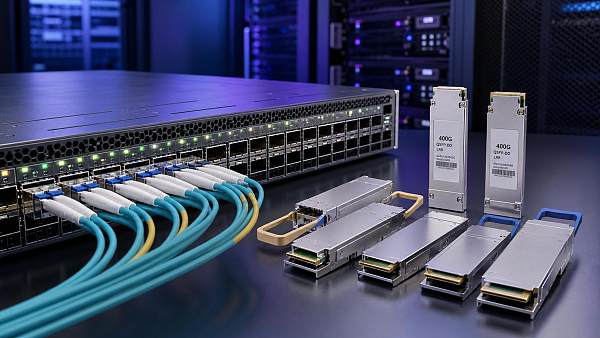
For that reason, 400g transceiver performance should be judged by how reliably the module behaves inside an actual architecture.
This is especially relevant in sectors linked to precision optics, smart grid systems, industrial automation, and maritime electronics.
Each of those settings values deterministic behavior more than headline throughput on a datasheet.
What “performance” really includes at 400G
A useful evaluation combines electrical integrity, optical behavior, protocol compliance, thermal stability, and operating efficiency.
In practice, the question is not whether the module can transmit 400 gigabits.
The real question is whether it can sustain that rate across the required distance, within power limits, and without driving error rates upward.
That broader view helps separate nominal compatibility from deployable performance.
Speed is more than aggregate bandwidth
Most 400G modules achieve total throughput through multiple lanes, often using PAM4 modulation.
This increases capacity, but it also raises sensitivity to signal noise, insertion loss, and equalization limits.
So when reviewing 400g transceiver performance, lane stability matters as much as the total rate.
Reach depends on application context
Short-reach links inside data halls face different challenges than metro, campus, or industrial backbone connections.
Reach claims should always be checked against fiber type, connector loss, patching complexity, and expected link margin.
Power affects both cost and reliability
Higher power draw increases operating expense, but the more immediate issue is heat concentration in dense chassis.
If cooling is uneven, optical output and error behavior can drift long before failure becomes obvious.
The metrics that carry the most decision value
Several measurements consistently reveal whether a 400G module will perform well beyond the lab.
The table below highlights the most useful review points.
Among these, BER trends often reveal problems earlier than pass-or-fail acceptance testing.
A module that depends heavily on forward error correction may operate, but with a smaller buffer against aging, contamination, or thermal drift.
Standards, form factors, and compatibility checks
Meaningful 400g transceiver performance evaluation should always include standards alignment.
IEEE 802.3, MSA definitions, and vendor interoperability notes provide the baseline, but field compatibility still needs confirmation.
QSFP-DD and OSFP platforms may support similar rates while behaving differently in thermal profiles and port density planning.
In mixed environments, EEPROM coding, host firmware, breakout use, and switch qualification lists can influence results as much as optics design.
This is where a benchmarking mindset, similar to G-MCE’s multi-standard review approach, becomes useful.
The objective is not just standards compliance on paper, but traceable confidence across platforms and operating conditions.
Questions worth asking during compatibility review
- Does the module pass host validation without unsupported feature flags?
- Are diagnostic readings stable across different switch vendors?
- Is the specified reach based on clean lab links or realistic channel loss?
- Does thermal throttling appear in dense front-panel deployment?
Where application context changes the evaluation
The same module may look excellent in one use case and marginal in another.
That is why 400g transceiver performance should be mapped to workload, topology, and service expectations before final comparison.
High-density switching fabrics
In dense racks, power per port and airflow discipline dominate the decision.
A slightly cheaper module can become costly if it forces lower port utilization or more aggressive cooling.
Industrial backbones and campus links
Here, reach margin and environmental stability usually outweigh maximum packing density.
Connector contamination, vibration, and temperature fluctuation become more significant than nominal throughput.
Optical and sensing ecosystems
In photonics-heavy environments, signal quality and timing consistency may matter more than raw traffic volume.
That aligns with G-MCE’s focus on precision benchmarking across optics and advanced industrial hardware.
A practical method for comparing modules
A disciplined review process usually produces better decisions than a feature checklist.
The goal is to compare modules under the same assumptions, not under marketing labels.
- Define the real channel: fiber type, connectors, distance, patch panels, and target margin.
- Measure BER, optical power, temperature, and power draw during sustained traffic.
- Repeat tests in high-density port occupancy, not only single-port conditions.
- Check DOM accuracy and alarm behavior for maintenance usefulness.
- Review interoperability logs, not only pass statements from datasheets.
- Document standards references and any vendor-specific limitations.
This method creates a more durable basis for selection, especially when procurement, compliance, and lifecycle planning intersect.
What to carry into the next evaluation cycle
Strong 400g transceiver performance is rarely about a single impressive number.
It comes from balanced behavior across speed integrity, reach margin, thermal control, and platform compatibility.
For organizations comparing network hardware across multiple industrial contexts, that balance is what protects uptime and capital efficiency.
A useful next step is to build a scoring framework around real channel conditions, standards references, and operating limits.
Once those criteria are fixed, comparing 400g transceiver performance becomes less subjective and far more actionable.
Recommended for You
 Digital SeaHow Does a Ballast Cleaner Screening System Separate Track Ballast?Discover how a ballast cleaner screening system separates reusable stone from fines, what affects performance, and how to assess the results.By: Captain Kenji SatoNov 14, 2026
 Smart MetersPakistan to Seek World Bank and ADB Funding for Smart MetersPakistan seeks World Bank and ADB funding for smart meters on distribution transformers. Explore the plan to tackle power theft and improve grid efficiency.By: Dr. Elena VoltNov 13, 2026
 Digital SeaWhat Is Precision Medicine and How Does It Guide Treatment?Discover how precision medicine uses biomarkers and genetic insights to guide treatment, where it can help, and what to ask before testing.By: Captain Kenji SatoNov 13, 2026
 Grid Resilience2026 CSEE Annual Meeting Opens with Focus on AI and Power SystemsThe 2026 CSEE Annual Meeting explores AI, low-carbon power systems and ultra-high-voltage transmission. Discover why these discussions matter.By: Dr. Elena VoltNov 12, 2026
 Digital SeaShip Radar Detection Range: How Far Can It See and What Limits It?Ship radar detection range depends on more than the display scale. Discover how antenna height, weather, target size, and settings affect what radar can see.By: Captain Kenji SatoNov 12, 2026
 UHV TransformersGE Vernova to Invest $34.5 Million in Louisiana Transformer Plant ExpansionGE Vernova plans a $34.5 million transformer plant expansion in Louisiana. Explore its potential impact on North American supply and procurement.By: Dr. Elena VoltNov 11, 2026
 Digital SeaMetro Station Noise Criteria: Limits and Measurement MethodsExplore metro station noise criteria, applicable limits and measurement methods. Learn how to select metrics and assess compliance with confidence.By: Captain Kenji SatoNov 11, 2026
 Digital SeaKongsberg Maritime Unveils Arctic Hunter Unmanned Surface VesselKongsberg Maritime's Arctic Hunter unmanned surface vessel is proposed for the Royal Navy's Type 92 programme. Explore its technology and procurement implications.By: Captain Kenji SatoNov 10, 2026
 Sorting RobotsHow Accurate Is AI in Food Quality Control? Metrics and Testing MethodsExplore AI in food quality control accuracy, from recall and false negatives to validation methods. Learn how to assess real-world inspection reliability.By: Marcus SterlingNov 10, 2026
 UHV TransformersGE Vernova Selected for 6 GW HVDC Link in IndiaGE Vernova will design a 6 GW HVDC link for PGCIL, connecting Rajasthan and South Kalamb to support India's clean energy transition. Discover the project.By: Dr. Elena VoltNov 09, 2026
 Grid ResilienceEurope's Grid Compliance Standards in 2026: Generator Connection RequirementsExplore new grid compliance standards 2026 Europe projects must address, from generator connection rules to testing and documentation. Prepare for approval.By: Dr. Elena VoltNov 09, 2026
 Technical FabricsNonwoven Bonding Cost Data: Comparing Thermal and Chemical ProcessesExplore nonwoven bonding cost data to compare thermal and chemical processes, assess usable yield, and choose the best-value option for your application.By: Chloe DuboisNov 08, 2026
 Fiber LasersIndustrial Lasers to 2035: Automotive Lightweighting and Precision Welding Drive DemandExplore the industrial laser market outlook to 2035 and discover how automotive lightweighting and precision welding could shape demand and procurement.By: Dr. Hideo TanakaNov 07, 2026
 Technical FabricsChoosing Geotextile Under Railway Ballast: Key Performance RequirementsChoosing geotextile under railway ballast? Explore essential filtration, drainage, strength and durability criteria to make a confident, project-specific selection.By: Chloe DuboisNov 07, 2026
 Digital SeaChoosing Rail Welding Equipment for Maintenance: Field Conditions and Weld TypesChoose rail welding equipment for maintenance with confidence. Compare welding methods, field constraints, inspection needs, and lifecycle costs.By: Captain Kenji SatoNov 06, 2026
 Digital SeaIndia Broadband Forum Urges Stronger Submarine Cable ResilienceIndia’s submarine cable resilience is in focus as the Broadband India Forum urges faster repairs, more vessels and stronger landing infrastructure.By: Captain Kenji SatoNov 06, 2026
 Digital SeaChoosing a Railway Network Switch Supplier: Reliability and Support CriteriaChoosing a railway network switch supplier? Compare reliability, standards evidence, cybersecurity, and lifecycle support to reduce project risk.By: Captain Kenji SatoNov 05, 2026
 Grid ResilienceUS Grid Equipment Import Ban Raises Cost and Implementation ConcernsThe US grid equipment import ban raises concerns over costs and delivery delays. Explore how unclear criteria could affect procurement and supply chains.By: Dr. Elena VoltNov 05, 2026
 Digital SeaRailway Coupler Price: How Type and Specifications Affect QuotesRailway coupler price depends on type, specifications, and order scope. Learn how to compare quotes, avoid hidden costs, and make a confident buying decision.By: Captain Kenji SatoNov 04, 2026
 Grid ResilienceGlobal Smart Grid Companies Raise $3 Billion in First Nine Months of 2026Global smart grid companies raised $3 billion in the first nine months of 2026. Explore the funding breakdown and potential implications for buyers and suppliers.By: Dr. Elena VoltNov 04, 2026
 Digital SeaChoosing Wholesale Pet Toys: How to Evaluate Suppliers and Minimum OrdersWholesale pet toys: learn how to assess suppliers, compare minimum orders and landed costs, and reduce inventory risk before you buy.By: Captain Kenji SatoNov 03, 2026
 Digital SeaSustainable Packaging Design: How to Choose Materials and Reduce WasteDiscover how sustainable packaging design helps reduce waste, protect products, and control costs with practical material choices and proven testing strategies.By: Captain Kenji SatoNov 02, 2026
 Technical FabricsUSMCA's First Joint Review Puts Textile Supply Chain Rules in FocusUSMCA's first joint review puts textile supply chain rules in focus. Explore potential impacts on origin compliance, sourcing and tariff treatment.By: Chloe DuboisNov 02, 2026
 Digital SeaManufacturing KPI Benchmarking: How to Compare Production PerformanceBenchmarking KPI manufacturing performance? Learn how to compare OEE, quality and downtime, identify meaningful gaps, and turn insights into practical improvements.By: Captain Kenji SatoNov 01, 2026
 Smart MetersCCI Approves Adani Energy Solutions' ₹305 Billion Acquisition of IntelliSmartCCI approves Adani Energy Solutions' ₹305 billion acquisition of IntelliSmart. Discover what the deal could mean for India's smart meter market.By: Dr. Elena VoltNov 01, 2026
 Digital SeaChoosing a Coin Laundry Machinery OEM: What Buyers Should EvaluateChoosing a coin laundry machinery OEM? Compare machine specifications, payment integration, lifecycle costs, and support to make a confident buying decision.By: Captain Kenji SatoOct 31, 2026
 Grid ResilienceUS Energy Department Announces $237 Million Grid SCALED Funding ProgramExplore the DOE's $237 million Grid SCALED funding program and its goals to strengthen grid equipment supply chains, lower electricity costs, and improve resilience.By: Dr. Elena VoltOct 31, 2026
 UHV TransformersA Decade of UHV Power in Shandong: Province Leads in Station NumbersShandong UHV power leads China in station numbers. Explore a decade of grid development and its implications for electricity supply and business planning.By: Dr. Elena VoltOct 30, 2026
 Digital SeaChoosing a Composite Train Body Panel Manufacturer: Fire Safety and Quality ChecksChoosing a composite train body panels manufacturer? Learn how to verify fire test evidence, audit production quality, and avoid costly approval gaps before you buy.By: Captain Kenji SatoOct 29, 2026
 Subsea ROV/AUVOcean Infinity Deploys Six AUVs Together Beyond 5,000 MetresOcean Infinity reportedly deployed six HUGIN AUVs beyond 5,200 metres. Explore what concurrent deepwater missions could mean for seabed surveys and procurement.By: Captain Kenji SatoOct 29, 2026
 Grid ResilienceRenewable Energy Grid Balancing: How Storage and Demand Response Work TogetherExplore renewable energy grid balancing with storage and demand response. Learn how coordinated controls manage shortfalls, absorb surplus power, and improve grid reliability.By: Dr. Elena VoltOct 28, 2026






























