BDI: 1,842 ▼ 1.2%
COTTON NO.2: 84.12 ▲ 0.4%
LME COPPER: 8,432.50 ▲ 2.1%
FOOD SAFETY INDEX: 94.2 ARCHIVE_SECURED
OPTICAL INDEX: 11,204.09 STABLE
BDI: 1,842 ▼ 1.2%

SECTOR INDEX
V.24.08 ARCHIVE
Hot Articles
- How Does a Ballast Cleaner Screening System Separate Track Ballast?Discover how a ballast cleaner screening system separates reusable stone from fines, what affects performance, and how to assess the results.
- Pakistan to Seek World Bank and ADB Funding for Smart MetersPakistan seeks World Bank and ADB funding for smart meters on distribution transformers. Explore the plan to tackle power theft and improve grid efficiency.
- What Is Precision Medicine and How Does It Guide Treatment?Discover how precision medicine uses biomarkers and genetic insights to guide treatment, where it can help, and what to ask before testing.
How Do You Verify ISO, IEC, or ASTM Compliance for Optical Sensors?


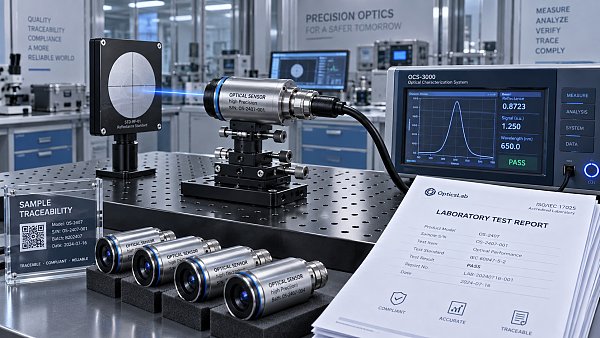
An ISO certificate does not establish that an optical sensor complies with IEC or ASTM requirements. Reliable verification requires an evidence chain connecting the applicable standard and edition, the tested configuration, the laboratory’s competence, the results, and the exact product being purchased.
The question “How can I verify whether a supplier meets ISO requirements?” therefore has two separate answers: verify the supplier’s management-system certification, then independently assess product conformity. Neither a certification logo nor a datasheet statement such as “IEC compliant” closes both questions.
Define what the sensor must comply with
Start with the sensor’s intended function, installation environment, and destination market—not with the standards listed in a supplier’s brochure. “Optical sensor” can describe a photoelectric proximity switch, a laser distance sensor, a photodiode module, or an optical measurement instrument. These products do not share one universal compliance standard.
Record the exact model, hardware revision, firmware where relevant, supply voltage, optical source, interfaces, enclosure, and intended operating conditions. Establish whether the purchase is a bare component, a finished instrument, or part of a larger machine. A component test does not automatically demonstrate compliance of the completed equipment.
Relevant standards may address different questions:
Verify each standard’s title, scope, edition, and amendments through the official ISO, IEC, or ASTM catalog. The newest international edition is not automatically the edition required by a contract or recognized under a particular market-access framework. National adoptions and transitional provisions can affect which version is appropriate.
Create a short requirements matrix linking each obligation to its source, acceptance criterion, and required evidence. Distinguish legal requirements from customer specifications and voluntary standards. This prevents a supplier from satisfying a convenient standard while leaving the actual application requirement unanswered.
Check the ISO certificate beyond its logo
ISO develops standards; it does not issue ISO 9001 certificates to suppliers. Such certificates are issued by certification bodies. Obtain the complete certificate, including any annex listing additional sites, rather than accepting a cropped image or a badge on a website.
Compare the certified legal entity and site addresses with the company manufacturing the sensor. A trading company’s certificate does not establish that its subcontracted factory operates under the same certified system. A group certificate may cover several facilities, but the relevant facility must appear within its coverage.
The scope matters equally. “Distribution of electronic components” is not equivalent to “design and manufacture of optical sensors.” If design controls are important to the purchase, establish whether design activities fall within the certified scope and how responsibilities are allocated between the supplier and the manufacturer.
Check the certificate number, issuing body, standard edition, validity dates, and current status. Authenticate it through the certification body’s official directory or direct contact using independently obtained contact details. A printed expiry date does not reveal whether certification has subsequently been suspended or withdrawn.
If accredited certification is required, verify the certification body’s accreditation with the named accreditation body and check its relevant scope. IAF CertSearch can provide an additional verification route where records are available. An unsuccessful database search alone is not conclusive evidence of fraud; unresolved discrepancies require confirmation from the issuing organization.
Require product evidence tied to the ordered configuration
A supplier declaration should identify the product, applicable standards and editions, the responsible legal entity, and the basis for the claim. Its significance depends on the conformity-assessment framework: some requirements permit manufacturer declarations, while others require third-party involvement. Do not assume that every standard requires a product certificate.
For technical verification, request the underlying reports or an appropriately controlled review of them. A one-page “certificate of compliance” may omit the conditions needed to judge the result.
The evidence package should identify:
- The tested model, sample identifiers, and relevant hardware or firmware revisions.
- The standard edition, clauses assessed, methods, and any deviations.
- The test conditions, equipment configuration, accessories, and operating modes.
- The measured results, applicable limits, and conformity conclusions.
- The report number, dates, issuing laboratory, and authorized approval.
- Any exclusions, subcontracted work, or tests outside the laboratory’s accredited scope.
Family-model coverage needs particular scrutiny. A report for one sensor may support related variants only when the differences and selection rationale are documented. Changes to emitter power, optics, enclosure, power electronics, cable length, or firmware can affect safety, electromagnetic compatibility, or environmental performance.
For example, an IP result obtained with a specified sealed connector does not establish the same protection when the ordered product uses an open cable termination. The relevant question is whether the tested assembly matches the delivered and installed assembly.
Verify the laboratory’s scope, not just its accreditation certificate
ISO/IEC 17025 accreditation supports confidence in laboratory competence, but only within the published accreditation scope. Find the laboratory in the accreditation body’s directory and obtain its current scope document.
Match the required test to the listed methods, technical fields, ranges, and laboratory location. Where a laboratory operates under a flexible scope, request the supporting current list of accredited activities. A laboratory accredited for dimensional calibration is not thereby accredited for optical radiation safety or electromagnetic compatibility testing.
International recognition can also matter in cross-border transactions. Check whether the accreditation body participates in the relevant ILAC Mutual Recognition Arrangement. This supports recognition of accredited results, but it does not override destination-market rules, contractual restrictions, or a requirement to use a specifically designated laboratory.
Authenticate significant reports directly with the laboratory, with supplier authorization where necessary. Use contact information from the laboratory’s official website or accreditation record. Confirm the report number, product identity, and whether the supplied copy is complete and unaltered.
An unaccredited report is not automatically technically invalid. However, it requires a separate assessment of competence, methods, calibration, and impartiality—and it cannot satisfy a requirement explicitly calling for accredited testing.
Read the conditions behind “pass”
A pass statement is meaningful only when the method, conditions, and acceptance criteria match the requirement. This is especially important for optical sensing, where target properties and ambient conditions can materially change performance.
For a distance or detection claim, inspect target reflectivity, target size, incidence angle, ambient illumination, temperature, supply voltage, response time, and averaging settings. A result obtained with a cooperative reference target cannot simply be transferred to dark, glossy, transparent, or angled surfaces.
Separate resolution, repeatability, and accuracy. A sensor may display small increments while showing larger systematic errors. Repeatable measurements at one distance do not establish accuracy throughout the operating range. Require results that correspond to the claimed metric and the application’s conditions.
Where electromagnetic compatibility applies, check that the chosen standard covers the product and environment. IEC 61326-1, for example, addresses electrical equipment for measurement, control, and laboratory use; it is not a universal requirement for every optical component. Review operating modes, cable arrangements, ports, and performance criteria during immunity testing. “No damage” is insufficient if interference causes unacceptable false detections or measurement drift.
For laser safety, confirm that classification addresses the finished product’s accessible emission—not merely the embedded laser component. Optics, protective housings, operating modes, and reasonably foreseeable access can affect the assessment. Integrating a laser module into another assembly may require evaluation of that assembly.
ASTM claims deserve a different question: does the cited document define a test method, a specification, or another type of standard? If it defines only a method, request the contractual acceptance limit separately. “Tested according to ASTM” does not by itself mean that a sensor meets a defined performance threshold.
For quantitative results close to a limit, review measurement uncertainty and the decision rule used to declare conformity. ISO/IEC 17025 requires the decision rule to be documented when a laboratory provides a conformity statement, subject to the standard’s provisions. The rule can determine how a borderline result is classified; a bare pass/fail label conceals that distinction.
Connect the tested sample to production deliveries
A valid report establishes evidence about the assessed samples and configuration. It does not, by itself, prove that every subsequent unit has identical characteristics.
Request the link between test samples, controlled drawings, bills of materials, firmware releases, and production identification. Serial numbers or lot codes should allow delivered sensors to be traced to relevant manufacturing and inspection records. Critical changes should trigger an assessment of whether existing evidence remains valid.
Calibration evidence serves a separate purpose. If the sensor is supplied as a measuring instrument, inspect the calibration range, uncertainty, method, and traceability statement. Traceability to a national metrology institute or the SI does not substitute for safety, EMC, or enclosure testing; likewise, those tests do not establish measurement accuracy.
The purchase agreement should define the approved configuration, required documentation, change-notification obligations, and rights to review evidence. Specify whether changes to the optical source, protective components, manufacturing site, or relevant firmware require approval or renewed testing. Incoming checks can then target identity, functionality, calibration status, and selected critical characteristics rather than attempting to repeat every qualification test.
Make acceptance depend on the evidence gap
Approve a compliance claim when the applicable requirements are defined, documents are authentic, test coverage is adequate, and the ordered configuration is traceable to the assessed product. Any remaining limitations should be recorded explicitly in the approval—not buried in correspondence.
Conditional acceptance can be appropriate when a clearly bounded gap can be closed before use, such as a missing annex or a required additional test. It is not a suitable substitute for unresolved safety classification, an unidentified manufacturing site, or evidence covering a materially different product.
Escalate claims supported only by logos, expired or mismatched certificates, unexplained model substitutions, incomplete reports, or refusal to permit confidential evidence review. Confidentiality can justify a nondisclosure agreement or controlled access; it does not make unsupported conformity claims sufficient.
The decisive question is not whether the supplier has collected recognizable certificates. It is whether verifiable evidence demonstrates that the exact sensor, in its intended configuration and conditions of use, meets the requirements governing the purchase.
Recommended for You
 Digital SeaHow Does a Ballast Cleaner Screening System Separate Track Ballast?Discover how a ballast cleaner screening system separates reusable stone from fines, what affects performance, and how to assess the results.By: Captain Kenji SatoNov 14, 2026
 Smart MetersPakistan to Seek World Bank and ADB Funding for Smart MetersPakistan seeks World Bank and ADB funding for smart meters on distribution transformers. Explore the plan to tackle power theft and improve grid efficiency.By: Dr. Elena VoltNov 13, 2026
 Digital SeaWhat Is Precision Medicine and How Does It Guide Treatment?Discover how precision medicine uses biomarkers and genetic insights to guide treatment, where it can help, and what to ask before testing.By: Captain Kenji SatoNov 13, 2026
 Grid Resilience2026 CSEE Annual Meeting Opens with Focus on AI and Power SystemsThe 2026 CSEE Annual Meeting explores AI, low-carbon power systems and ultra-high-voltage transmission. Discover why these discussions matter.By: Dr. Elena VoltNov 12, 2026
 Digital SeaShip Radar Detection Range: How Far Can It See and What Limits It?Ship radar detection range depends on more than the display scale. Discover how antenna height, weather, target size, and settings affect what radar can see.By: Captain Kenji SatoNov 12, 2026
 UHV TransformersGE Vernova to Invest $34.5 Million in Louisiana Transformer Plant ExpansionGE Vernova plans a $34.5 million transformer plant expansion in Louisiana. Explore its potential impact on North American supply and procurement.By: Dr. Elena VoltNov 11, 2026
 Digital SeaMetro Station Noise Criteria: Limits and Measurement MethodsExplore metro station noise criteria, applicable limits and measurement methods. Learn how to select metrics and assess compliance with confidence.By: Captain Kenji SatoNov 11, 2026
 Digital SeaKongsberg Maritime Unveils Arctic Hunter Unmanned Surface VesselKongsberg Maritime's Arctic Hunter unmanned surface vessel is proposed for the Royal Navy's Type 92 programme. Explore its technology and procurement implications.By: Captain Kenji SatoNov 10, 2026
 Sorting RobotsHow Accurate Is AI in Food Quality Control? Metrics and Testing MethodsExplore AI in food quality control accuracy, from recall and false negatives to validation methods. Learn how to assess real-world inspection reliability.By: Marcus SterlingNov 10, 2026
 UHV TransformersGE Vernova Selected for 6 GW HVDC Link in IndiaGE Vernova will design a 6 GW HVDC link for PGCIL, connecting Rajasthan and South Kalamb to support India's clean energy transition. Discover the project.By: Dr. Elena VoltNov 09, 2026
 Grid ResilienceEurope's Grid Compliance Standards in 2026: Generator Connection RequirementsExplore new grid compliance standards 2026 Europe projects must address, from generator connection rules to testing and documentation. Prepare for approval.By: Dr. Elena VoltNov 09, 2026
 Technical FabricsNonwoven Bonding Cost Data: Comparing Thermal and Chemical ProcessesExplore nonwoven bonding cost data to compare thermal and chemical processes, assess usable yield, and choose the best-value option for your application.By: Chloe DuboisNov 08, 2026
 Fiber LasersIndustrial Lasers to 2035: Automotive Lightweighting and Precision Welding Drive DemandExplore the industrial laser market outlook to 2035 and discover how automotive lightweighting and precision welding could shape demand and procurement.By: Dr. Hideo TanakaNov 07, 2026
 Technical FabricsChoosing Geotextile Under Railway Ballast: Key Performance RequirementsChoosing geotextile under railway ballast? Explore essential filtration, drainage, strength and durability criteria to make a confident, project-specific selection.By: Chloe DuboisNov 07, 2026
 Digital SeaChoosing Rail Welding Equipment for Maintenance: Field Conditions and Weld TypesChoose rail welding equipment for maintenance with confidence. Compare welding methods, field constraints, inspection needs, and lifecycle costs.By: Captain Kenji SatoNov 06, 2026
 Digital SeaIndia Broadband Forum Urges Stronger Submarine Cable ResilienceIndia’s submarine cable resilience is in focus as the Broadband India Forum urges faster repairs, more vessels and stronger landing infrastructure.By: Captain Kenji SatoNov 06, 2026
 Digital SeaChoosing a Railway Network Switch Supplier: Reliability and Support CriteriaChoosing a railway network switch supplier? Compare reliability, standards evidence, cybersecurity, and lifecycle support to reduce project risk.By: Captain Kenji SatoNov 05, 2026
 Grid ResilienceUS Grid Equipment Import Ban Raises Cost and Implementation ConcernsThe US grid equipment import ban raises concerns over costs and delivery delays. Explore how unclear criteria could affect procurement and supply chains.By: Dr. Elena VoltNov 05, 2026
 Digital SeaRailway Coupler Price: How Type and Specifications Affect QuotesRailway coupler price depends on type, specifications, and order scope. Learn how to compare quotes, avoid hidden costs, and make a confident buying decision.By: Captain Kenji SatoNov 04, 2026
 Grid ResilienceGlobal Smart Grid Companies Raise $3 Billion in First Nine Months of 2026Global smart grid companies raised $3 billion in the first nine months of 2026. Explore the funding breakdown and potential implications for buyers and suppliers.By: Dr. Elena VoltNov 04, 2026
 Digital SeaChoosing Wholesale Pet Toys: How to Evaluate Suppliers and Minimum OrdersWholesale pet toys: learn how to assess suppliers, compare minimum orders and landed costs, and reduce inventory risk before you buy.By: Captain Kenji SatoNov 03, 2026
 Digital SeaSustainable Packaging Design: How to Choose Materials and Reduce WasteDiscover how sustainable packaging design helps reduce waste, protect products, and control costs with practical material choices and proven testing strategies.By: Captain Kenji SatoNov 02, 2026
 Technical FabricsUSMCA's First Joint Review Puts Textile Supply Chain Rules in FocusUSMCA's first joint review puts textile supply chain rules in focus. Explore potential impacts on origin compliance, sourcing and tariff treatment.By: Chloe DuboisNov 02, 2026
 Digital SeaManufacturing KPI Benchmarking: How to Compare Production PerformanceBenchmarking KPI manufacturing performance? Learn how to compare OEE, quality and downtime, identify meaningful gaps, and turn insights into practical improvements.By: Captain Kenji SatoNov 01, 2026
 Smart MetersCCI Approves Adani Energy Solutions' ₹305 Billion Acquisition of IntelliSmartCCI approves Adani Energy Solutions' ₹305 billion acquisition of IntelliSmart. Discover what the deal could mean for India's smart meter market.By: Dr. Elena VoltNov 01, 2026
 Digital SeaChoosing a Coin Laundry Machinery OEM: What Buyers Should EvaluateChoosing a coin laundry machinery OEM? Compare machine specifications, payment integration, lifecycle costs, and support to make a confident buying decision.By: Captain Kenji SatoOct 31, 2026
 Grid ResilienceUS Energy Department Announces $237 Million Grid SCALED Funding ProgramExplore the DOE's $237 million Grid SCALED funding program and its goals to strengthen grid equipment supply chains, lower electricity costs, and improve resilience.By: Dr. Elena VoltOct 31, 2026
 UHV TransformersA Decade of UHV Power in Shandong: Province Leads in Station NumbersShandong UHV power leads China in station numbers. Explore a decade of grid development and its implications for electricity supply and business planning.By: Dr. Elena VoltOct 30, 2026
 Digital SeaChoosing a Composite Train Body Panel Manufacturer: Fire Safety and Quality ChecksChoosing a composite train body panels manufacturer? Learn how to verify fire test evidence, audit production quality, and avoid costly approval gaps before you buy.By: Captain Kenji SatoOct 29, 2026
 Subsea ROV/AUVOcean Infinity Deploys Six AUVs Together Beyond 5,000 MetresOcean Infinity reportedly deployed six HUGIN AUVs beyond 5,200 metres. Explore what concurrent deepwater missions could mean for seabed surveys and procurement.By: Captain Kenji SatoOct 29, 2026
 Grid ResilienceRenewable Energy Grid Balancing: How Storage and Demand Response Work TogetherExplore renewable energy grid balancing with storage and demand response. Learn how coordinated controls manage shortfalls, absorb surplus power, and improve grid reliability.By: Dr. Elena VoltOct 28, 2026