BDI: 1,842 ▼ 1.2%
COTTON NO.2: 84.12 ▲ 0.4%
LME COPPER: 8,432.50 ▲ 2.1%
FOOD SAFETY INDEX: 94.2 ARCHIVE_SECURED
OPTICAL INDEX: 11,204.09 STABLE
BDI: 1,842 ▼ 1.2%

SECTOR INDEX
V.24.08 ARCHIVE
Hot Articles
- How Does a Ballast Cleaner Screening System Separate Track Ballast?Discover how a ballast cleaner screening system separates reusable stone from fines, what affects performance, and how to assess the results.
- Pakistan to Seek World Bank and ADB Funding for Smart MetersPakistan seeks World Bank and ADB funding for smart meters on distribution transformers. Explore the plan to tackle power theft and improve grid efficiency.
- What Is Precision Medicine and How Does It Guide Treatment?Discover how precision medicine uses biomarkers and genetic insights to guide treatment, where it can help, and what to ask before testing.
How to Select a Cooled Infrared Camera for Long-Range Thermal Inspection


A cooled infrared camera earns its cost only when the inspection task requires useful thermal information at a distance where an uncooled system cannot provide enough detail, contrast, or measurement confidence. For long-range work, a high detector resolution alone is not a sufficient reason to specify cooling. The selection should start with the smallest defect or target feature that must be recognized, the distance at which it must be seen, and the operating conditions that can degrade the thermal signal before it reaches the sensor.
This distinction matters for technical evaluators working around high-voltage assets, offshore equipment, industrial process lines, perimeter monitoring points, and other installations where access is limited or unsafe. A camera that produces a sharp thermal image on a short indoor demonstration may still fail to support a reliable field decision at several hundred metres, through humid air, across a hot background, or while mounted on a moving platform.
Start with the inspection decision, not the camera specification sheet
Long-range thermal inspection has several different objectives, and each one creates a different requirement. Detecting that a large transformer bay is warmer than its surroundings is far less demanding than identifying an overheated connector within that bay. Locating a vessel at night, tracking a moving hot object, confirming a flare condition, and quantifying a temperature anomaly on a fixed industrial component are also different tasks.
Before comparing models, define what the operator must be able to do at the maximum working range:
- Detect the presence of a thermal target.
- Recognize the target as a particular class of object or asset.
- Identify a specific component, fault location, or abnormal condition.
- Measure temperature or compare temperature trends with enough confidence to trigger maintenance action.
These are not interchangeable. A target may be detectable while remaining too small to classify. It may be recognizable as electrical equipment while still lacking enough pixels for an operator to distinguish a bushing connection from a nearby structural element. For condition monitoring, the issue is stricter: the inspected area must occupy enough of the image, remain stable enough during acquisition, and be observed under conditions suitable for thermal interpretation.
A practical specification should therefore state the target dimensions, expected temperature difference from the background, distance band, viewing angle, and minimum decision required. “Long range” without these details invites suppliers to optimize around favourable assumptions that may not match the installation.
Choose the spectral band around the target, atmosphere, and measurement objective
A cooled infrared camera commonly uses an indium antimonide, mercury cadmium telluride, or related high-performance detector, typically operating in the mid-wave infrared (MWIR) or long-wave infrared (LWIR) region. Cooling reduces detector noise and supports high sensitivity, rapid imaging, and demanding optical configurations. That does not make every cooled camera suitable for every long-distance thermal task.
MWIR systems are often considered when the target is hot, fast-moving, or observed at significant range. Many high-temperature industrial processes emit strongly in this region, and MWIR optics can support relatively narrow fields of view with compact high-performance lenses. Such systems can be valuable for furnace monitoring, combustion-related observation, gas-turbine inspection, maritime surveillance, and certain long-range security or tracking roles.
LWIR systems can be appropriate for targets nearer to ambient temperature, including electrical assets, building envelopes, process equipment, and personnel or vehicles in low-light conditions. However, the usable result depends heavily on the atmospheric path, the optics, the target emissivity, and the measurement method. Neither band should be chosen through a simple rule such as “MWIR is for distance” or “LWIR is for inspection.”
Atmospheric transmission deserves early attention. Water vapour, fog, rain, smoke, dust, heat shimmer, and airborne emissions can reduce contrast or distort an apparent hot spot. A very long focal-length lens can magnify the target, but it also magnifies atmospheric disturbance and platform vibration. For a fixed installation, review representative environmental conditions at the intended line of sight rather than relying on a single clear-weather range claim.
Where radiometric temperature measurement is required, ask the supplier to distinguish between image quality and measurement capability. A camera may deliver excellent imagery while still requiring careful correction for emissivity, reflected temperature, transmission losses, distance, and viewing geometry before its temperature readings can support a maintenance threshold.
Calculate pixel coverage with the final lens, not with detector resolution alone
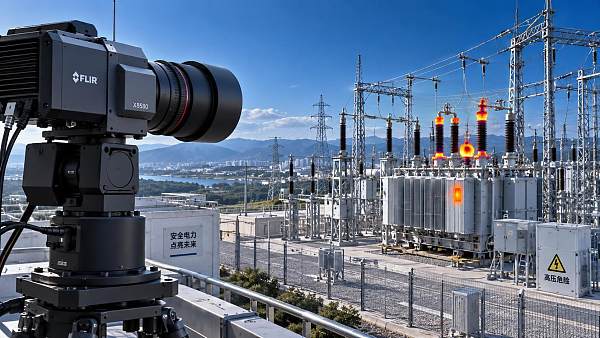
Resolution figures are easy to compare and easy to overvalue. A detector with more pixels can improve target coverage, but the lens field of view determines how those pixels are distributed across the scene. At a fixed distance, a wide-angle lens may place an entire substation or production area in frame while leaving a suspect connection represented by only a few pixels. The image can look detailed overall and still be inadequate for inspection.
The useful calculation begins with the instantaneous field of view of the combined camera and lens. This indicates the angular scene represented by one detector element. From there, evaluators can estimate the ground sampling distance at the inspection range and calculate how many pixels cover the target feature.
Request calculations for the proposed camera-lens combination at the actual stand-off distance. Ask for more than a quoted “detection range.” A defensible evaluation will show the assumed target size and temperature contrast, the lens focal length, the field of view, and the basis used to distinguish detection, recognition, and identification. This makes it easier to compare offers that use different terminology or different target assumptions.
For fixed-asset inspection, a two-camera arrangement can sometimes be more useful than a single extreme-zoom system: one wider view provides orientation and context, while a narrow-field camera examines predefined high-risk components. The additional integration work may be justified when operators must locate the exact inspected point quickly and consistently.
Sensitivity matters, but field performance is broader than NETD
Noise equivalent temperature difference, often expressed as NETD, is a useful indicator of thermal sensitivity under stated conditions. Lower values generally indicate that the camera can distinguish smaller temperature differences. It should not be treated as a standalone measure of long-range inspection quality.
At range, the observed contrast may be constrained by atmospheric attenuation, background radiation, target size, lens transmission, focus quality, and image processing. A low-NETD detector paired with an unsuitable lens or exposed to an unstable thermal background may not provide a better operational result than a less impressive laboratory figure suggests.
Frame rate is similarly task-dependent. Slow or stationary assets may allow a moderate frame rate, provided the camera and mount are stable. Fast conveyors, rotating machinery, vehicle-mounted payloads, maritime platforms, and tracking applications may require higher frame rates to reduce motion blur and to support reliable automated tracking. Higher-performance acquisition can increase data volume, processing requirements, and system cost, so the requirement should be tied to the movement of both target and platform.
Focus control is another frequent source of disappointment. A long-range lens has limited depth of field, particularly at narrow fields of view. Manual focus may be acceptable in controlled test work, but unattended monitoring often needs repeatable motorized focus, stored presets, or autofocus behaviour that has been validated against the target type. Assess focus performance through the intended viewing window, enclosure, or protective housing; each optical surface can influence contrast and introduce reflections.
Separate thermal imaging from quantitative thermography
Many inspection programmes need a clear image of an anomaly, not a traceable surface temperature value. Others use temperature trends and alarm thresholds to prioritize maintenance. These use cases should be separated in the procurement specification because radiometric capability affects calibration, software, workflows, and acceptance testing.
For quantitative thermography, define whether the system must provide spot readings, area statistics, isotherms, alarms, image records with measurement metadata, or trend analysis over time. Also define the expected temperature range. A camera optimized to discriminate small changes around moderate operating temperatures may not be the right instrument for a process with much higher temperatures or strong reflected radiation.
Surface emissivity is particularly important for electrical and industrial assets. Polished metal, painted surfaces, oxidized components, insulation materials, and wet surfaces do not behave alike. At long range, the angle of observation can further complicate interpretation. A thermal image of a reflective connector may show radiation reflected from the sky, sun-heated structures, or adjacent hot equipment rather than the connector’s own temperature.
This does not make remote inspection unsuitable. It means alarm logic should account for the asset material and observation geometry. In many maintenance programmes, a repeatable relative comparison under similar load and environmental conditions is more actionable than a single absolute temperature value presented without context.
Assess the complete operating envelope
The camera core is only one part of a long-range installation. Field reliability often depends on the enclosure, mount, lens protection, power arrangement, communications path, and maintenance access. A high-performance cooled sensor placed behind a poor optical window or on an unstable pole will not meet its theoretical capability.
For outdoor or industrial deployment, review the following conditions against the intended site:
- Ambient temperature limits, solar loading, wind, vibration, salt exposure, dust, and water ingress.
- Window material and spectral transmission for the selected waveband.
- Need for window heaters, wipers, air purge, sunshields, or contamination monitoring.
- Mount stiffness, pan-tilt positioning accuracy, and susceptibility to vibration.
- Network bandwidth, video compression effects, storage retention, and cybersecurity requirements.
- Interface requirements for control systems, alarms, video management platforms, and time synchronization.
- Access restrictions for periodic cleaning, alignment, calibration checks, and cooler service.
Cooled systems also introduce lifecycle considerations that should be explicit in the investment case. The cryocooler is a mechanical subsystem with its own operating life, power demand, startup behaviour, noise characteristics, and service implications. The right question is not simply whether a cooler has a stated operating-hour figure. Procurement teams should clarify how uptime is defined, what service actions are expected, whether the detector assembly can be replaced in the field, and how long repair or replacement would take for the installed configuration.
For critical assets, examine failure modes at the system level. If the camera becomes unavailable, can operations continue using a fallback patrol, a redundant viewing point, or another sensor? Can the system report degraded image quality, loss of focus, enclosure temperature issues, or communication failure before a monitoring gap goes unnoticed?
Use a scenario-based acceptance test
Datasheet comparison should narrow the shortlist; it should not be the final decision. The most useful acceptance process reproduces the inspection decision the system is expected to support. This can be done during a site survey, a controlled demonstration, or a factory acceptance procedure designed around representative assumptions.
Ask shortlisted suppliers to demonstrate the final detector, lens, housing, and software configuration at the required range. The test should examine target acquisition, focus repeatability, image stability, thermal contrast, operator workflow, alarm handling, and data export. Where remote temperature measurement is part of the scope, include representative surfaces and viewing angles rather than a convenient blackbody target alone.
It is also sensible to test the boundary conditions: lower contrast targets, moderate haze, background clutter, changing load, and the longest usable zoom position. These conditions expose whether the proposed solution retains enough decision value when the environment is less favourable than a product demonstration.
Build the specification around a defendable decision
A cooled infrared camera is well suited to long-range thermal inspection when the inspection task demands narrow-field detail, rapid imaging, high sensitivity, or performance beyond the practical reach of an uncooled system. It becomes an expensive and fragile choice when its capabilities are specified without a clear target-size, range, and workflow requirement.
The strongest procurement brief describes the asset, smallest relevant feature, stand-off distance, environmental path, required operator decision, measurement need, integration constraints, and expected service model. It then requires suppliers to demonstrate performance with the proposed lens and installed configuration. That approach shifts the evaluation away from impressive isolated specifications and toward the question that matters: whether the system will support a dependable inspection decision when access is difficult and the consequence of missing an anomaly is high.
Recommended for You
 Digital SeaHow Does a Ballast Cleaner Screening System Separate Track Ballast?Discover how a ballast cleaner screening system separates reusable stone from fines, what affects performance, and how to assess the results.By: Captain Kenji SatoNov 14, 2026
 Smart MetersPakistan to Seek World Bank and ADB Funding for Smart MetersPakistan seeks World Bank and ADB funding for smart meters on distribution transformers. Explore the plan to tackle power theft and improve grid efficiency.By: Dr. Elena VoltNov 13, 2026
 Digital SeaWhat Is Precision Medicine and How Does It Guide Treatment?Discover how precision medicine uses biomarkers and genetic insights to guide treatment, where it can help, and what to ask before testing.By: Captain Kenji SatoNov 13, 2026
 Grid Resilience2026 CSEE Annual Meeting Opens with Focus on AI and Power SystemsThe 2026 CSEE Annual Meeting explores AI, low-carbon power systems and ultra-high-voltage transmission. Discover why these discussions matter.By: Dr. Elena VoltNov 12, 2026
 Digital SeaShip Radar Detection Range: How Far Can It See and What Limits It?Ship radar detection range depends on more than the display scale. Discover how antenna height, weather, target size, and settings affect what radar can see.By: Captain Kenji SatoNov 12, 2026
 UHV TransformersGE Vernova to Invest $34.5 Million in Louisiana Transformer Plant ExpansionGE Vernova plans a $34.5 million transformer plant expansion in Louisiana. Explore its potential impact on North American supply and procurement.By: Dr. Elena VoltNov 11, 2026
 Digital SeaMetro Station Noise Criteria: Limits and Measurement MethodsExplore metro station noise criteria, applicable limits and measurement methods. Learn how to select metrics and assess compliance with confidence.By: Captain Kenji SatoNov 11, 2026
 Digital SeaKongsberg Maritime Unveils Arctic Hunter Unmanned Surface VesselKongsberg Maritime's Arctic Hunter unmanned surface vessel is proposed for the Royal Navy's Type 92 programme. Explore its technology and procurement implications.By: Captain Kenji SatoNov 10, 2026
 Sorting RobotsHow Accurate Is AI in Food Quality Control? Metrics and Testing MethodsExplore AI in food quality control accuracy, from recall and false negatives to validation methods. Learn how to assess real-world inspection reliability.By: Marcus SterlingNov 10, 2026
 UHV TransformersGE Vernova Selected for 6 GW HVDC Link in IndiaGE Vernova will design a 6 GW HVDC link for PGCIL, connecting Rajasthan and South Kalamb to support India's clean energy transition. Discover the project.By: Dr. Elena VoltNov 09, 2026
 Grid ResilienceEurope's Grid Compliance Standards in 2026: Generator Connection RequirementsExplore new grid compliance standards 2026 Europe projects must address, from generator connection rules to testing and documentation. Prepare for approval.By: Dr. Elena VoltNov 09, 2026
 Technical FabricsNonwoven Bonding Cost Data: Comparing Thermal and Chemical ProcessesExplore nonwoven bonding cost data to compare thermal and chemical processes, assess usable yield, and choose the best-value option for your application.By: Chloe DuboisNov 08, 2026
 Fiber LasersIndustrial Lasers to 2035: Automotive Lightweighting and Precision Welding Drive DemandExplore the industrial laser market outlook to 2035 and discover how automotive lightweighting and precision welding could shape demand and procurement.By: Dr. Hideo TanakaNov 07, 2026
 Technical FabricsChoosing Geotextile Under Railway Ballast: Key Performance RequirementsChoosing geotextile under railway ballast? Explore essential filtration, drainage, strength and durability criteria to make a confident, project-specific selection.By: Chloe DuboisNov 07, 2026
 Digital SeaChoosing Rail Welding Equipment for Maintenance: Field Conditions and Weld TypesChoose rail welding equipment for maintenance with confidence. Compare welding methods, field constraints, inspection needs, and lifecycle costs.By: Captain Kenji SatoNov 06, 2026
 Digital SeaIndia Broadband Forum Urges Stronger Submarine Cable ResilienceIndia’s submarine cable resilience is in focus as the Broadband India Forum urges faster repairs, more vessels and stronger landing infrastructure.By: Captain Kenji SatoNov 06, 2026
 Digital SeaChoosing a Railway Network Switch Supplier: Reliability and Support CriteriaChoosing a railway network switch supplier? Compare reliability, standards evidence, cybersecurity, and lifecycle support to reduce project risk.By: Captain Kenji SatoNov 05, 2026
 Grid ResilienceUS Grid Equipment Import Ban Raises Cost and Implementation ConcernsThe US grid equipment import ban raises concerns over costs and delivery delays. Explore how unclear criteria could affect procurement and supply chains.By: Dr. Elena VoltNov 05, 2026
 Digital SeaRailway Coupler Price: How Type and Specifications Affect QuotesRailway coupler price depends on type, specifications, and order scope. Learn how to compare quotes, avoid hidden costs, and make a confident buying decision.By: Captain Kenji SatoNov 04, 2026
 Grid ResilienceGlobal Smart Grid Companies Raise $3 Billion in First Nine Months of 2026Global smart grid companies raised $3 billion in the first nine months of 2026. Explore the funding breakdown and potential implications for buyers and suppliers.By: Dr. Elena VoltNov 04, 2026
 Digital SeaChoosing Wholesale Pet Toys: How to Evaluate Suppliers and Minimum OrdersWholesale pet toys: learn how to assess suppliers, compare minimum orders and landed costs, and reduce inventory risk before you buy.By: Captain Kenji SatoNov 03, 2026
 Digital SeaSustainable Packaging Design: How to Choose Materials and Reduce WasteDiscover how sustainable packaging design helps reduce waste, protect products, and control costs with practical material choices and proven testing strategies.By: Captain Kenji SatoNov 02, 2026
 Technical FabricsUSMCA's First Joint Review Puts Textile Supply Chain Rules in FocusUSMCA's first joint review puts textile supply chain rules in focus. Explore potential impacts on origin compliance, sourcing and tariff treatment.By: Chloe DuboisNov 02, 2026
 Digital SeaManufacturing KPI Benchmarking: How to Compare Production PerformanceBenchmarking KPI manufacturing performance? Learn how to compare OEE, quality and downtime, identify meaningful gaps, and turn insights into practical improvements.By: Captain Kenji SatoNov 01, 2026
 Smart MetersCCI Approves Adani Energy Solutions' ₹305 Billion Acquisition of IntelliSmartCCI approves Adani Energy Solutions' ₹305 billion acquisition of IntelliSmart. Discover what the deal could mean for India's smart meter market.By: Dr. Elena VoltNov 01, 2026
 Digital SeaChoosing a Coin Laundry Machinery OEM: What Buyers Should EvaluateChoosing a coin laundry machinery OEM? Compare machine specifications, payment integration, lifecycle costs, and support to make a confident buying decision.By: Captain Kenji SatoOct 31, 2026
 Grid ResilienceUS Energy Department Announces $237 Million Grid SCALED Funding ProgramExplore the DOE's $237 million Grid SCALED funding program and its goals to strengthen grid equipment supply chains, lower electricity costs, and improve resilience.By: Dr. Elena VoltOct 31, 2026
 UHV TransformersA Decade of UHV Power in Shandong: Province Leads in Station NumbersShandong UHV power leads China in station numbers. Explore a decade of grid development and its implications for electricity supply and business planning.By: Dr. Elena VoltOct 30, 2026
 Digital SeaChoosing a Composite Train Body Panel Manufacturer: Fire Safety and Quality ChecksChoosing a composite train body panels manufacturer? Learn how to verify fire test evidence, audit production quality, and avoid costly approval gaps before you buy.By: Captain Kenji SatoOct 29, 2026
 Subsea ROV/AUVOcean Infinity Deploys Six AUVs Together Beyond 5,000 MetresOcean Infinity reportedly deployed six HUGIN AUVs beyond 5,200 metres. Explore what concurrent deepwater missions could mean for seabed surveys and procurement.By: Captain Kenji SatoOct 29, 2026
 Grid ResilienceRenewable Energy Grid Balancing: How Storage and Demand Response Work TogetherExplore renewable energy grid balancing with storage and demand response. Learn how coordinated controls manage shortfalls, absorb surplus power, and improve grid reliability.By: Dr. Elena VoltOct 28, 2026