How to Qualify OEM Consumer Electronics for Medical Device Integration
Qualifying OEM consumer electronics for medical devices requires more than comparing price, performance, and availability. Technical evaluators must assess safety, controls, traceability, cybersecurity, lifecycle support, and regulatory fit.
The central question is not whether a consumer component works today. It is whether its design, documentation, supply chain, and failure behavior can support a medical device throughout its intended lifecycle.
Consumer-grade modules can accelerate development and reduce cost, especially for displays, cameras, processors, wireless radios, batteries, and sensors. However, integration transfers substantial responsibility to the medical device manufacturer.
A practical qualification process distinguishes between components that are merely capable and components that are controllable. The latter can be verified, monitored, changed, serviced, and defended during regulatory review.
Start With Intended Use and Patient Risk
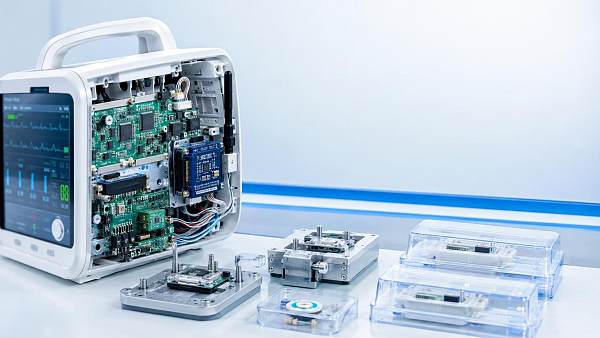
Technical qualification should begin with the medical device’s intended use, operating environment, user profile, and patient contact pathway. These factors determine how much evidence each OEM component must provide.
A touchscreen used for administrative workflow presents different hazards from one used to control therapy delivery. Likewise, a camera for documentation differs materially from one supporting diagnostic interpretation.
Define whether the OEM consumer electronics component can directly influence diagnosis, treatment, monitoring, alarm delivery, or clinical decisions. Direct influence generally demands more rigorous risk controls and verification.
Use ISO 14971 risk management principles to connect component failure modes with device-level hazardous situations. Do not assume a component is low risk simply because it is physically small.
A wireless chipset may affect alarm transmission, while a battery-management circuit may affect overheating, unexpected shutdown, or loss of essential performance. Risk depends on system context, not procurement category.
Document the rationale for using the component before requesting supplier evidence. This clarifies which specifications are critical, which changes require notification, and which verification activities remain mandatory.
For OEM consumer electronics for medical devices, the qualification threshold should rise as clinical impact, use duration, environmental stress, and dependence on the component increase.
Separate Consumer Performance From Medical Suitability
Consumer specifications often emphasize speed, resolution, battery life, connectivity, or visual quality. Medical suitability additionally depends on predictable behavior, tolerances, failure detection, and retained evidence.
A high-resolution display may be impressive in normal conditions but unsuitable if brightness varies significantly, optical characteristics drift, or replacement lots cannot be controlled over time.
Evaluate performance across the full operating envelope rather than supplier headline values. Include temperature, humidity, vibration, charging conditions, storage, electromagnetic exposure, and repeated cleaning where relevant.
Ask whether performance limits are guaranteed, typical, or merely observed during sample testing. Medical product specifications should be built around controlled limits, not favorable laboratory demonstrations.
Consumer suppliers may optimize components for rapid feature updates. Medical device teams need stability, reproducibility, repairability, and a disciplined process for evaluating every revision.
Build a component requirement matrix that distinguishes desirable consumer features from medical critical-to-quality attributes. This prevents nonessential performance targets from obscuring safety-critical gaps.
The result should be a clear engineering position: acceptable as supplied, acceptable with system controls, acceptable only after redesign, or unsuitable for the intended medical application.
Verify Design Controls and Supplier Quality Evidence
Supplier qualification should assess whether the OEM has mature design and manufacturing controls, not simply whether it holds a recognizable certification or serves well-known consumer brands.
ISO 9001 certification can indicate baseline quality management discipline, but it does not automatically demonstrate medical-device readiness. ISO 13485 alignment is more relevant when available.
Review how the supplier controls design changes, production deviations, nonconforming materials, software releases, manufacturing transfers, and corrective actions. These processes affect long-term product consistency.
Request documented specifications, drawings, test methods, inspection criteria, reliability reports, process flow information, and relevant certificates of conformance. Evidence should correspond to the exact part number and revision.
Technical evaluators should also determine whether data are supplier-controlled or marketing-oriented. A datasheet is useful, but it rarely replaces formal acceptance criteria or lot-specific quality records.
Where direct audits are impractical, use structured supplier questionnaires, remote document reviews, sample lot testing, and contractual rights to obtain update notifications and corrective-action information.
The objective is not to force every consumer OEM into a medical quality system. It is to establish enough visibility and control for the medical manufacturer’s own quality system.
Establish Material Traceability and Biocompatibility Boundaries
Material information becomes essential when an electronic assembly is patient-contacting, skin-adjacent, cleaned frequently, enclosed in a sealed housing, or exposed to heat during operation.
Even components without direct patient contact can create risks through outgassing, flammability, corrosion, particulate release, optical coating degradation, or migration of substances into adjacent materials.
Identify all relevant material layers, including plastics, adhesives, inks, coatings, glass treatments, solder masks, cables, elastomers, battery wraps, and conformal coatings.
For patient-contacting finished devices, evaluate the complete material configuration under ISO 10993 principles. Component-level claims alone may not represent the final assembly or intended exposure duration.
Traceability should link incoming lots to production records, test outcomes, finished devices, and field actions. This is particularly important for batteries, displays, sensors, and safety-relevant connectors.
Ask suppliers how they manage restricted substances, including RoHS, REACH, halogens, phthalates, and conflict minerals where commercially or regionally applicable.
A supplier unable to identify material changes creates a hidden verification burden. That burden may be manageable, but it must be recognized before design freeze rather than after launch.
Test Electromagnetic Compatibility at the System Level
Consumer electronic modules frequently contain switching regulators, high-speed processors, Bluetooth radios, Wi-Fi functions, displays, and cables that can create electromagnetic emissions or susceptibility concerns.
Module certifications are useful starting points, but they do not prove that the finished medical device meets applicable electromagnetic compatibility requirements in its actual enclosure and configuration.
Assess both emissions and immunity early, especially when integrating wireless modules, touch interfaces, imaging sensors, motor controls, charging circuits, or external power adapters.
System-level testing should consider cable routing, grounding, shielding, antenna placement, enclosure materials, power architecture, and software behavior during disturbed communications or transient events.
Define what safe behavior looks like when interference occurs. The system may need to alarm, retry communications, preserve data integrity, enter a safe state, or clearly notify the user.
IEC 60601-1-2 is often central for medical electrical equipment, although the exact standard pathway depends on device type, intended environment, and applicable regulatory jurisdiction.
Do not defer EMC decisions until final validation. Early pre-compliance testing can reveal layout, shielding, and grounding issues while corrective design changes remain relatively inexpensive.
Assess Software, Firmware, and Cybersecurity Exposure
Many consumer components include firmware, drivers, operating systems, cloud dependencies, application programming interfaces, or third-party libraries. These elements can materially affect medical device safety and security.
Determine which software elements are embedded, who controls them, how updates are distributed, and whether versions can be locked for released medical device configurations.
Uncontrolled automatic updates are generally incompatible with a validated medical product. Changes may affect performance, cybersecurity posture, electromagnetic behavior, battery consumption, or interoperability.
Request a software bill of materials when feasible, especially for network-connected components. This supports vulnerability monitoring and provides a defensible foundation for postmarket cybersecurity maintenance.
Evaluate security features such as secure boot, signed firmware, encryption support, authentication options, debug-port control, key management, and vulnerability disclosure processes.
For connected devices, assess whether the component introduces external services that could become unavailable, change commercial terms, collect data, or create cross-border data protection concerns.
Cybersecurity qualification should align with the device threat model. The right question is whether the component’s capabilities and limitations can be securely managed within the complete medical architecture.
Control Lifecycle, Obsolescence, and Supply-Chain Change
Consumer electronics suppliers often refresh products rapidly. A component that is readily available during prototyping may be discontinued, revised, or allocated before medical device commercialization.
Evaluate expected production life, last-time-buy policies, end-of-life notices, alternate sources, tooling ownership, and availability of repair parts. Avoid relying solely on informal sales assurances.
Change notification agreements should cover form, fit, function, firmware, material, manufacturing site, test method, sub-supplier, packaging, and labeling changes relevant to device performance.
Establish an approved vendor list and define which component changes require engineering review, risk reassessment, verification testing, regulatory evaluation, or formal design change control.
Second sourcing can reduce supply risk, but it can also introduce hidden variability. Equivalent consumer parts should not be substituted without documented comparison against medical critical requirements.
Consider counterfeit exposure and unauthorized distribution channels, particularly for processors, memory, batteries, displays, and high-demand wireless modules. Procurement controls must protect technical qualification decisions.
A lifecycle plan should include strategic inventory, validated alternatives, component monitoring, and commercial escalation paths. These measures are often more valuable than a modest unit-cost reduction.
Use a Practical Qualification Decision Framework
A disciplined framework prevents teams from approving consumer components based on enthusiasm, sample performance, or supplier reputation. It also creates evidence for design reviews and procurement decisions.
First, define critical requirements covering safety, performance, materials, EMC, software, cybersecurity, manufacturing quality, lifecycle, and serviceability. Each requirement needs an owner and acceptance method.
Second, identify evidence available from the supplier and evidence that must be generated internally. Gaps should be classified by risk, cost, schedule impact, and feasibility of mitigation.
Third, test representative production-intent samples in the final or near-final device architecture. Breadboard results are informative but cannot establish released-product performance on their own.
Fourth, document residual risks and compensating controls. Examples include protective housings, watchdog functions, additional inspection, locked firmware, environmental derating, redundancy, or inventory commitments.
Fifth, formalize quality and commercial agreements before volume release. The agreement should specify notifications, documentation access, traceability expectations, complaint cooperation, and responsibilities during field actions.
This approach allows teams to use OEM consumer electronics for medical devices responsibly, while preserving the evidence and control expected from regulated product development.
Conclusion: Qualification Is an Evidence and Control Exercise
Consumer technology can add useful capability to medical devices, but commercial availability does not equal medical readiness. Qualification must connect component choices to patient safety and regulatory obligations.
The strongest decisions evaluate intended use, failure consequences, supplier controls, material traceability, EMC, software security, and lifecycle stability as one integrated engineering problem.
Technical evaluators should prioritize components that can be specified, tested, monitored, and changed under documented control. When evidence is limited, device-level verification and contractual safeguards become more important.
Ultimately, successful integration depends on treating consumer electronics as managed subsystems within a medical product, not as interchangeable commodities selected only by feature set or price.