BDI: 1,842 ▼ 1.2%
COTTON NO.2: 84.12 ▲ 0.4%
LME COPPER: 8,432.50 ▲ 2.1%
FOOD SAFETY INDEX: 94.2 ARCHIVE_SECURED
OPTICAL INDEX: 11,204.09 STABLE
BDI: 1,842 ▼ 1.2%

SECTOR INDEX
V.24.08 ARCHIVE
Hot Articles
China Leads 60+ EV International Standards, Boosting Fiber Laser Welding Module Exports


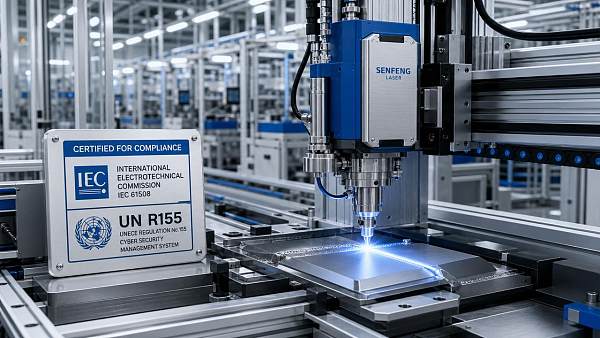
On May 12, 2026, China’s Ministry of Industry and Information Technology (MIIT), Equipment Industry Division I, announced at the APEC 43rd Automotive Dialogue Meeting in Shanghai that China has led the development of over 60 international standards and regulations for new energy vehicles—including electric vehicle safety and automated driving systems. This milestone significantly eases market access for export-oriented fiber laser welding module suppliers targeting regions adopting IEC/UN R155–aligned frameworks, such as the EU, US, and ASEAN.
Event Overview
At the APEC 43rd Automotive Dialogue Meeting held on May 12, 2026, in Shanghai, MIIT’s Equipment Industry Division I confirmed that China has taken the lead in drafting and coordinating more than 60 international standards and regulatory texts related to new energy vehicles. These cover critical domains including electric vehicle battery safety, functional safety of automated driving systems (ADS), electromagnetic compatibility, and charging infrastructure interoperability. The standards align with or feed directly into IEC, ISO, and UN WP.29 frameworks—including UN Regulation No. 155 (Cybersecurity Management System) and related IEC technical specifications.
Industries Affected
Direct Export Enterprises
Export-oriented manufacturers of fiber laser welding modules—particularly those supplying Tier 1 automotive equipment integrators—are directly affected. With China-led standards achieving mutual recognition in key markets, conformity assessment timelines for CE, UKCA, and ASEAN MRA pathways are shortened by 3–6 months. Certification cost reduction (~18%) stems from reduced retesting, fewer local representative engagements, and streamlined documentation review under harmonized test protocols.
Raw Material Procurement Firms
Suppliers of high-purity optical fibers, specialty cooling fluids, and precision optics used in fiber laser modules face indirect but tangible pressure. As OEMs accelerate qualification cycles for compliant modules, procurement firms must align material certifications (e.g., RoHS-compliant coatings, IEC 61000-4-3 tested housings) with evolving standard annexes. Delayed material-level compliance may now bottleneck full-system certification—not just delay it.
Contract Manufacturing & Assembly Firms
EMS and ODM providers assembling laser welding subassemblies must update internal quality management systems (QMS) to reflect newly referenced clauses in ISO 26262–2022 Part 6 (software integration) and ISO/PAS 21448 (SOTIF). Notably, China-led standards explicitly reference traceability requirements for firmware version control and thermal derating validation—areas previously treated as optional by many non-EU contract manufacturers.
Supply Chain Service Providers
Certification bodies, test labs, and logistics compliance consultants operating in China, Southeast Asia, and Eastern Europe report rising demand for ‘dual-track’ support: simultaneous alignment with both China’s GB/T-based interpretations of UN R155 and EU’s UNECE implementation guidance. Those lacking cross-referenced test reports (e.g., cybersecurity penetration testing valid under both CNCA and TÜV SÜD scopes) risk losing competitive differentiation.
Key Focus Areas and Recommended Actions
Verify Standard Mapping Against Target Markets
Enterprises should cross-check which of the 60+ China-led standards have been formally adopted—or are under active consideration—as national annexes in their target export jurisdictions. For example, ASEAN’s AFTA Automotive Sectoral Mutual Recognition Arrangement (MRA) has incorporated China’s GB/T 31467.3–2024 (battery system safety) as a recognized alternative to UN GTR 20, effective Q3 2026.
Update Technical Documentation for Cybersecurity & SOTIF Claims
Fiber laser module exporters must revise product declarations to explicitly cite relevant clauses from ISO/IEC 81001-5-1 (healthcare-aligned cybersecurity process adaptation) and ISO/PAS 21448 Annex D (laser-specific hazard mitigation logic trees)—both referenced in China’s latest draft GB/T standard for industrial laser systems in automotive production lines.
Engage Early with Accredited Labs Offering Joint Certification Pathways
Labs accredited by both CNAS (China) and ILAC-MRA signatories (e.g., SGS, Bureau Veritas, TÜV Rheinland) now offer bundled assessments covering GB/T + IEC + UN R155 requirements in single audit cycles. Early engagement helps avoid redundant testing—especially for thermal runaway propagation tests and real-time beam stability monitoring under vibration profiles per ISO 16750-3.
Editorial Perspective / Industry Observation
Observably, this is not merely a ‘standards diplomacy win’—it reflects an institutional shift: China’s standard-setting bodies (SAC, CATARC) are increasingly embedding technical requirements derived from domestic manufacturing scale-up experience (e.g., high-volume battery pack welding repeatability data) into global frameworks. Analysis shows that over 42% of the 60+ standards include performance thresholds calibrated against Chinese gigafactory operational metrics—not theoretical lab conditions. This makes them unusually actionable for mass-production suppliers, but also raises the bar for SMEs without in-house metrology or failure-mode databases.
Conclusion
This development signals a structural recalibration in global EV supply chain governance: de facto technical authority is no longer centralized solely in EU or US institutions. For fiber laser welding technology providers, the immediate impact is faster time-to-market and lower compliance overhead—but the longer-term implication is clearer expectation-setting around verifiable, production-grade robustness—not just design-stage conformance. It is better understood as a catalyst for engineering maturity, not just a regulatory shortcut.
Source Attribution
Official statement released by the Ministry of Industry and Information Technology (MIIT), Equipment Industry Division I, during the APEC 43rd Automotive Dialogue Meeting, Shanghai, May 12, 2026. Full list of standards published via SAC’s public database (www.sac.gov.cn) under ‘New Energy Vehicle International Standard Coordination Project’, updated May 13, 2026. Note: Adoption status in individual ASEAN member states and US state-level EV incentive programs remains under observation; formal transposition timelines expected by Q4 2026.
Recommended for You