BDI: 1,842 ▼ 1.2%
COTTON NO.2: 84.12 ▲ 0.4%
LME COPPER: 8,432.50 ▲ 2.1%
FOOD SAFETY INDEX: 94.2 ARCHIVE_SECURED
OPTICAL INDEX: 11,204.09 STABLE
BDI: 1,842 ▼ 1.2%

SECTOR INDEX
V.24.08 ARCHIVE
Hot Articles
- Metro Station Noise Criteria: Limits and Measurement MethodsExplore metro station noise criteria, applicable limits and measurement methods. Learn how to select metrics and assess compliance with confidence.
- Kongsberg Maritime Unveils Arctic Hunter Unmanned Surface VesselKongsberg Maritime's Arctic Hunter unmanned surface vessel is proposed for the Royal Navy's Type 92 programme. Explore its technology and procurement implications.
- How Accurate Is AI in Food Quality Control? Metrics and Testing MethodsExplore AI in food quality control accuracy, from recall and false negatives to validation methods. Learn how to assess real-world inspection reliability.
How to Evaluate Plant-Based Meat Manufacturing Partners in the USA


How to Evaluate Plant-Based Meat Manufacturing Partners in the USA
Choosing the right plant-based meat manufacturing USA partner requires more than comparing price lists or installed capacity. A manufacturer may look strong on paper and still be a poor fit if its extrusion capability does not match your target texture, if allergen segregation is weak, or if its ingredient sourcing is vulnerable to swings in pea, soy, or specialty oil availability. For teams making supplier decisions, the real work sits in the gap between a commercial proposal and operational reality.
That is especially true in the U.S. market, where manufacturers range from highly specialized co-manufacturers serving emerging food brands to large-scale processors with broader protein and prepared-food capabilities. Some are excellent at scaling repeatable formulations. Others are better at pilot runs, niche formats, or fast reformulation. Treating them as interchangeable is where many evaluations start to drift off course.
A more useful approach is to assess a partner across five dimensions at once: technical fit, food safety and compliance, supply resilience, economic model, and strategic alignment. This is broadly consistent with the way cross-sector benchmarking works in industrial procurement. Organizations such as G-MCE, which compare technical systems across different manufacturing and infrastructure environments using standards-based evaluation, reflect an important lesson here: supplier selection becomes stronger when decision-makers look beyond a single KPI and test the whole operating system.
Start with the product you actually need to make
“Plant-based meat” is a broad category, but manufacturing suitability is highly format-specific. A partner that performs well on burger patties may not be the right choice for whole-cut analogs, formed nuggets, crumbles, sausages, deli slices, or hybrid products that blend plant proteins with other inputs. Texture development, moisture management, binding systems, fat distribution, and post-extrusion handling all shift depending on the end product.
Before comparing vendors, define a short technical brief internally. It should include target format, protein base, allergen profile, refrigerated or frozen distribution, shelf-life expectations, labeling constraints, and expected annual volume by phase. Without that baseline, manufacturers tend to respond with generalized capability statements, and those are rarely enough for a serious decision.
Ask direct questions about processing pathways. Are they using high-moisture extrusion, low-moisture extrusion with downstream hydration, shear-cell methods, or conventional mixing and forming for simpler formats? Do they formulate in-house or mostly execute customer-provided recipes? Can they handle flavor encapsulation, oil systems, color stability, and thermal behavior during cooking? The answers will tell you much more than a brochure ever will.
Capability is not the same as capacity
Many buyer questionnaires overemphasize line throughput. Capacity matters, but capability usually matters first. A supplier may have open line time yet struggle to deliver the bite, juiciness, or cook performance your product needs. In plant-based meat, small process differences can change water activity, texture consistency, and freeze-thaw behavior enough to create downstream complaints.
This is where pilot validation becomes critical. Request more than a sample. Review how the sample was made, on what scale, and under what process settings. A benchtop prototype is useful for R&D screening, but it does not prove that a 5,000 lb or 20,000 lb batch will behave the same way. Commercialization risk often appears in scale-up: residence time changes, ingredient hydration shifts, throughput pressures alter texture, and packaging lines expose weaknesses in product integrity.
A practical evaluation question is this: can the manufacturer show a disciplined transfer path from development batch to routine production? If the answer is vague, the technical risk is higher than the initial quote suggests.
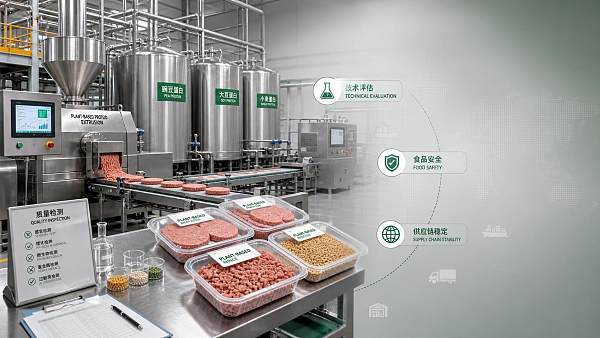
Food safety, labeling, and regulatory discipline are part of partner quality
In the U.S., a plant-based meat partner should be assessed with the same seriousness applied to any food processor handling complex formulations and national distribution. That means looking closely at food safety systems, environmental controls, allergen management, traceability, sanitation validation, recall readiness, and documentation discipline.
There is no need to romanticize certifications, but they do matter when backed by real operating practice. Depending on the facility and customer base, buyers may review GFSI-recognized schemes such as SQF or BRCGS, along with HACCP-based controls, allergen programs, and supplier approval procedures. If your product claims require non-GMO, organic, kosher, halal, gluten-free, or specific clean-label positioning, confirm whether the facility is set up to support those claims without creating cross-contact or documentation problems. This is not something to settle later in commercialization.
Labeling deserves its own attention. Ingredient statements for plant-based products can become complicated when binders, natural flavors, colors, starches, methylcellulose, fibers, and specialty fats are involved. If your go-to-market strategy depends on a tight label deck, ask the manufacturer how often formulations are adjusted due to raw material substitutions, and what notice period applies. A technically equivalent substitute may still trigger label review, claim changes, or customer approval delays.
Look upstream: ingredient sourcing can make or break the program
Plant-based meat programs are exposed to ingredient market volatility in ways that are not always obvious at sourcing stage. Protein isolates, concentrates, functional starches, fibers, fats, flavors, and specialty inclusions do not all have the same supply profile. Some are readily substitutable; some are not. If the product depends on a narrow set of functional ingredients, the manufacturing partner’s procurement depth matters almost as much as its line performance.
Ask how many approved suppliers exist for core materials and which inputs are single-source or qualification-intensive. Request clarity on lead times, inventory policy, and substitution governance. In some cases, the lowest quoted conversion cost comes from a manufacturer carrying minimal ingredient risk. That can look efficient until a delayed protein shipment stops production or forces reformulation.
This is one reason multidisciplinary market intelligence has value in supplier evaluation. G-MCE’s broader model of connecting technical benchmarks with real-time commercial and policy signals is relevant here, even in food processing. A plant-based meat manufacturer is not operating in isolation; freight conditions, energy costs, packaging availability, and commodity input pressures all influence delivery reliability.
What to verify during a plant visit or technical audit
A site visit often reveals more than weeks of email exchanges. You do not need to turn it into a theatrical audit, but you should observe the process with a manufacturing lens. Watch material flow. Check whether allergen and non-allergen pathways are genuinely separated. Look at ingredient staging, weighing accuracy, rework handling, line changeover discipline, and finished-goods release controls.
Pay attention to the details people tend to skip:
- How stable is the workforce on the line and in QA?
- Is maintenance reactive or planned?
- Are process deviations logged and investigated?
- Does the pilot area connect cleanly to commercial production, or is it effectively a separate world?
- Can the team explain critical control points in plain operational terms, not just in audit language?
When operators, QA, and commercial staff tell a consistent story, confidence usually increases. When every answer routes back to sales, proceed carefully.
Commercial fit is broader than the unit price
In plant-based meat manufacturing USA projects, quote comparisons often break down because bidders are pricing different realities. One supplier may include formulation support, pilot runs, packaging trials, QA release testing, and raw material management. Another may price only conversion and expect the customer to absorb the rest. Unless the scope is normalized, the cheapest line item is not a meaningful result.
A stronger commercial review looks at minimum order quantities, campaign length, startup waste assumptions, storage terms, yield accountability, forecast flexibility, packaging procurement responsibility, and liability around obsolete inventory. Also ask how the manufacturer handles underutilized line time if your launch ramps more slowly than expected. Some partners are structured for steady, high-volume production and become expensive when demand is uneven.
It helps to compare offers using a total delivered cost lens rather than a single conversion fee.
Do not ignore strategic alignment
A technically capable manufacturer can still be the wrong long-term partner. Some focus on private-label execution and do not invest much in joint innovation. Others prefer a small number of anchor accounts and may not prioritize a mid-sized challenger brand. If your roadmap includes line extensions, retail and foodservice split volumes, or eventual entry into adjacent protein formats, you need to know whether the manufacturer can grow with that trajectory.
This part of the evaluation is less about promises and more about operating behavior. How quickly do they return technical feedback? Do they raise formulation trade-offs early, or after pricing? Can they discuss packaging, cold-chain handling, and retailer requirements in an informed way? Mature partners tend to understand that successful launches are cross-functional, not just manufacturing events.
That cross-functional view is common in sophisticated industrial sourcing, where procurement decisions sit at the intersection of specification, compliance, logistics, and downstream performance. It is also where G-MCE’s multi-core approach has practical relevance: complex supplier choices improve when technical benchmarking is connected to market context rather than isolated from it.
A sensible shortlist usually emerges from evidence, not impressions
If you are evaluating plant-based meat manufacturing partners in the USA, the goal is not to find a universally “best” manufacturer. It is to find the one whose process, controls, sourcing model, and commercial structure match your product and growth path with the fewest avoidable risks. That usually requires three layers of proof: a clear technical brief, structured diligence on the facility and its systems, and honest comparison of total program economics.
Where information is incomplete, do not fill the gaps with optimism. Ask for the pilot protocol, ingredient sourcing logic, validation records, and assumptions behind the quote. If a supplier is strong, that scrutiny will clarify the fit. If not, the weaknesses generally show up before contract signature, which is the best time for them to surface.
For teams building a shortlist, the next step is usually straightforward: align internal product requirements, define non-negotiable compliance points, and pressure-test each candidate against scale-up reality rather than presentation quality. In this category, that discipline tends to save more time and money than aggressive price negotiation ever will.
Recommended for You
 Digital SeaMetro Station Noise Criteria: Limits and Measurement MethodsExplore metro station noise criteria, applicable limits and measurement methods. Learn how to select metrics and assess compliance with confidence.By: Captain Kenji SatoNov 11, 2026
 Digital SeaKongsberg Maritime Unveils Arctic Hunter Unmanned Surface VesselKongsberg Maritime's Arctic Hunter unmanned surface vessel is proposed for the Royal Navy's Type 92 programme. Explore its technology and procurement implications.By: Captain Kenji SatoNov 10, 2026
 Sorting RobotsHow Accurate Is AI in Food Quality Control? Metrics and Testing MethodsExplore AI in food quality control accuracy, from recall and false negatives to validation methods. Learn how to assess real-world inspection reliability.By: Marcus SterlingNov 10, 2026
 UHV TransformersGE Vernova Selected for 6 GW HVDC Link in IndiaGE Vernova will design a 6 GW HVDC link for PGCIL, connecting Rajasthan and South Kalamb to support India's clean energy transition. Discover the project.By: Dr. Elena VoltNov 09, 2026
 Grid ResilienceEurope's Grid Compliance Standards in 2026: Generator Connection RequirementsExplore new grid compliance standards 2026 Europe projects must address, from generator connection rules to testing and documentation. Prepare for approval.By: Dr. Elena VoltNov 09, 2026
 Technical FabricsNonwoven Bonding Cost Data: Comparing Thermal and Chemical ProcessesExplore nonwoven bonding cost data to compare thermal and chemical processes, assess usable yield, and choose the best-value option for your application.By: Chloe DuboisNov 08, 2026
 Fiber LasersIndustrial Lasers to 2035: Automotive Lightweighting and Precision Welding Drive DemandExplore the industrial laser market outlook to 2035 and discover how automotive lightweighting and precision welding could shape demand and procurement.By: Dr. Hideo TanakaNov 07, 2026
 Technical FabricsChoosing Geotextile Under Railway Ballast: Key Performance RequirementsChoosing geotextile under railway ballast? Explore essential filtration, drainage, strength and durability criteria to make a confident, project-specific selection.By: Chloe DuboisNov 07, 2026
 Digital SeaChoosing Rail Welding Equipment for Maintenance: Field Conditions and Weld TypesChoose rail welding equipment for maintenance with confidence. Compare welding methods, field constraints, inspection needs, and lifecycle costs.By: Captain Kenji SatoNov 06, 2026
 Digital SeaIndia Broadband Forum Urges Stronger Submarine Cable ResilienceIndia’s submarine cable resilience is in focus as the Broadband India Forum urges faster repairs, more vessels and stronger landing infrastructure.By: Captain Kenji SatoNov 06, 2026
 Digital SeaChoosing a Railway Network Switch Supplier: Reliability and Support CriteriaChoosing a railway network switch supplier? Compare reliability, standards evidence, cybersecurity, and lifecycle support to reduce project risk.By: Captain Kenji SatoNov 05, 2026
 Grid ResilienceUS Grid Equipment Import Ban Raises Cost and Implementation ConcernsThe US grid equipment import ban raises concerns over costs and delivery delays. Explore how unclear criteria could affect procurement and supply chains.By: Dr. Elena VoltNov 05, 2026
 Digital SeaRailway Coupler Price: How Type and Specifications Affect QuotesRailway coupler price depends on type, specifications, and order scope. Learn how to compare quotes, avoid hidden costs, and make a confident buying decision.By: Captain Kenji SatoNov 04, 2026
 Grid ResilienceGlobal Smart Grid Companies Raise $3 Billion in First Nine Months of 2026Global smart grid companies raised $3 billion in the first nine months of 2026. Explore the funding breakdown and potential implications for buyers and suppliers.By: Dr. Elena VoltNov 04, 2026
 Digital SeaChoosing Wholesale Pet Toys: How to Evaluate Suppliers and Minimum OrdersWholesale pet toys: learn how to assess suppliers, compare minimum orders and landed costs, and reduce inventory risk before you buy.By: Captain Kenji SatoNov 03, 2026
 Digital SeaSustainable Packaging Design: How to Choose Materials and Reduce WasteDiscover how sustainable packaging design helps reduce waste, protect products, and control costs with practical material choices and proven testing strategies.By: Captain Kenji SatoNov 02, 2026
 Technical FabricsUSMCA's First Joint Review Puts Textile Supply Chain Rules in FocusUSMCA's first joint review puts textile supply chain rules in focus. Explore potential impacts on origin compliance, sourcing and tariff treatment.By: Chloe DuboisNov 02, 2026
 Digital SeaManufacturing KPI Benchmarking: How to Compare Production PerformanceBenchmarking KPI manufacturing performance? Learn how to compare OEE, quality and downtime, identify meaningful gaps, and turn insights into practical improvements.By: Captain Kenji SatoNov 01, 2026
 Smart MetersCCI Approves Adani Energy Solutions' ₹305 Billion Acquisition of IntelliSmartCCI approves Adani Energy Solutions' ₹305 billion acquisition of IntelliSmart. Discover what the deal could mean for India's smart meter market.By: Dr. Elena VoltNov 01, 2026
 Digital SeaChoosing a Coin Laundry Machinery OEM: What Buyers Should EvaluateChoosing a coin laundry machinery OEM? Compare machine specifications, payment integration, lifecycle costs, and support to make a confident buying decision.By: Captain Kenji SatoOct 31, 2026
 Grid ResilienceUS Energy Department Announces $237 Million Grid SCALED Funding ProgramExplore the DOE's $237 million Grid SCALED funding program and its goals to strengthen grid equipment supply chains, lower electricity costs, and improve resilience.By: Dr. Elena VoltOct 31, 2026
 UHV TransformersA Decade of UHV Power in Shandong: Province Leads in Station NumbersShandong UHV power leads China in station numbers. Explore a decade of grid development and its implications for electricity supply and business planning.By: Dr. Elena VoltOct 30, 2026
 Digital SeaChoosing a Composite Train Body Panel Manufacturer: Fire Safety and Quality ChecksChoosing a composite train body panels manufacturer? Learn how to verify fire test evidence, audit production quality, and avoid costly approval gaps before you buy.By: Captain Kenji SatoOct 29, 2026
 Subsea ROV/AUVOcean Infinity Deploys Six AUVs Together Beyond 5,000 MetresOcean Infinity reportedly deployed six HUGIN AUVs beyond 5,200 metres. Explore what concurrent deepwater missions could mean for seabed surveys and procurement.By: Captain Kenji SatoOct 29, 2026
 Grid ResilienceRenewable Energy Grid Balancing: How Storage and Demand Response Work TogetherExplore renewable energy grid balancing with storage and demand response. Learn how coordinated controls manage shortfalls, absorb surplus power, and improve grid reliability.By: Dr. Elena VoltOct 28, 2026
 Subsea ROV/AUVSeaber Introduces 13 kg RAVEN AUV to Target Mine Countermeasure CostsSeaber’s 13 kg RAVEN AUV targets lower mine countermeasure costs with two mission configurations. Explore its potential value for naval operations and procurement.By: Captain Kenji SatoOct 28, 2026
 Digital SeaBallast Water Management Rules: IMO vs. USCG Compliance RequirementsBallast water management rules explained: compare IMO and USCG approvals, operating limits, and records. Get practical checks to reduce compliance risks and costly port delays.By: Captain Kenji SatoOct 27, 2026
 Subsea ROV/AUVEni Signs Main Cronos Contracts, Moving Gas Project into ExecutionEni’s Cronos gas project enters execution as major contracts are signed. Explore the Cyprus development, Egypt processing plans and key milestones toward first gas in 2028.By: Captain Kenji SatoOct 27, 2026
 Digital SeaBenefits of Refurbished Semiconductor Equipment: When Do Savings Justify the Risk?Explore the benefits of refurbished semiconductor equipment. Learn how to weigh savings against process risks, qualification costs, and support gaps before investing.By: Captain Kenji SatoOct 26, 2026
 Digital SeaSemiconductor Equipment Overhaul: Diagnosing Persistent Process DriftSemiconductor equipment overhaul leaving process drift unresolved? Discover how to pinpoint vacuum, sensor, thermal, and conditioning issues to restore stability and reduce repeat service calls.By: Captain Kenji SatoOct 26, 2026
 Digital SeaSemiconductor Equipment Refurbishment Process: Cleaning to QualificationExplore the semiconductor equipment refurbishment process, from precision cleaning to qualification. Learn how measurable testing helps verify production readiness and reduce risk.By: Captain Kenji SatoOct 26, 2026