BDI: 1,842 ▼ 1.2%
COTTON NO.2: 84.12 ▲ 0.4%
LME COPPER: 8,432.50 ▲ 2.1%
FOOD SAFETY INDEX: 94.2 ARCHIVE_SECURED
OPTICAL INDEX: 11,204.09 STABLE
BDI: 1,842 ▼ 1.2%

SECTOR INDEX
V.24.08 ARCHIVE
Hot Articles
- How Does a Ballast Cleaner Screening System Separate Track Ballast?Discover how a ballast cleaner screening system separates reusable stone from fines, what affects performance, and how to assess the results.
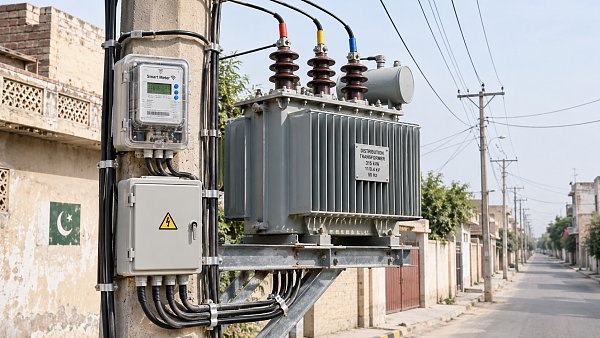
- Pakistan to Seek World Bank and ADB Funding for Smart MetersPakistan seeks World Bank and ADB funding for smart meters on distribution transformers. Explore the plan to tackle power theft and improve grid efficiency.
- What Is Precision Medicine and How Does It Guide Treatment?Discover how precision medicine uses biomarkers and genetic insights to guide treatment, where it can help, and what to ask before testing.
How to test loaded temperature uniformity in industrial oven validation


To test loaded temperature uniformity, map temperatures throughout the oven’s usable working zone while running a defined, representative load through its actual operating cycle. Compare every measurement location with limits agreed before testing, and use separate product probes when the process depends on the temperature reached inside the material.
A controller reading at setpoint does not establish either result. Loading changes airflow, absorbs heat, and can create cold pockets behind fixtures or hot surfaces near heaters. Reliable industrial oven validation must show where acceptable processing occurs, how long it takes to reach that condition, and which loading arrangements the evidence supports.
Define what the test must demonstrate
Loaded chamber uniformity and product heating are related, but they answer different questions. Chamber mapping measures the thermal environment surrounding the load. Product measurements show how a particular item responds to that environment. A chamber can satisfy its temperature limits while the center of a thick component remains too cold.
Define the validated working zone before placing sensors. This is the space approved for production, which may exclude areas close to walls, doors, heaters, or air returns. A passing survey of a central region does not justify using the entire chamber.
The test protocol should establish:
- The operating temperature or temperatures, recipe, and oven configuration being assessed.
- The permitted temperature band at each chamber measurement location.
- Any separate limit on the simultaneous difference between the hottest and coldest locations.
- The rules for stabilization, the evaluation period, and treatment of loading or door-opening transients.
- Product temperature and exposure requirements, where these determine process acceptance.
- The load configurations and working-zone boundaries covered by the result.
A temperature band and a uniformity spread are different acceptance criteria. A small spread can occur when every location is below the required temperature. Conversely, all locations may remain within an allowed band while exceeding a separately specified spread limit. Evaluate each criterion required by the process.
Avoid choosing limits simply because the oven supplier advertises a particular uniformity. Equipment capability must support the product’s processing window, including the measurement uncertainty relevant to the acceptance decision.
Use standards according to the process being validated
There is no single universal loaded-survey procedure for every industrial oven. Heat treatment, drying, coating cure, food processing, and laboratory applications can have different requirements for sensor placement, instrumentation, survey frequency, and documentation.
Identify the governing customer specification, process standard, or approved internal procedure before designing the test. Where it prescribes a survey method, follow its requirements for the tested configuration. A loaded study can provide valuable process evidence, but it does not automatically replace another required survey or instrument accuracy check.
Keep three activities distinct: checking the measurement system, surveying chamber temperature distribution, and demonstrating that the product receives its required thermal treatment. Passing one does not establish the others.
For example, food safety may depend on the thermal exposure at the product’s coldest point, while coating cure may depend on the substrate’s temperature history. Air-temperature uniformity supports those assessments but cannot establish the complete process outcome by itself.
Choose loads that challenge the oven realistically
The largest load is not automatically the most demanding. A dense batch may heat slowly, while a small batch may experience greater overshoot because it absorbs less energy. Closely spaced trays can obstruct circulation more severely than a heavier, open arrangement.
Select configurations by the mechanisms likely to cause failure. Relevant variables include total thermal mass, item thickness, spacing, rack position, fixture design, packaging, moisture content, and initial temperature. Include routine extremes where they change heat transfer or controller behavior.
For a drying process, a dry substitute load may reproduce occupied volume but miss evaporative cooling. A metal dummy can match weight yet conduct heat differently from the production material. Substitute loads are useful only when their thermal behavior represents the feature being challenged.
Document the arrangement with a loading diagram and photographs. Record clearances around supply and return paths, tray orientation, and any permitted gaps. These details become part of the operating conditions supported by the study.
When several products share an oven, group them only where their heating behavior supports that decision. Similar dimensions alone do not establish equivalence. Material properties, internal structure, and processing requirements can produce different temperature histories.
Place sensors where temperature differences are likely
A useful sensor layout combines spatial coverage with targeted measurements at suspected problem locations. Cover the working zone across its height, width, and depth, then add locations near airflow obstructions, the door, heavily loaded shelves, and areas identified as hot or cold during earlier mapping.
Do not rely on a fixed sensor count without considering chamber geometry and the applicable procedure. A tall rack oven, a shallow cabinet, and a conveyor oven present different measurement problems. Each independently controlled zone or distinct airflow region may need specific coverage.
For chamber measurements, secure sensing junctions at defined positions without unintended contact with products, racks, or walls. Contact can make the reading reflect the object’s temperature rather than the surrounding environment. Direct radiant exposure can also influence a sensor; placement and any shielding should follow the measurement objective and approved method.
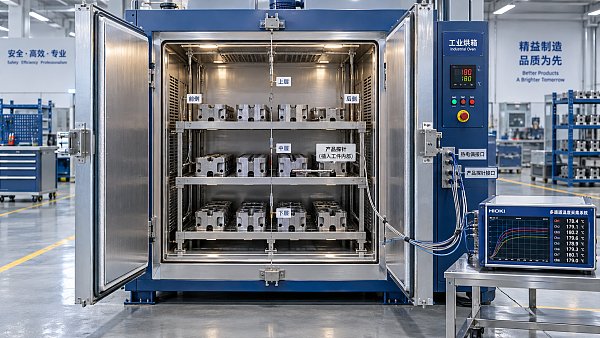
Product probes require a separate placement rationale. Position them at locations expected to heat most slowly or reach potentially damaging temperatures. Depending on the item, that may mean a thick section, an internal cavity, the center of a packed container, or an exposed surface.
Describe how probes are attached or inserted. Poor surface contact can allow a probe to respond mainly to surrounding air. A drilled hole, adhesive, or fastening method can alter local heat transfer, so the installation must suit the material and measurement purpose.
In conveyor systems, capture the temperature profile experienced by the moving load, including differences across the belt and through relevant zones. A stationary measurement beside the conveyor does not represent the complete exposure of a moving product.
Check the complete measurement chain
Use sensors and a data logger suitable for the operating temperature, exposure duration, atmosphere, and required measurement accuracy. Calibration evidence should cover the relevant range and establish traceability for the measurement chain used in the study.
Account for the sensor, logger channel, connectors, extension cable, and any applicable calibration correction. With thermocouples, incompatible extension materials or incorrect connections can introduce errors even when the sensing junction is sound.
Choose a recording interval that resolves the behavior being evaluated. Slow logging can hide brief overshoot, controller cycling, or recovery after opening the door. Excessively frequent readings add little if sensor response is too slow to capture those events.
Synchronize chamber probes, product probes, controller data, and event records. Before the run, check channel identification and look for implausible differences under a common stable condition. Route cables through a suitable access point so they do not compromise the door seal or obstruct airflow.
Define how measurement uncertainty affects acceptance before collecting results. A reading close to a limit needs a documented decision rule. Where the governing procedure requires a margin or guard band, apply it consistently rather than introducing it after seeing the outcome.
Run the production sequence and define when evaluation begins
Start by checking the oven’s operating condition: fan function, airflow settings, seals, dampers, racks, and heater controls. A test performed with an abnormal equipment condition cannot establish normal production performance. Record settings that operators can change, including exhaust and recirculation arrangements.
Follow the actual loading sequence. If production loads a preheated oven, reproduce the door opening and loading activity. If production starts cold, record that cycle. Capture the complete temperature history even when the uniformity acceptance period covers only a defined portion.
Distinguish controller recovery, chamber stabilization, and product readiness. These events may occur at different times. The controller may return to setpoint while a shielded chamber location remains cool and the product core continues heating.
Use an objective stabilization rule that considers all relevant chamber locations and their behavior over time. Do not begin the evaluation simply because the controller display appears steady. Record long enough to assess normal control cycling and any drift relevant to the processing period.
If product exposure must begin only after every designated product location reaches its required temperature, use those measurements to establish the start of that exposure. A chamber stabilization timestamp cannot substitute for product readiness.
Where routine operation includes door openings, loading changes, or other disturbances, assess their effect on recovery and product exposure. Keep the evaluation of those events clearly defined so that unacceptable process interruptions are not hidden by a later stable period.
Evaluate locations, timing, and exposure separately
Plot the temperature traces together, but retain individual channel results. At each recorded time within the evaluation period, identify the hottest and coldest chamber locations. Their difference gives the instantaneous spatial spread:
Spatial spread at time t = highest chamber reading at t − lowest chamber reading at t.
For each location, also report its minimum and maximum temperature during the evaluation period and any time outside the permitted band. These results distinguish a persistent cold zone from a short excursion or a chamber-wide control oscillation.
Subtracting the lowest reading anywhere in the entire run from the highest reading anywhere in that run combines spatial variation with changes over time. It may be useful as an overall range, but it is not the same as simultaneous temperature uniformity. Averaging readings can likewise conceal excursions that matter to acceptance.
Review product data against the product’s own requirements. Consider time to reach temperature, required exposure, and excessive temperature where damage is possible. Processes based on cumulative thermal exposure need their approved calculation method; a chamber spread alone cannot demonstrate that exposure.
A controller offset deserves separate attention. A spatially uniform oven may run consistently above or below its intended operating temperature. Correcting that offset can address the overall level, but it will not repair an airflow-related hot or cold zone.
Resolve failures and make the approved operating limits usable
When a location fails, examine its position, nearby load geometry, fan behavior, door leakage, and controller cycle. A cold region behind tightly packed trays suggests a different cause from synchronized oscillation across the chamber.
Check suspected measurement faults before dismissing data. A loose probe, wrong channel assignment, or unintended surface contact can distort a result, but exclusion needs a documented technical basis. Preserve the original record and explain any repeat measurement.
Corrective actions may include changing spacing, restricting usable rack positions, repairing circulation components, adjusting control settings, or extending product heating time. Retest the affected configuration after the change. A longer hold may improve product heating without resolving unacceptable chamber variation.
The validation report should contain the approved protocol, equipment identification, calibration records, sensor map, load arrangement, operating settings, raw data, evaluation results, deviations, and final disposition. State which recipes, loads, temperatures, and working-zone boundaries are approved.
Turn those boundaries into instructions that operators can follow: permitted loading patterns, required clearances, cycle settings, and the rule for starting exposure time. Define review triggers for changes to fans, heaters, controls, fixtures, load patterns, or recipes. The test is useful only when daily operation preserves the conditions that made the result acceptable.
Recommended for You
 Digital SeaHow Does a Ballast Cleaner Screening System Separate Track Ballast?Discover how a ballast cleaner screening system separates reusable stone from fines, what affects performance, and how to assess the results.By: Captain Kenji SatoNov 14, 2026
 Smart MetersPakistan to Seek World Bank and ADB Funding for Smart MetersPakistan seeks World Bank and ADB funding for smart meters on distribution transformers. Explore the plan to tackle power theft and improve grid efficiency.By: Dr. Elena VoltNov 13, 2026
 Digital SeaWhat Is Precision Medicine and How Does It Guide Treatment?Discover how precision medicine uses biomarkers and genetic insights to guide treatment, where it can help, and what to ask before testing.By: Captain Kenji SatoNov 13, 2026
 Grid Resilience2026 CSEE Annual Meeting Opens with Focus on AI and Power SystemsThe 2026 CSEE Annual Meeting explores AI, low-carbon power systems and ultra-high-voltage transmission. Discover why these discussions matter.By: Dr. Elena VoltNov 12, 2026
 Digital SeaShip Radar Detection Range: How Far Can It See and What Limits It?Ship radar detection range depends on more than the display scale. Discover how antenna height, weather, target size, and settings affect what radar can see.By: Captain Kenji SatoNov 12, 2026
 UHV TransformersGE Vernova to Invest $34.5 Million in Louisiana Transformer Plant ExpansionGE Vernova plans a $34.5 million transformer plant expansion in Louisiana. Explore its potential impact on North American supply and procurement.By: Dr. Elena VoltNov 11, 2026
 Digital SeaMetro Station Noise Criteria: Limits and Measurement MethodsExplore metro station noise criteria, applicable limits and measurement methods. Learn how to select metrics and assess compliance with confidence.By: Captain Kenji SatoNov 11, 2026
 Digital SeaKongsberg Maritime Unveils Arctic Hunter Unmanned Surface VesselKongsberg Maritime's Arctic Hunter unmanned surface vessel is proposed for the Royal Navy's Type 92 programme. Explore its technology and procurement implications.By: Captain Kenji SatoNov 10, 2026
 Sorting RobotsHow Accurate Is AI in Food Quality Control? Metrics and Testing MethodsExplore AI in food quality control accuracy, from recall and false negatives to validation methods. Learn how to assess real-world inspection reliability.By: Marcus SterlingNov 10, 2026
 UHV TransformersGE Vernova Selected for 6 GW HVDC Link in IndiaGE Vernova will design a 6 GW HVDC link for PGCIL, connecting Rajasthan and South Kalamb to support India's clean energy transition. Discover the project.By: Dr. Elena VoltNov 09, 2026
 Grid ResilienceEurope's Grid Compliance Standards in 2026: Generator Connection RequirementsExplore new grid compliance standards 2026 Europe projects must address, from generator connection rules to testing and documentation. Prepare for approval.By: Dr. Elena VoltNov 09, 2026
 Technical FabricsNonwoven Bonding Cost Data: Comparing Thermal and Chemical ProcessesExplore nonwoven bonding cost data to compare thermal and chemical processes, assess usable yield, and choose the best-value option for your application.By: Chloe DuboisNov 08, 2026
 Fiber LasersIndustrial Lasers to 2035: Automotive Lightweighting and Precision Welding Drive DemandExplore the industrial laser market outlook to 2035 and discover how automotive lightweighting and precision welding could shape demand and procurement.By: Dr. Hideo TanakaNov 07, 2026
 Technical FabricsChoosing Geotextile Under Railway Ballast: Key Performance RequirementsChoosing geotextile under railway ballast? Explore essential filtration, drainage, strength and durability criteria to make a confident, project-specific selection.By: Chloe DuboisNov 07, 2026
 Digital SeaChoosing Rail Welding Equipment for Maintenance: Field Conditions and Weld TypesChoose rail welding equipment for maintenance with confidence. Compare welding methods, field constraints, inspection needs, and lifecycle costs.By: Captain Kenji SatoNov 06, 2026
 Digital SeaIndia Broadband Forum Urges Stronger Submarine Cable ResilienceIndia’s submarine cable resilience is in focus as the Broadband India Forum urges faster repairs, more vessels and stronger landing infrastructure.By: Captain Kenji SatoNov 06, 2026
 Digital SeaChoosing a Railway Network Switch Supplier: Reliability and Support CriteriaChoosing a railway network switch supplier? Compare reliability, standards evidence, cybersecurity, and lifecycle support to reduce project risk.By: Captain Kenji SatoNov 05, 2026
 Grid ResilienceUS Grid Equipment Import Ban Raises Cost and Implementation ConcernsThe US grid equipment import ban raises concerns over costs and delivery delays. Explore how unclear criteria could affect procurement and supply chains.By: Dr. Elena VoltNov 05, 2026
 Digital SeaRailway Coupler Price: How Type and Specifications Affect QuotesRailway coupler price depends on type, specifications, and order scope. Learn how to compare quotes, avoid hidden costs, and make a confident buying decision.By: Captain Kenji SatoNov 04, 2026
 Grid ResilienceGlobal Smart Grid Companies Raise $3 Billion in First Nine Months of 2026Global smart grid companies raised $3 billion in the first nine months of 2026. Explore the funding breakdown and potential implications for buyers and suppliers.By: Dr. Elena VoltNov 04, 2026
 Digital SeaChoosing Wholesale Pet Toys: How to Evaluate Suppliers and Minimum OrdersWholesale pet toys: learn how to assess suppliers, compare minimum orders and landed costs, and reduce inventory risk before you buy.By: Captain Kenji SatoNov 03, 2026
 Digital SeaSustainable Packaging Design: How to Choose Materials and Reduce WasteDiscover how sustainable packaging design helps reduce waste, protect products, and control costs with practical material choices and proven testing strategies.By: Captain Kenji SatoNov 02, 2026
 Technical FabricsUSMCA's First Joint Review Puts Textile Supply Chain Rules in FocusUSMCA's first joint review puts textile supply chain rules in focus. Explore potential impacts on origin compliance, sourcing and tariff treatment.By: Chloe DuboisNov 02, 2026
 Digital SeaManufacturing KPI Benchmarking: How to Compare Production PerformanceBenchmarking KPI manufacturing performance? Learn how to compare OEE, quality and downtime, identify meaningful gaps, and turn insights into practical improvements.By: Captain Kenji SatoNov 01, 2026
 Smart MetersCCI Approves Adani Energy Solutions' ₹305 Billion Acquisition of IntelliSmartCCI approves Adani Energy Solutions' ₹305 billion acquisition of IntelliSmart. Discover what the deal could mean for India's smart meter market.By: Dr. Elena VoltNov 01, 2026
 Digital SeaChoosing a Coin Laundry Machinery OEM: What Buyers Should EvaluateChoosing a coin laundry machinery OEM? Compare machine specifications, payment integration, lifecycle costs, and support to make a confident buying decision.By: Captain Kenji SatoOct 31, 2026
 Grid ResilienceUS Energy Department Announces $237 Million Grid SCALED Funding ProgramExplore the DOE's $237 million Grid SCALED funding program and its goals to strengthen grid equipment supply chains, lower electricity costs, and improve resilience.By: Dr. Elena VoltOct 31, 2026
 UHV TransformersA Decade of UHV Power in Shandong: Province Leads in Station NumbersShandong UHV power leads China in station numbers. Explore a decade of grid development and its implications for electricity supply and business planning.By: Dr. Elena VoltOct 30, 2026
 Digital SeaChoosing a Composite Train Body Panel Manufacturer: Fire Safety and Quality ChecksChoosing a composite train body panels manufacturer? Learn how to verify fire test evidence, audit production quality, and avoid costly approval gaps before you buy.By: Captain Kenji SatoOct 29, 2026
 Subsea ROV/AUVOcean Infinity Deploys Six AUVs Together Beyond 5,000 MetresOcean Infinity reportedly deployed six HUGIN AUVs beyond 5,200 metres. Explore what concurrent deepwater missions could mean for seabed surveys and procurement.By: Captain Kenji SatoOct 29, 2026
 Grid ResilienceRenewable Energy Grid Balancing: How Storage and Demand Response Work TogetherExplore renewable energy grid balancing with storage and demand response. Learn how coordinated controls manage shortfalls, absorb surplus power, and improve grid reliability.By: Dr. Elena VoltOct 28, 2026