Battery manufacturing is reshaping the industrial ovens market by increasing demand for precise drying, controlled atmospheres, and thermal equipment that can scale without compromising production quality.
For business evaluators, the strongest opportunities involve equipment that improves usable output and operating economics. Announced battery capacity alone provides an incomplete picture of commercial potential.
Oven performance can influence electrode consistency, residual moisture, energy consumption, and production bottlenecks. These effects make thermal equipment a strategic purchasing decision for battery manufacturers.
However, battery plants require different thermal systems at different production stages. Electrode dryers, vacuum ovens, and materials processing furnaces serve distinct purposes and should be evaluated separately.
The practical question is whether a supplier can meet a specific process requirement at an acceptable lifetime cost, with credible safety provisions and dependable local support.
This assessment requires looking beyond headline growth forecasts to examine process compatibility, factory utilization, commissioning risk, and the relationship between thermal performance and saleable production.
Where battery production creates demand for industrial ovens
Battery manufacturing generates thermal equipment demand across electrode production, component drying, and selected assembly operations. Upstream active material production also requires heat treatment, often using specialized furnaces.
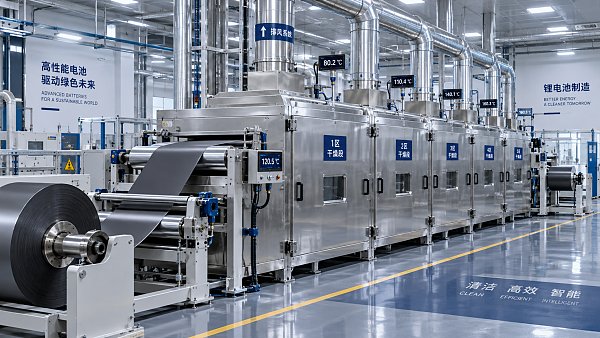
During electrode manufacturing, coated metal foils pass through drying systems that remove solvents or water. Drying conditions influence coating integrity and the consistency of downstream processing.
Excessively aggressive drying can contribute to binder migration or coating defects. Insufficient drying leaves residual liquid, creating quality problems that later production stages may not resolve.
Vacuum drying addresses another requirement: removing moisture from electrodes or cell components before moisture sensitive operations. Required conditions depend on materials, product design, and validated manufacturing recipes.
These applications create different purchasing priorities. Continuous electrode dryers emphasize stable web handling and evaporation control, while vacuum systems emphasize pressure performance, moisture removal, and batch consistency.
Cell formation is primarily an electrochemical process, although temperature management matters. Formation chambers and environmental systems should not automatically be counted as conventional industrial oven demand.
Similarly, cathode calcination and other high temperature materials processes may belong to industrial furnace categories. Market estimates become misleading when analysts combine equipment segments without explaining boundaries.
Business evaluators should therefore map each supplier’s products to specific manufacturing steps. A broad claim of battery exposure says little about addressable spending or technical competitiveness.
Why capacity announcements are an unreliable demand forecast
Battery factory announcements indicate potential equipment demand, but they do not establish purchase timing. Projects can change scope, delay construction, or commission production lines gradually.
A more useful forecast distinguishes announced capacity, financed projects, installed equipment, and operating output. Each stage carries a different probability of generating near term supplier revenue.
Utilization also matters. Manufacturers with underused lines may prioritize process improvements and maintenance before ordering additional ovens, even when long term battery demand remains attractive.
Conversely, an existing plant may invest in replacement equipment without expanding its nameplate capacity. Better drying performance can unlock throughput or support a new electrode formulation.
Evaluators should examine customer funding, construction progress, utility readiness, and equipment procurement milestones. These indicators provide stronger evidence of executable demand than promotional capacity figures.
Supplier order books require similar scrutiny. Deposits, cancellation provisions, customer concentration, and delivery schedules help determine whether reported orders represent durable business or uncertain project commitments.
The industrial ovens market therefore benefits from battery investment unevenly. Suppliers serving qualified projects and operational improvements may outperform those dependent on speculative greenfield expansion.
Which technical capabilities justify a higher purchase price?
Temperature uniformity matters, but a single specification rarely captures process performance. Buyers need evidence that the equipment achieves required results under representative production loading conditions.
For continuous dryers, relevant variables include airflow distribution, exhaust management, residence time, and web speed. These factors interact, so evaluating each specification independently can obscure limitations.
For vacuum ovens, chamber temperature alone is insufficient. Pumping capacity, leakage, load configuration, and moisture release characteristics all affect drying time and final material condition.
Ask suppliers to define their performance claims precisely. Uniformity measured inside an empty chamber does not demonstrate equivalent temperatures throughout a densely loaded production batch.
Acceptance criteria should connect equipment performance to process outcomes, including residual moisture, cycle time, coating quality, or other indicators agreed with the manufacturer’s process team.
Recipe control, calibrated instrumentation, and traceable production records can support consistent operation. Their value depends on whether the factory can use the resulting data effectively.
Automation deserves a similar test: does it reduce handling losses, prevent recipe errors, or improve throughput? Connectivity alone does not establish a meaningful operating advantage.
A premium becomes defensible when validated performance produces measurable benefits. Buyers should require representative trials and explicit acceptance conditions before assigning financial value to supplier claims.
How to compare total cost per unit of usable production
Purchase price is only one component of ownership cost. Installation, exhaust systems, vacuum pumps, solvent management, utilities, maintenance, and production losses can materially change investment economics.
For commercial comparison, calculate cost per accepted unit of production. Depending on the application, this could mean qualified electrode area, dried component batches, or saleable cells.
The denominator matters because nominal capacity can overstate value. An inexpensive oven delivering inconsistent quality may produce less usable output than a more capable alternative.
Energy comparisons should use equivalent loading, recipes, and output requirements. Installed electrical power is a sizing parameter; it does not directly establish energy consumed per production unit.
Include auxiliary equipment in the energy boundary. Vacuum pumps, air handling, cooling, and solvent recovery can significantly influence consumption even when the oven itself appears efficient.
Heat recovery may improve economics, but feasibility depends on exhaust composition, temperature, contamination risks, and operating schedules. Savings should reflect the actual process configuration and utilization.
A practical financial model compares annualized capital cost, utilities, maintenance, consumables, labor, and expected downtime against accepted output. Apply consistent assumptions across all shortlisted suppliers.
Test the model under lower utilization, higher energy prices, and slower cycle times. Equipment that remains economical under these scenarios offers a stronger investment case.
How chemistry changes affect equipment flexibility
Changes in battery chemistry influence thermal equipment requirements, but chemistry labels alone are insufficient. Electrode formulations, binders, solvents, coating thickness, and manufacturing routes determine actual needs.
Lithium iron phosphate and nickel rich cathode production can involve different upstream thermal processes. Downstream electrode drying requirements still depend heavily on the selected formulation.
Water based processing may reduce reliance on certain organic solvents, yet it does not eliminate drying requirements. Evaporation behavior, corrosion considerations, and energy demand still require assessment.
Dry electrode manufacturing could reduce conventional solvent drying in applications where it becomes commercially established. Its adoption rate and equipment implications remain dependent on demonstrated production performance.
Solid state battery approaches introduce further variation in materials and processing. Buyers should avoid assuming that one oven platform can accommodate every emerging manufacturing route.
Useful flexibility includes adjustable process windows, modular capacity, accessible controls, and practical retrofit options. Each feature should correspond to a credible future requirement identified by the customer.
Request a documented changeover assessment covering recipe qualification, throughput, utilities, and modification costs. This helps distinguish meaningful adaptability from broad claims about future compatibility and readiness.
For investors and procurement teams, equipment versatility is valuable when it reduces identifiable transition costs. Paying for undefined flexibility can weaken returns without reducing material risk.
Which safety and delivery risks deserve commercial scrutiny?
Solvent handling can materially affect project scope. Where flammable vapors are present, ventilation, monitoring, interlocks, and protective measures must match the process hazards and applicable requirements.
Vacuum equipment introduces additional considerations, including chamber integrity, pressure controls, and pump maintenance. Safety reviews should also examine cleaning, servicing, and foreseeable failures during normal operation.
Depending on equipment design and location, relevant requirements may include NFPA 86, EN 1539, electrical standards, and local regulations. Applicability requires assessment by qualified specialists.
A general certification claim cannot replace project specific compliance evidence. Buyers need documentation showing how the proposed system addresses its intended materials, operating conditions, and jurisdiction.
Delivery risk extends beyond the oven shipment. Exhaust capacity, electrical infrastructure, controls integration, and building readiness can delay commissioning and increase the cost of idle assets.
Clarify which party owns each interface and acceptance milestone. Undefined responsibilities can turn technically capable equipment into a prolonged installation dispute or an expensive production delay.
Aftermarket support also affects commercial resilience. Assess spare parts availability, service response, remote diagnostics, and access to trained technicians in the region where equipment will operate.
For supplier evaluation, examine warranty obligations and commissioning resources alongside revenue growth. Rapid expansion can strain engineering capacity, field service, and working capital during simultaneous installations.
What makes a battery oven investment commercially attractive?
A credible opportunity combines an executable customer project, a defined thermal process, validated equipment performance, and attractive economics at realistic utilization. Market growth alone cannot supply these conditions.
Procurement teams should shortlist suppliers using process fit and representative trial results, then compare ownership costs. Final decisions should incorporate integration responsibilities, acceptance terms, and service capability.
Business evaluators assessing suppliers should investigate customer concentration, application expertise, order quality, and aftermarket revenue. These factors help explain whether battery exposure can support durable earnings.
The strongest competitive positions often develop around difficult process requirements and accumulated application knowledge. Standardized equipment may face greater price pressure where buyers can readily substitute suppliers.
Battery manufacturing is changing the industrial ovens market by raising expectations for quality, efficiency, and integration. Attractive investments translate those expectations into verified production benefits.
The decisive measure is reliable output at a defensible lifetime cost. That standard helps buyers and investors distinguish sustainable commercial value from spending driven by capacity announcements.