BDI: 1,842 ▼ 1.2%
COTTON NO.2: 84.12 ▲ 0.4%
LME COPPER: 8,432.50 ▲ 2.1%
FOOD SAFETY INDEX: 94.2 ARCHIVE_SECURED
OPTICAL INDEX: 11,204.09 STABLE
BDI: 1,842 ▼ 1.2%

SECTOR INDEX
V.24.08 ARCHIVE
Hot Articles
- How Does a Ballast Cleaner Screening System Separate Track Ballast?Discover how a ballast cleaner screening system separates reusable stone from fines, what affects performance, and how to assess the results.
- Pakistan to Seek World Bank and ADB Funding for Smart MetersPakistan seeks World Bank and ADB funding for smart meters on distribution transformers. Explore the plan to tackle power theft and improve grid efficiency.
- What Is Precision Medicine and How Does It Guide Treatment?Discover how precision medicine uses biomarkers and genetic insights to guide treatment, where it can help, and what to ask before testing.
When is aseptic food processing a better choice than hot filling?


When is aseptic food processing a better choice than hot filling?
Aseptic food processing is usually the stronger choice when a product must remain shelf-stable without refrigeration, cannot tolerate prolonged heating, or needs packaging unsuitable for hot filling. But those advantages only matter if the plant can maintain and validate an aseptic system. For suitable acidic beverages, hot filling often remains the more practical option.
The decision starts with product acidity, microbial hazards, formulation, and package design—not the advertised speed of the filler. Food aseptic processing separates product sterilization from package sterilization, then brings them together under controlled aseptic conditions. Hot filling uses the product’s heat to help control contamination on internal package surfaces. That difference affects everything from flavor retention to restart procedures after a stoppage.
Product acidity sets the first boundary
Before comparing equipment quotations, establish whether the formulation is acidic, acidified, or low-acid under the rules of the destination market. In the United States, 21 CFR Part 113 generally defines low-acid foods using a finished equilibrium pH above 4.6 and water activity above 0.85, subject to specified exclusions. Part 114 addresses acidified foods. These are regulatory classification points, not temperatures or instructions for designing a safe process.
For a conventional acidic juice drink or fruit beverage, a validated hot-fill process may provide the required microbial control without a fully aseptic filling environment. The operating window still depends on the formulation, relevant spoilage organisms, container geometry, closure, filling temperature, and exposure time. A pH reading alone does not establish shelf stability.
For low-acid products such as many dairy beverages, plant-based drinks, soups, and nutritional liquids, conventional beverage hot filling is generally not an adequate route to ambient shelf stability. Relevant spore-forming organisms require a different level of control. Aseptic processing becomes a serious candidate, although retort processing may also be appropriate. The real comparison is therefore sometimes aseptic versus retort—not aseptic versus hot fill.
Use the actual commercial recipe for this assessment. Protein additions, mineral fortification, suspended solids, and formulation changes can affect pH, thermal behavior, or microbial protection. If acidification is involved, equilibrium pH and variability across the product matter more than a convenient reading from one freshly mixed sample.
Aseptic processing wins on quality only when the whole thermal history improves
Aseptic systems can use high-temperature, short-time product treatment followed by rapid cooling before filling. For some formulations, that reduces cumulative heat damage compared with holding a product hot through filling and package cooling. This can help preserve flavor, color, and heat-sensitive components while meeting the required microbial lethality.
The important word is “can.” A poorly matched heat exchanger, excessive residence time, or repeated recirculation can erase the expected quality advantage. Evaluators should compare the complete temperature-time history, including startup, balance-tank holding, diversion, and shutdown—not just the nominal sterilization temperature.
Consider a protein-fortified beverage. Its challenge may be cooked flavor, sedimentation, or heat-induced aggregation rather than microbial control alone. Direct steam heating may offer rapid heating and cooling, but steam quality, condensate addition, and flash removal need evaluation. An indirect tubular system avoids direct steam contact, yet fouling and heat-transfer behavior can constrain the operating window. Neither design is automatically superior.
A clear acidic beverage with acceptable flavor after hot filling presents a different decision. If the existing process already meets shelf-life and sensory requirements, switching to aseptic filling needs another justification: a new package, a broader product portfolio, or a demonstrated improvement worth the added operating burden.
The package changes the process—not just the shelf appearance
Hot-fill containers must tolerate the validated filling temperature and subsequent cooling. Depending on the package, this may require heat-resistant materials, structural features to accommodate vacuum, and compatible closures. Package cooling is also part of the line design; it affects thermal exposure, utility demand, and floor space.
Aseptic filling can allow packages that would deform under hot-fill conditions because the treated product is cooled before filling. That creates options for certain lightweight bottles, cartons, and other formats. However, the package and closure must withstand their own decontamination process and maintain integrity throughout distribution. Oxygen and light barriers may still determine shelf life even when microbial control is satisfactory.
Evaluate the exact container, neck finish, cap, liner, and material combination. A filler described as compatible with “PET bottles” does not establish compatibility with every bottle design. Sterilant access, shadowed surfaces, exposure conditions, residual limits where applicable, and seal performance require evidence for the proposed configuration.
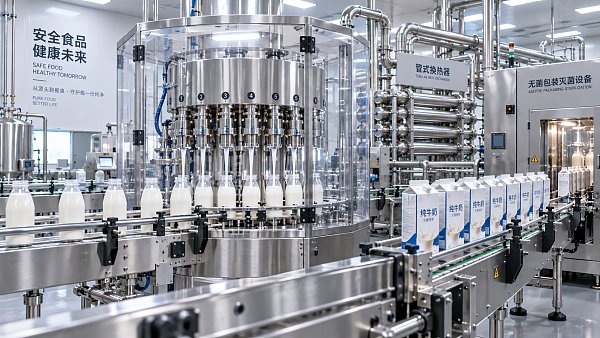
The useful process distinction is simple: hot filling relies on a validated hot-product-to-package contact sequence, while aseptic filling requires separately treated product and packaging to meet inside a maintained aseptic boundary. A line review should trace both paths, including closures and every downstream product-contact surface.
Viscosity and particles can overturn an attractive proposal
Equipment selection becomes less straightforward when the product contains pulp, fibers, cereal pieces, or vegetable particles. The liquid phase and the slowest-heating particle may not receive equivalent treatment. Particle size, distribution, density, and movement through the holding section must be considered during process development.
Viscosity introduces another complication. A sauce that appears pumpable in a laboratory sample may behave differently at processing temperature or after shear. Pressure drop, residence-time distribution, pump selection, and heat-exchanger fouling can all change. A quoted flow rate for water is not a dependable production rate for that sauce.
Ask suppliers to define the validated product envelope: viscosity conditions, maximum particle dimensions, solids loading, temperature limits, and supported package sizes. Products outside that envelope need further assessment. For a portfolio containing both smooth beverages and chunky soups, one aseptic line may not be the sensible answer, even if both categories need ambient distribution.
The decisive cost is saleable output between interventions
Aseptic equipment typically carries greater system complexity: package decontamination, sterile-zone controls, instrumentation, specialized utilities, and validated cleaning and sterilization sequences. Whether that complexity pays back depends heavily on production scheduling. Long campaigns of compatible products can support the investment; frequent short runs can make it difficult to recover.
Compare total operating cost using the intended SKU schedule rather than continuous nameplate production. Include these often-overlooked items:
- Product lost during startup, diversion, changeover, and end-of-run recovery.
- Cleaning-in-place and sterilization-in-place time, chemicals, water, and energy.
- Package decontamination consumables, maintenance parts, and waste handling.
- Microbiological verification, product-release procedures, and specialist support.
- The time and materials needed to restore validated conditions after different faults.
Heat regeneration can reduce thermal utility demand in some aseptic systems, while package changes may alter material and transport costs. Neither should be treated as a guaranteed saving. Obtain a mass-and-energy balance for the proposed formulation, package, and throughput. An aseptic line may be commercially stronger because it enables a required low-acid product—not because every operating expense is lower.
For a factory running many short batches of acidic drinks, a well-designed hot-fill line may remain the better fit. It still requires disciplined hygiene and validated controls, but avoids some of the sterile-boundary management that an aseptic operation demands.
Validation and recovery deserve as much attention as normal production
Commercial sterility does not mean the absolute absence of every microorganism. It concerns organisms capable of growing under the intended nonrefrigerated storage and distribution conditions, together with the applicable food-safety requirements. The process must be established for the product and system; an equipment certificate cannot substitute for that work.
For aseptic processing, validation must address product treatment, downstream equipment sterilization, package and closure treatment, and maintenance of aseptic conditions during filling. Depending on the market and product, a qualified process authority or equivalent specialist should establish or review the scheduled process. Confirm applicable requirements early, especially when one line will supply several jurisdictions.
A revealing supplier question is: “What happens after loss of sterile-air pressure, insufficient holding temperature, or a package-treatment deviation?” The answer should identify automatic actions, affected-product segregation, restart conditions, and records. “The operator resets the alarm” is not a sufficient control strategy.
This also tests plant readiness. Aseptic production requires trained operators, dependable utilities, maintenance discipline, and clear escalation rules. If local service support is weak or replacement components have long lead times, those constraints belong in the selection decision—not in a troubleshooting discussion after installation.
Make the selection against a defined product envelope
Aseptic processing is the better choice when validated ambient stability, meaningful quality benefits, or package requirements justify its complexity—and the facility can sustain the operating controls. Hot filling remains compelling when suitable acidic products, proven heat-tolerant packaging, and manageable sensory changes meet the business requirement.
For an industrial benchmarking hub such as Global Multi-Core Enterprise (G-MCE), the useful comparison is not a ranking of filler specifications. It connects food-processing performance with utility reliability, packaging supply, service capability, and destination-market requirements. General machinery standards and supplier credentials support due diligence, but do not replace product-specific food-safety validation.
Before requesting final quotations, define representative formulations, worst-case viscosity and particles, target shelf life, distribution conditions, package configurations, and expected campaign lengths. Then request trials and acceptance criteria against that envelope. Choose the process that reliably produces the required food in the required package—not the technology with the most impressive standalone specification.
Recommended for You
 Digital SeaHow Does a Ballast Cleaner Screening System Separate Track Ballast?Discover how a ballast cleaner screening system separates reusable stone from fines, what affects performance, and how to assess the results.By: Captain Kenji SatoNov 14, 2026
 Smart MetersPakistan to Seek World Bank and ADB Funding for Smart MetersPakistan seeks World Bank and ADB funding for smart meters on distribution transformers. Explore the plan to tackle power theft and improve grid efficiency.By: Dr. Elena VoltNov 13, 2026
 Digital SeaWhat Is Precision Medicine and How Does It Guide Treatment?Discover how precision medicine uses biomarkers and genetic insights to guide treatment, where it can help, and what to ask before testing.By: Captain Kenji SatoNov 13, 2026
 Grid Resilience2026 CSEE Annual Meeting Opens with Focus on AI and Power SystemsThe 2026 CSEE Annual Meeting explores AI, low-carbon power systems and ultra-high-voltage transmission. Discover why these discussions matter.By: Dr. Elena VoltNov 12, 2026
 Digital SeaShip Radar Detection Range: How Far Can It See and What Limits It?Ship radar detection range depends on more than the display scale. Discover how antenna height, weather, target size, and settings affect what radar can see.By: Captain Kenji SatoNov 12, 2026
 UHV TransformersGE Vernova to Invest $34.5 Million in Louisiana Transformer Plant ExpansionGE Vernova plans a $34.5 million transformer plant expansion in Louisiana. Explore its potential impact on North American supply and procurement.By: Dr. Elena VoltNov 11, 2026
 Digital SeaMetro Station Noise Criteria: Limits and Measurement MethodsExplore metro station noise criteria, applicable limits and measurement methods. Learn how to select metrics and assess compliance with confidence.By: Captain Kenji SatoNov 11, 2026
 Digital SeaKongsberg Maritime Unveils Arctic Hunter Unmanned Surface VesselKongsberg Maritime's Arctic Hunter unmanned surface vessel is proposed for the Royal Navy's Type 92 programme. Explore its technology and procurement implications.By: Captain Kenji SatoNov 10, 2026
 Sorting RobotsHow Accurate Is AI in Food Quality Control? Metrics and Testing MethodsExplore AI in food quality control accuracy, from recall and false negatives to validation methods. Learn how to assess real-world inspection reliability.By: Marcus SterlingNov 10, 2026
 UHV TransformersGE Vernova Selected for 6 GW HVDC Link in IndiaGE Vernova will design a 6 GW HVDC link for PGCIL, connecting Rajasthan and South Kalamb to support India's clean energy transition. Discover the project.By: Dr. Elena VoltNov 09, 2026
 Grid ResilienceEurope's Grid Compliance Standards in 2026: Generator Connection RequirementsExplore new grid compliance standards 2026 Europe projects must address, from generator connection rules to testing and documentation. Prepare for approval.By: Dr. Elena VoltNov 09, 2026
 Technical FabricsNonwoven Bonding Cost Data: Comparing Thermal and Chemical ProcessesExplore nonwoven bonding cost data to compare thermal and chemical processes, assess usable yield, and choose the best-value option for your application.By: Chloe DuboisNov 08, 2026
 Fiber LasersIndustrial Lasers to 2035: Automotive Lightweighting and Precision Welding Drive DemandExplore the industrial laser market outlook to 2035 and discover how automotive lightweighting and precision welding could shape demand and procurement.By: Dr. Hideo TanakaNov 07, 2026
 Technical FabricsChoosing Geotextile Under Railway Ballast: Key Performance RequirementsChoosing geotextile under railway ballast? Explore essential filtration, drainage, strength and durability criteria to make a confident, project-specific selection.By: Chloe DuboisNov 07, 2026
 Digital SeaChoosing Rail Welding Equipment for Maintenance: Field Conditions and Weld TypesChoose rail welding equipment for maintenance with confidence. Compare welding methods, field constraints, inspection needs, and lifecycle costs.By: Captain Kenji SatoNov 06, 2026
 Digital SeaIndia Broadband Forum Urges Stronger Submarine Cable ResilienceIndia’s submarine cable resilience is in focus as the Broadband India Forum urges faster repairs, more vessels and stronger landing infrastructure.By: Captain Kenji SatoNov 06, 2026
 Digital SeaChoosing a Railway Network Switch Supplier: Reliability and Support CriteriaChoosing a railway network switch supplier? Compare reliability, standards evidence, cybersecurity, and lifecycle support to reduce project risk.By: Captain Kenji SatoNov 05, 2026
 Grid ResilienceUS Grid Equipment Import Ban Raises Cost and Implementation ConcernsThe US grid equipment import ban raises concerns over costs and delivery delays. Explore how unclear criteria could affect procurement and supply chains.By: Dr. Elena VoltNov 05, 2026
 Digital SeaRailway Coupler Price: How Type and Specifications Affect QuotesRailway coupler price depends on type, specifications, and order scope. Learn how to compare quotes, avoid hidden costs, and make a confident buying decision.By: Captain Kenji SatoNov 04, 2026
 Grid ResilienceGlobal Smart Grid Companies Raise $3 Billion in First Nine Months of 2026Global smart grid companies raised $3 billion in the first nine months of 2026. Explore the funding breakdown and potential implications for buyers and suppliers.By: Dr. Elena VoltNov 04, 2026
 Digital SeaChoosing Wholesale Pet Toys: How to Evaluate Suppliers and Minimum OrdersWholesale pet toys: learn how to assess suppliers, compare minimum orders and landed costs, and reduce inventory risk before you buy.By: Captain Kenji SatoNov 03, 2026
 Digital SeaSustainable Packaging Design: How to Choose Materials and Reduce WasteDiscover how sustainable packaging design helps reduce waste, protect products, and control costs with practical material choices and proven testing strategies.By: Captain Kenji SatoNov 02, 2026
 Technical FabricsUSMCA's First Joint Review Puts Textile Supply Chain Rules in FocusUSMCA's first joint review puts textile supply chain rules in focus. Explore potential impacts on origin compliance, sourcing and tariff treatment.By: Chloe DuboisNov 02, 2026
 Digital SeaManufacturing KPI Benchmarking: How to Compare Production PerformanceBenchmarking KPI manufacturing performance? Learn how to compare OEE, quality and downtime, identify meaningful gaps, and turn insights into practical improvements.By: Captain Kenji SatoNov 01, 2026
 Smart MetersCCI Approves Adani Energy Solutions' ₹305 Billion Acquisition of IntelliSmartCCI approves Adani Energy Solutions' ₹305 billion acquisition of IntelliSmart. Discover what the deal could mean for India's smart meter market.By: Dr. Elena VoltNov 01, 2026
 Digital SeaChoosing a Coin Laundry Machinery OEM: What Buyers Should EvaluateChoosing a coin laundry machinery OEM? Compare machine specifications, payment integration, lifecycle costs, and support to make a confident buying decision.By: Captain Kenji SatoOct 31, 2026
 Grid ResilienceUS Energy Department Announces $237 Million Grid SCALED Funding ProgramExplore the DOE's $237 million Grid SCALED funding program and its goals to strengthen grid equipment supply chains, lower electricity costs, and improve resilience.By: Dr. Elena VoltOct 31, 2026
 UHV TransformersA Decade of UHV Power in Shandong: Province Leads in Station NumbersShandong UHV power leads China in station numbers. Explore a decade of grid development and its implications for electricity supply and business planning.By: Dr. Elena VoltOct 30, 2026
 Digital SeaChoosing a Composite Train Body Panel Manufacturer: Fire Safety and Quality ChecksChoosing a composite train body panels manufacturer? Learn how to verify fire test evidence, audit production quality, and avoid costly approval gaps before you buy.By: Captain Kenji SatoOct 29, 2026
 Subsea ROV/AUVOcean Infinity Deploys Six AUVs Together Beyond 5,000 MetresOcean Infinity reportedly deployed six HUGIN AUVs beyond 5,200 metres. Explore what concurrent deepwater missions could mean for seabed surveys and procurement.By: Captain Kenji SatoOct 29, 2026
 Grid ResilienceRenewable Energy Grid Balancing: How Storage and Demand Response Work TogetherExplore renewable energy grid balancing with storage and demand response. Learn how coordinated controls manage shortfalls, absorb surplus power, and improve grid reliability.By: Dr. Elena VoltOct 28, 2026






























