BDI: 1,842 ▼ 1.2%
COTTON NO.2: 84.12 ▲ 0.4%
LME COPPER: 8,432.50 ▲ 2.1%
FOOD SAFETY INDEX: 94.2 ARCHIVE_SECURED
OPTICAL INDEX: 11,204.09 STABLE
BDI: 1,842 ▼ 1.2%

SECTOR INDEX
V.24.08 ARCHIVE
Hot Articles
- How Does a Ballast Cleaner Screening System Separate Track Ballast?Discover how a ballast cleaner screening system separates reusable stone from fines, what affects performance, and how to assess the results.
- Pakistan to Seek World Bank and ADB Funding for Smart MetersPakistan seeks World Bank and ADB funding for smart meters on distribution transformers. Explore the plan to tackle power theft and improve grid efficiency.
- What Is Precision Medicine and How Does It Guide Treatment?Discover how precision medicine uses biomarkers and genetic insights to guide treatment, where it can help, and what to ask before testing.
How to Evaluate Bioreactor Oxygen Transfer Coefficient for Scale-Up Performance


Why kLa Becomes the Real Scale-Up Test
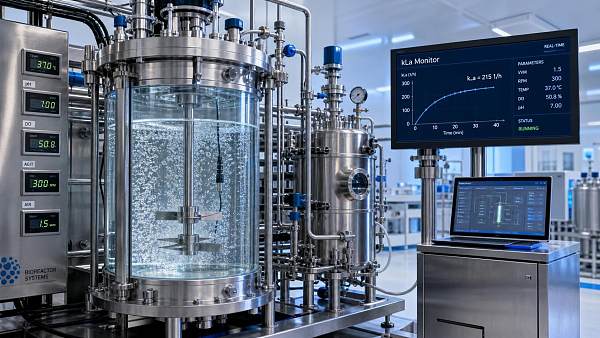
For technical evaluators, the bioreactor oxygen transfer coefficient is rarely just another process number. It is where vessel geometry, sparger design, agitation, gas distribution, broth behavior, and operating philosophy all show up at once. In practice, when people discuss whether a fermentation or cell culture process can be scaled without losing productivity, they are often asking a more specific question: can the larger system still deliver oxygen at the rate the biology demands, and can it do so without creating new shear, foaming, or control problems? That is the context in which the bioreactor oxygen transfer coefficient, usually expressed as kLa, matters.
The term combines two parts. The kL portion describes liquid-side mass transfer, while a represents interfacial area per unit volume. Together they indicate how effectively oxygen moves from gas bubbles into the liquid phase. That sounds straightforward until scale-up begins. A lab reactor may maintain dissolved oxygen with generous impeller power and short bubble residence distances. A production vessel operates under different hydrodynamics, gas hold-up, mixing times, and sometimes different constraints on pressure, heat removal, or contamination control. Two systems can have the same working volume ratio or the same impeller tip speed and still behave very differently in oxygen transfer.
This is why experienced teams do not treat kLa as a single headline value detached from method and context. A number without test conditions is barely useful. The same reactor can produce very different oxygen transfer coefficients depending on gas flow, agitation rate, medium composition, temperature, backpressure, probe response, and whether the measurement is taken in water, a defined medium, or a viscous production broth.
What Should Actually Be Compared
A common mistake in technical reviews is to compare kLa values from vendor literature as if they were directly interchangeable. They often are not. Some are measured by dynamic gassing-out methods, some are estimated from correlations, and some are generated under simplified water-test conditions that reduce foaming and rheology effects. For early screening, those values can still be useful, but only if they are read as indicators of relative behavior rather than guaranteed process performance.
A sound evaluation starts with four questions.
- Under what medium and physical conditions was kLa measured?
- What combination of agitation, aeration, and pressure produced the value?
- Was the result taken at process-relevant scale and fill volume?
- Does the value represent a stable operating window or an extreme point that may not be practical in production?
Those questions matter because oxygen transfer is not just a reactor capability issue; it is a process operating issue. A vessel that reaches an impressive kLa only at very high agitation may be unsuitable for shear-sensitive cells. Another may rely on high gas rates that trigger stripping of carbon dioxide control, excessive foaming, or filter loading. For microbial fermentations, the tolerance is often different, but even there, power cost, antifoam use, and mixing nonuniformity can limit what looks acceptable on paper.
The bioreactor oxygen transfer coefficient should therefore be interpreted with neighboring parameters, not in isolation. Dissolved oxygen setpoint strategy, oxygen uptake rate, power input per volume, superficial gas velocity, mixing time, and pressure envelope all help determine whether a kLa value is operationally meaningful.
How kLa Is Usually Evaluated in Practice
In bioprocess work, the dynamic method is widely discussed because it is practical for many systems. The basic idea is to disturb dissolved oxygen conditions, then observe how oxygen concentration returns toward equilibrium when aeration resumes or process conditions change. From that response, kLa can be estimated. The method is useful, but it has limitations that evaluators should keep in view. Probe lag, control loop behavior, gas blending delays, and nonideal mixing can distort the result, especially in larger vessels.
This is where scale-up reviews often go wrong. Teams assume that because the same calculation formula was used, the values are directly comparable across scales. They may not be. In a bench reactor, probe response might be fast relative to system dynamics. In a production-scale unit, the measurement may reflect both oxygen transfer and mixing heterogeneity. If the vessel has zones with different dissolved oxygen levels, one probe cannot fully represent the whole liquid volume.
When reviewing a kLa dataset, it helps to look for evidence that the measurement window matched the intended process regime. For example, was the reactor tested across the agitation and airflow range that the actual process can sustain? Were tests run at representative working volumes? Was backpressure included if the production system normally uses it? These details often separate a technically credible scale-up study from a brochure-level claim.
The Scale-Up Variables That Change the Meaning of the Number
At larger scale, oxygen transfer is shaped by hydrodynamic compromises. Increasing agitation can improve bubble breakup and interfacial area, but it also increases power draw and may change shear exposure. Raising gas flow can increase oxygen availability, yet larger bubbles or poor distribution can reduce transfer efficiency. Additional pressure can help oxygen solubility, though pressure limits and process sensitivity may narrow that option.
Medium properties also matter more than some early evaluations admit. Water-like calibration systems are convenient, but real broths can behave very differently. Viscosity, biomass concentration, proteins, surfactants, and antifoam all affect bubble coalescence and gas-liquid contact. That means a reactor with strong water-test kLa may not deliver equivalent performance in a dense or non-Newtonian broth. The gap is not a minor correction; in some processes it becomes the reason scale-up targets are missed.
For this reason, a robust evaluation tends to separate three layers of evidence:
For technical benchmarking, these layers are complementary. If only one is available, the evaluator should be clear about what can and cannot be inferred.
Common Misreadings in Vendor and Project Reviews
One frequent misunderstanding is that a higher kLa always means a better reactor. That is too simplistic. The better reactor is the one that reaches the required oxygen transfer range under acceptable process stress and with controllable operating cost. If a design posts a high coefficient by pushing conditions beyond what the biology tolerates, the number has limited value.
Another weak assumption is that maintaining dissolved oxygen at setpoint proves the oxygen transfer problem is solved. Sometimes the control system is compensating aggressively through oxygen enrichment, pressure adjustment, or transient agitation increases. The process may still be close to an oxygen limitation boundary, especially during peak uptake phases. Evaluators should ask what manipulations were needed to maintain control and whether those interventions are sustainable at larger campaign scale.
There is also a tendency to treat scale-up criteria as interchangeable. Constant tip speed, constant power per volume, constant gas flow per liquid volume, and constant kLa each preserve different aspects of reactor behavior. No single rule works universally across organisms and reactor families. In many industrial decisions, the right question is not which criterion is theoretically best, but which one best protects the critical process attribute in that specific system.
What a Technical Evaluator Should Ask For
If the task is to compare vessels, scale-up routes, or supply options, ask for the test method and the operating map rather than a single maximum value. A useful submission should identify agitation range, gas flow range, pressure conditions, temperature, liquid system, and working volume. Where possible, it should also clarify sparger type, impeller configuration, and whether the reported coefficient is volumetric average performance or derived from a limited test point.
For higher-risk projects, especially where transfer margins are narrow, it is worth asking how oxygen transfer was assessed against expected oxygen uptake rate peaks. That shifts the discussion from generic capability to process fit. In commercial terms, this matters because a scale-up failure related to oxygen limitation does not usually appear as one dramatic event. It shows up as slower growth, altered metabolite profile, inconsistent product quality, or compressed control room options during peak demand windows.
Standards also deserve careful handling. While bioreactor performance may be discussed alongside broader quality or engineering frameworks, there is no single universal standard that substitutes for process-specific oxygen transfer evaluation. ISO, ASTM, or related engineering references may help frame equipment quality, testing discipline, or analytical practice, but they do not eliminate the need to review actual operating conditions and biological relevance.
A Better Way to Use kLa in Decision-Making
The most reliable use of the bioreactor oxygen transfer coefficient is comparative and conditional. It helps answer whether a candidate system can deliver enough transfer capacity across the expected operating window, what tradeoffs are needed to reach that window, and how much margin remains when the process moves from development optimism to production reality.
That is especially relevant for organizations evaluating equipment across different industrial supply chains, where data quality can vary widely. A disciplined review does not look for the biggest number. It looks for traceable methods, process-relevant conditions, and evidence that scale-up logic is consistent with the biology and the hardware. In other words, kLa is not the answer by itself. It is a test of whether the reactor story hangs together.
When a scale-up program is being judged, the practical question is straightforward: under the conditions the plant can actually run, does the reactor maintain oxygen transfer with enough margin to protect yield, quality, and control stability? If the available kLa data helps answer that directly, it is useful. If it only decorates a specification sheet, it is not yet an evaluation.
Recommended for You
 Digital SeaHow Does a Ballast Cleaner Screening System Separate Track Ballast?Discover how a ballast cleaner screening system separates reusable stone from fines, what affects performance, and how to assess the results.By: Captain Kenji SatoNov 14, 2026
 Smart MetersPakistan to Seek World Bank and ADB Funding for Smart MetersPakistan seeks World Bank and ADB funding for smart meters on distribution transformers. Explore the plan to tackle power theft and improve grid efficiency.By: Dr. Elena VoltNov 13, 2026
 Digital SeaWhat Is Precision Medicine and How Does It Guide Treatment?Discover how precision medicine uses biomarkers and genetic insights to guide treatment, where it can help, and what to ask before testing.By: Captain Kenji SatoNov 13, 2026
 Grid Resilience2026 CSEE Annual Meeting Opens with Focus on AI and Power SystemsThe 2026 CSEE Annual Meeting explores AI, low-carbon power systems and ultra-high-voltage transmission. Discover why these discussions matter.By: Dr. Elena VoltNov 12, 2026
 Digital SeaShip Radar Detection Range: How Far Can It See and What Limits It?Ship radar detection range depends on more than the display scale. Discover how antenna height, weather, target size, and settings affect what radar can see.By: Captain Kenji SatoNov 12, 2026
 UHV TransformersGE Vernova to Invest $34.5 Million in Louisiana Transformer Plant ExpansionGE Vernova plans a $34.5 million transformer plant expansion in Louisiana. Explore its potential impact on North American supply and procurement.By: Dr. Elena VoltNov 11, 2026
 Digital SeaMetro Station Noise Criteria: Limits and Measurement MethodsExplore metro station noise criteria, applicable limits and measurement methods. Learn how to select metrics and assess compliance with confidence.By: Captain Kenji SatoNov 11, 2026
 Digital SeaKongsberg Maritime Unveils Arctic Hunter Unmanned Surface VesselKongsberg Maritime's Arctic Hunter unmanned surface vessel is proposed for the Royal Navy's Type 92 programme. Explore its technology and procurement implications.By: Captain Kenji SatoNov 10, 2026
 Sorting RobotsHow Accurate Is AI in Food Quality Control? Metrics and Testing MethodsExplore AI in food quality control accuracy, from recall and false negatives to validation methods. Learn how to assess real-world inspection reliability.By: Marcus SterlingNov 10, 2026
 UHV TransformersGE Vernova Selected for 6 GW HVDC Link in IndiaGE Vernova will design a 6 GW HVDC link for PGCIL, connecting Rajasthan and South Kalamb to support India's clean energy transition. Discover the project.By: Dr. Elena VoltNov 09, 2026
 Grid ResilienceEurope's Grid Compliance Standards in 2026: Generator Connection RequirementsExplore new grid compliance standards 2026 Europe projects must address, from generator connection rules to testing and documentation. Prepare for approval.By: Dr. Elena VoltNov 09, 2026
 Technical FabricsNonwoven Bonding Cost Data: Comparing Thermal and Chemical ProcessesExplore nonwoven bonding cost data to compare thermal and chemical processes, assess usable yield, and choose the best-value option for your application.By: Chloe DuboisNov 08, 2026
 Fiber LasersIndustrial Lasers to 2035: Automotive Lightweighting and Precision Welding Drive DemandExplore the industrial laser market outlook to 2035 and discover how automotive lightweighting and precision welding could shape demand and procurement.By: Dr. Hideo TanakaNov 07, 2026
 Technical FabricsChoosing Geotextile Under Railway Ballast: Key Performance RequirementsChoosing geotextile under railway ballast? Explore essential filtration, drainage, strength and durability criteria to make a confident, project-specific selection.By: Chloe DuboisNov 07, 2026
 Digital SeaChoosing Rail Welding Equipment for Maintenance: Field Conditions and Weld TypesChoose rail welding equipment for maintenance with confidence. Compare welding methods, field constraints, inspection needs, and lifecycle costs.By: Captain Kenji SatoNov 06, 2026
 Digital SeaIndia Broadband Forum Urges Stronger Submarine Cable ResilienceIndia’s submarine cable resilience is in focus as the Broadband India Forum urges faster repairs, more vessels and stronger landing infrastructure.By: Captain Kenji SatoNov 06, 2026
 Digital SeaChoosing a Railway Network Switch Supplier: Reliability and Support CriteriaChoosing a railway network switch supplier? Compare reliability, standards evidence, cybersecurity, and lifecycle support to reduce project risk.By: Captain Kenji SatoNov 05, 2026
 Grid ResilienceUS Grid Equipment Import Ban Raises Cost and Implementation ConcernsThe US grid equipment import ban raises concerns over costs and delivery delays. Explore how unclear criteria could affect procurement and supply chains.By: Dr. Elena VoltNov 05, 2026
 Digital SeaRailway Coupler Price: How Type and Specifications Affect QuotesRailway coupler price depends on type, specifications, and order scope. Learn how to compare quotes, avoid hidden costs, and make a confident buying decision.By: Captain Kenji SatoNov 04, 2026
 Grid ResilienceGlobal Smart Grid Companies Raise $3 Billion in First Nine Months of 2026Global smart grid companies raised $3 billion in the first nine months of 2026. Explore the funding breakdown and potential implications for buyers and suppliers.By: Dr. Elena VoltNov 04, 2026
 Digital SeaChoosing Wholesale Pet Toys: How to Evaluate Suppliers and Minimum OrdersWholesale pet toys: learn how to assess suppliers, compare minimum orders and landed costs, and reduce inventory risk before you buy.By: Captain Kenji SatoNov 03, 2026
 Digital SeaSustainable Packaging Design: How to Choose Materials and Reduce WasteDiscover how sustainable packaging design helps reduce waste, protect products, and control costs with practical material choices and proven testing strategies.By: Captain Kenji SatoNov 02, 2026
 Technical FabricsUSMCA's First Joint Review Puts Textile Supply Chain Rules in FocusUSMCA's first joint review puts textile supply chain rules in focus. Explore potential impacts on origin compliance, sourcing and tariff treatment.By: Chloe DuboisNov 02, 2026
 Digital SeaManufacturing KPI Benchmarking: How to Compare Production PerformanceBenchmarking KPI manufacturing performance? Learn how to compare OEE, quality and downtime, identify meaningful gaps, and turn insights into practical improvements.By: Captain Kenji SatoNov 01, 2026
 Smart MetersCCI Approves Adani Energy Solutions' ₹305 Billion Acquisition of IntelliSmartCCI approves Adani Energy Solutions' ₹305 billion acquisition of IntelliSmart. Discover what the deal could mean for India's smart meter market.By: Dr. Elena VoltNov 01, 2026
 Digital SeaChoosing a Coin Laundry Machinery OEM: What Buyers Should EvaluateChoosing a coin laundry machinery OEM? Compare machine specifications, payment integration, lifecycle costs, and support to make a confident buying decision.By: Captain Kenji SatoOct 31, 2026
 Grid ResilienceUS Energy Department Announces $237 Million Grid SCALED Funding ProgramExplore the DOE's $237 million Grid SCALED funding program and its goals to strengthen grid equipment supply chains, lower electricity costs, and improve resilience.By: Dr. Elena VoltOct 31, 2026
 UHV TransformersA Decade of UHV Power in Shandong: Province Leads in Station NumbersShandong UHV power leads China in station numbers. Explore a decade of grid development and its implications for electricity supply and business planning.By: Dr. Elena VoltOct 30, 2026
 Digital SeaChoosing a Composite Train Body Panel Manufacturer: Fire Safety and Quality ChecksChoosing a composite train body panels manufacturer? Learn how to verify fire test evidence, audit production quality, and avoid costly approval gaps before you buy.By: Captain Kenji SatoOct 29, 2026
 Subsea ROV/AUVOcean Infinity Deploys Six AUVs Together Beyond 5,000 MetresOcean Infinity reportedly deployed six HUGIN AUVs beyond 5,200 metres. Explore what concurrent deepwater missions could mean for seabed surveys and procurement.By: Captain Kenji SatoOct 29, 2026
 Grid ResilienceRenewable Energy Grid Balancing: How Storage and Demand Response Work TogetherExplore renewable energy grid balancing with storage and demand response. Learn how coordinated controls manage shortfalls, absorb surplus power, and improve grid reliability.By: Dr. Elena VoltOct 28, 2026






























