BDI: 1,842 ▼ 1.2%
COTTON NO.2: 84.12 ▲ 0.4%
LME COPPER: 8,432.50 ▲ 2.1%
FOOD SAFETY INDEX: 94.2 ARCHIVE_SECURED
OPTICAL INDEX: 11,204.09 STABLE
BDI: 1,842 ▼ 1.2%

SECTOR INDEX
V.24.08 ARCHIVE
Hot Articles
- Kongsberg Maritime Unveils Arctic Hunter Unmanned Surface VesselKongsberg Maritime's Arctic Hunter unmanned surface vessel is proposed for the Royal Navy's Type 92 programme. Explore its technology and procurement implications.
- How Accurate Is AI in Food Quality Control? Metrics and Testing MethodsExplore AI in food quality control accuracy, from recall and false negatives to validation methods. Learn how to assess real-world inspection reliability.
- GE Vernova Selected for 6 GW HVDC Link in IndiaGE Vernova will design a 6 GW HVDC link for PGCIL, connecting Rajasthan and South Kalamb to support India's clean energy transition. Discover the project.
How to Choose a Circular Knitting Machine Manufacturer for Capacity, Gauge, and After-Sales Support


How to Choose a Circular Knitting Machine Manufacturer for Capacity, Gauge, and After-Sales Support
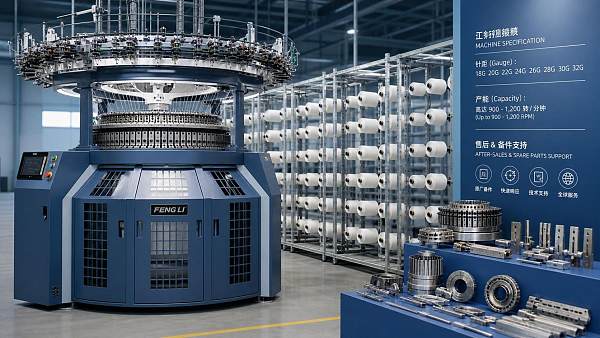
Choosing the right circular knitting machine manufacturer can directly affect production capacity, fabric consistency, and long-term operating costs.
The decision is rarely about unit price alone.
Gauge range, machine stability, parts access, and service response usually decide whether an investment performs well after delivery.
In practical sourcing, a circular knitting machine manufacturer should be assessed as a long-term operating partner.
This guide breaks the evaluation into clear steps so comparison becomes more consistent and less risky.
Start with Production Reality, Not Catalog Claims
The first filter is internal demand.
Before contacting any circular knitting machine manufacturer, define fabric types, order mix, and target output per shift.
That sounds basic, but many poor purchases start with unclear production assumptions.
Ask four internal questions first.
- What daily capacity is required at stable efficiency, not peak trial speed?
- Which gauges are needed for current and near-term fabric programs?
- Which yarn counts, blends, and finishing standards must the machine support?
- How much downtime can the production plan absorb?
A capable circular knitting machine manufacturer should respond with application-specific guidance, not generic sales language.
If the supplier avoids production detail, that is already useful information.
Evaluate Capacity Through Stable Output
Capacity should be measured under real operating conditions.
A strong circular knitting machine manufacturer can explain productivity in terms of yarn type, fabric structure, machine diameter, feeder count, and operator skill.
This matters because high theoretical RPM does not always create better output.
In many mills, more stable speed creates better saleable fabric volume.
What to verify
- Actual production per day for similar fabric constructions.
- Defect rate at normal speed.
- Changeover time between orders.
- Energy consumption per kilogram of output.
- Maintenance hours required each month.
A credible circular knitting machine manufacturer should provide reference cases with comparable production settings.
When possible, ask for data over several months, not only factory acceptance tests.
Longer operating evidence usually reveals whether output claims are dependable.
Match Gauge to Product Strategy
Gauge selection sits at the center of machine suitability.
The right circular knitting machine manufacturer should discuss gauge in relation to fabric hand feel, structure definition, yarn behavior, and target applications.
A wider gauge portfolio is useful, but only if supported by stable engineering and service parts.
From a sourcing perspective, gauge flexibility can reduce future reinvestment pressure.
Questions worth asking
- Which gauge ranges are standard, and which are special-order?
- How does performance change across different gauges?
- Are needle, sinker, and cylinder tolerances consistent across models?
- Can the machine handle both present fabric programs and adjacent market demand?
For example, a circular knitting machine manufacturer serving sportswear, underwear, and technical knit applications should show clearer gauge-use mapping.
That makes comparison more grounded than relying on broad model descriptions.
Look Beyond the Machine to Process Compatibility
A machine may be technically strong and still be a poor fit.
The better circular knitting machine manufacturer will ask about yarn suppliers, dyeing standards, factory power conditions, humidity control, and operator skill levels.
That is a positive sign.
It suggests the supplier understands the full production chain.
Compatibility checklist
A circular knitting machine manufacturer that understands process compatibility is usually easier to work with after commissioning.
Test After-Sales Support Before You Buy
After-sales support is often the real differentiator.
A circular knitting machine manufacturer may offer competitive pricing, but weak support can erase that advantage quickly.
Downtime costs are rarely theoretical in textile production.
More often, they show up as delayed shipments, inconsistent quality, and rushed planning.
Support points to confirm
- Response time for remote troubleshooting.
- Local or regional spare parts inventory.
- Lead time for needles, sinkers, cylinders, and key electronic parts.
- On-site service availability.
- Training scope for operators and maintenance staff.
- Warranty terms with exclusions clearly defined.
A practical step is to test the supplier before placing the order.
Send technical questions and track response quality, speed, and detail.
That small exercise often predicts the post-sale experience better than brochures do.
Check Manufacturing Depth and Quality Control
Not every circular knitting machine manufacturer controls the same level of production quality.
Some assemble efficiently but depend heavily on outsourced core components.
That is not automatically a problem.
The issue is whether supplier control remains consistent.
Useful verification points
- Component traceability procedures.
- Inspection standards for critical moving parts.
- Balancing and vibration control methods.
- Electrical safety and control system documentation.
- Factory testing protocol before shipment.
Where available, request documentation aligned with ISO-style quality systems or equivalent internal controls.
A disciplined circular knitting machine manufacturer should be able to explain how consistency is maintained across production batches.
Compare Suppliers with a Weighted Decision Matrix
When several options look similar, scoring helps.
A weighted matrix turns supplier discussions into a more disciplined evaluation.
This is especially useful when the circular knitting machine manufacturer list includes both established brands and aggressive price challengers.
Suggested scoring categories
- Capacity fit and output stability.
- Gauge suitability for current and future products.
- Machine reliability and defect control.
- After-sales responsiveness and spare parts support.
- Total cost of ownership over three to five years.
- Training, commissioning, and technical documentation.
This method also helps internal approval.
It shows why one circular knitting machine manufacturer creates lower operating risk, even if its purchase price is higher.
In many cases, that difference is the more important number.
Final Selection Should Reduce Risk, Not Just Cost
The best circular knitting machine manufacturer is rarely the one with the lowest quote.
The better choice is the supplier that matches capacity needs, supports the right gauge range, and proves dependable after the sale.
That balance supports more stable output and fewer expensive surprises.
In real procurement work, a disciplined evaluation process usually outperforms fast price-driven decisions.
Use supplier discussions to verify production data, gauge logic, service depth, and parts access.
Then compare each circular knitting machine manufacturer against the same operating criteria.
That approach creates a decision that is easier to defend and more likely to perform well on the factory floor.
Recommended for You
 Digital SeaKongsberg Maritime Unveils Arctic Hunter Unmanned Surface VesselKongsberg Maritime's Arctic Hunter unmanned surface vessel is proposed for the Royal Navy's Type 92 programme. Explore its technology and procurement implications.By: Captain Kenji SatoNov 10, 2026
 Sorting RobotsHow Accurate Is AI in Food Quality Control? Metrics and Testing MethodsExplore AI in food quality control accuracy, from recall and false negatives to validation methods. Learn how to assess real-world inspection reliability.By: Marcus SterlingNov 10, 2026
 UHV TransformersGE Vernova Selected for 6 GW HVDC Link in IndiaGE Vernova will design a 6 GW HVDC link for PGCIL, connecting Rajasthan and South Kalamb to support India's clean energy transition. Discover the project.By: Dr. Elena VoltNov 09, 2026
 Grid ResilienceEurope's Grid Compliance Standards in 2026: Generator Connection RequirementsExplore new grid compliance standards 2026 Europe projects must address, from generator connection rules to testing and documentation. Prepare for approval.By: Dr. Elena VoltNov 09, 2026
 Technical FabricsNonwoven Bonding Cost Data: Comparing Thermal and Chemical ProcessesExplore nonwoven bonding cost data to compare thermal and chemical processes, assess usable yield, and choose the best-value option for your application.By: Chloe DuboisNov 08, 2026
 Fiber LasersIndustrial Lasers to 2035: Automotive Lightweighting and Precision Welding Drive DemandExplore the industrial laser market outlook to 2035 and discover how automotive lightweighting and precision welding could shape demand and procurement.By: Dr. Hideo TanakaNov 07, 2026
 Technical FabricsChoosing Geotextile Under Railway Ballast: Key Performance RequirementsChoosing geotextile under railway ballast? Explore essential filtration, drainage, strength and durability criteria to make a confident, project-specific selection.By: Chloe DuboisNov 07, 2026
 Digital SeaChoosing Rail Welding Equipment for Maintenance: Field Conditions and Weld TypesChoose rail welding equipment for maintenance with confidence. Compare welding methods, field constraints, inspection needs, and lifecycle costs.By: Captain Kenji SatoNov 06, 2026
 Digital SeaIndia Broadband Forum Urges Stronger Submarine Cable ResilienceIndia’s submarine cable resilience is in focus as the Broadband India Forum urges faster repairs, more vessels and stronger landing infrastructure.By: Captain Kenji SatoNov 06, 2026
 Digital SeaChoosing a Railway Network Switch Supplier: Reliability and Support CriteriaChoosing a railway network switch supplier? Compare reliability, standards evidence, cybersecurity, and lifecycle support to reduce project risk.By: Captain Kenji SatoNov 05, 2026
 Grid ResilienceUS Grid Equipment Import Ban Raises Cost and Implementation ConcernsThe US grid equipment import ban raises concerns over costs and delivery delays. Explore how unclear criteria could affect procurement and supply chains.By: Dr. Elena VoltNov 05, 2026
 Digital SeaRailway Coupler Price: How Type and Specifications Affect QuotesRailway coupler price depends on type, specifications, and order scope. Learn how to compare quotes, avoid hidden costs, and make a confident buying decision.By: Captain Kenji SatoNov 04, 2026
 Grid ResilienceGlobal Smart Grid Companies Raise $3 Billion in First Nine Months of 2026Global smart grid companies raised $3 billion in the first nine months of 2026. Explore the funding breakdown and potential implications for buyers and suppliers.By: Dr. Elena VoltNov 04, 2026
 Digital SeaChoosing Wholesale Pet Toys: How to Evaluate Suppliers and Minimum OrdersWholesale pet toys: learn how to assess suppliers, compare minimum orders and landed costs, and reduce inventory risk before you buy.By: Captain Kenji SatoNov 03, 2026
 Digital SeaSustainable Packaging Design: How to Choose Materials and Reduce WasteDiscover how sustainable packaging design helps reduce waste, protect products, and control costs with practical material choices and proven testing strategies.By: Captain Kenji SatoNov 02, 2026
 Technical FabricsUSMCA's First Joint Review Puts Textile Supply Chain Rules in FocusUSMCA's first joint review puts textile supply chain rules in focus. Explore potential impacts on origin compliance, sourcing and tariff treatment.By: Chloe DuboisNov 02, 2026
 Digital SeaManufacturing KPI Benchmarking: How to Compare Production PerformanceBenchmarking KPI manufacturing performance? Learn how to compare OEE, quality and downtime, identify meaningful gaps, and turn insights into practical improvements.By: Captain Kenji SatoNov 01, 2026
 Smart MetersCCI Approves Adani Energy Solutions' ₹305 Billion Acquisition of IntelliSmartCCI approves Adani Energy Solutions' ₹305 billion acquisition of IntelliSmart. Discover what the deal could mean for India's smart meter market.By: Dr. Elena VoltNov 01, 2026
 Digital SeaChoosing a Coin Laundry Machinery OEM: What Buyers Should EvaluateChoosing a coin laundry machinery OEM? Compare machine specifications, payment integration, lifecycle costs, and support to make a confident buying decision.By: Captain Kenji SatoOct 31, 2026
 Grid ResilienceUS Energy Department Announces $237 Million Grid SCALED Funding ProgramExplore the DOE's $237 million Grid SCALED funding program and its goals to strengthen grid equipment supply chains, lower electricity costs, and improve resilience.By: Dr. Elena VoltOct 31, 2026
 UHV TransformersA Decade of UHV Power in Shandong: Province Leads in Station NumbersShandong UHV power leads China in station numbers. Explore a decade of grid development and its implications for electricity supply and business planning.By: Dr. Elena VoltOct 30, 2026
 Digital SeaChoosing a Composite Train Body Panel Manufacturer: Fire Safety and Quality ChecksChoosing a composite train body panels manufacturer? Learn how to verify fire test evidence, audit production quality, and avoid costly approval gaps before you buy.By: Captain Kenji SatoOct 29, 2026
 Subsea ROV/AUVOcean Infinity Deploys Six AUVs Together Beyond 5,000 MetresOcean Infinity reportedly deployed six HUGIN AUVs beyond 5,200 metres. Explore what concurrent deepwater missions could mean for seabed surveys and procurement.By: Captain Kenji SatoOct 29, 2026
 Grid ResilienceRenewable Energy Grid Balancing: How Storage and Demand Response Work TogetherExplore renewable energy grid balancing with storage and demand response. Learn how coordinated controls manage shortfalls, absorb surplus power, and improve grid reliability.By: Dr. Elena VoltOct 28, 2026
 Subsea ROV/AUVSeaber Introduces 13 kg RAVEN AUV to Target Mine Countermeasure CostsSeaber’s 13 kg RAVEN AUV targets lower mine countermeasure costs with two mission configurations. Explore its potential value for naval operations and procurement.By: Captain Kenji SatoOct 28, 2026
 Digital SeaBallast Water Management Rules: IMO vs. USCG Compliance RequirementsBallast water management rules explained: compare IMO and USCG approvals, operating limits, and records. Get practical checks to reduce compliance risks and costly port delays.By: Captain Kenji SatoOct 27, 2026
 Subsea ROV/AUVEni Signs Main Cronos Contracts, Moving Gas Project into ExecutionEni’s Cronos gas project enters execution as major contracts are signed. Explore the Cyprus development, Egypt processing plans and key milestones toward first gas in 2028.By: Captain Kenji SatoOct 27, 2026
 Digital SeaBenefits of Refurbished Semiconductor Equipment: When Do Savings Justify the Risk?Explore the benefits of refurbished semiconductor equipment. Learn how to weigh savings against process risks, qualification costs, and support gaps before investing.By: Captain Kenji SatoOct 26, 2026
 Digital SeaSemiconductor Equipment Overhaul: Diagnosing Persistent Process DriftSemiconductor equipment overhaul leaving process drift unresolved? Discover how to pinpoint vacuum, sensor, thermal, and conditioning issues to restore stability and reduce repeat service calls.By: Captain Kenji SatoOct 26, 2026
 Digital SeaSemiconductor Equipment Refurbishment Process: Cleaning to QualificationExplore the semiconductor equipment refurbishment process, from precision cleaning to qualification. Learn how measurable testing helps verify production readiness and reduce risk.By: Captain Kenji SatoOct 26, 2026
 Digital SeaBidding for Offshore Decommissioning Projects: Scope and Liability ChecksBidding for offshore decommissioning projects? Discover key scope, liability, and insurance checks to avoid hidden costs, protect margins, and bid with confidence.By: Captain Kenji SatoOct 26, 2026