BDI: 1,842 ▼ 1.2%
COTTON NO.2: 84.12 ▲ 0.4%
LME COPPER: 8,432.50 ▲ 2.1%
FOOD SAFETY INDEX: 94.2 ARCHIVE_SECURED
OPTICAL INDEX: 11,204.09 STABLE
BDI: 1,842 ▼ 1.2%

SECTOR INDEX
V.24.08 ARCHIVE
Hot Articles
- How Does a Ballast Cleaner Screening System Separate Track Ballast?Discover how a ballast cleaner screening system separates reusable stone from fines, what affects performance, and how to assess the results.
- Pakistan to Seek World Bank and ADB Funding for Smart MetersPakistan seeks World Bank and ADB funding for smart meters on distribution transformers. Explore the plan to tackle power theft and improve grid efficiency.
- What Is Precision Medicine and How Does It Guide Treatment?Discover how precision medicine uses biomarkers and genetic insights to guide treatment, where it can help, and what to ask before testing.
How Do You Evaluate Whether a Textile Technology Supplier Can Scale?


A textile technology supplier may look ready to grow because it has a modern machine list, an impressive sample room, or unused floor space. Those signals matter, but they do not answer the procurement question that becomes urgent once volumes rise: can the supplier increase output while holding the same quality, lead time, traceability, and compliance performance?
How do I evaluate whether a textile technology supplier can scale production? Treat scale as a repeatability test, not a capacity claim. A supplier is genuinely scalable when its equipment, materials, people, production controls, and cash position can absorb a higher order load without relying on overtime, emergency subcontracting, unapproved material substitutions, or weaker inspection standards. The strongest evaluation combines document review with direct operational questions and a staged production validation.
The risk often appears after a successful development order. A supplier can produce a small run of coated fabric, engineered knit, nonwoven composite, automated cut components, or digitally printed material under close attention. The problem is whether the same process remains stable when several production lots are running, raw materials arrive on different dates, and delivery windows become less forgiving.
Start by defining what “scale” means for the order
Before assessing the supplier, translate demand into operating requirements. “Can you make more?” is too broad to produce a useful answer. A factory may have enough nominal output for one product category but lack the right finishing line, inspection capacity, laboratory support, or packaging flow for the product you intend to buy.
Build the evaluation around the conditions that would change during ramp-up:
- Expected monthly or quarterly volume, including peak demand rather than average demand.
- Required lead time from purchase order release to shipment.
- Number of colors, constructions, finishes, or product variants.
- Critical specifications such as weight, thickness, tensile properties, shrinkage, color consistency, water resistance, flame performance, or dimensional stability.
- Approved raw material sources and whether substitutions require approval.
- Traceability, labeling, testing, and documentation obligations.
- Whether the order needs phased growth or a rapid jump from sampling to sustained production.
This definition prevents a misleading comparison. A supplier that can produce a high volume of standard greige fabric may not be able to scale a multilayer technical textile requiring controlled lamination, inspection under specific lighting, batch-level test records, and restricted-substance documentation.
Look beyond stated machine capacity
Suppliers commonly state capacity as an output figure per month or per year. Ask how that figure was calculated. Is it based on installed machinery, current production, a full shift pattern, or a theoretical maximum with no allowance for changeovers, maintenance, rejects, or product complexity?
A credible answer distinguishes between installed capacity, available capacity, and qualified capacity. Installed capacity is what equipment could produce in principle. Available capacity reflects open production time after existing commitments. Qualified capacity is the volume the supplier can make while meeting the required specification and quality plan. Qualified capacity is the figure that matters most.
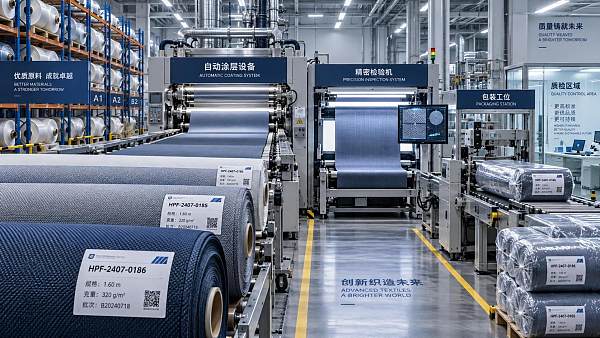
Ask the supplier to walk through the actual production route. For example, a fabric may move through yarn preparation, knitting or weaving, dyeing, finishing, inspection, rolling, laboratory release, and packing. The slowest stable stage determines scalable output. A fast weaving department does not solve a bottleneck in dyeing, heat-setting, coating, or final inspection.
Ask for the practical constraints, not only the favorable numbers. A supplier that openly identifies a dye-house limit, a specialized operator shortage, or a constrained imported polymer may be easier to manage than one that promises unrestricted output without explaining the production assumptions.
Test process stability before committing to a large ramp
Scalability is closely tied to process control. A process that requires continual manual adjustment can produce acceptable samples but become inconsistent when operators, shifts, or material lots change. This is especially relevant for technical textiles where performance depends on coating weight, curing conditions, yarn tension, knit density, laminate bonding, print registration, or controlled finishing chemistry.
Review how the supplier sets and preserves critical process parameters. There should be a defined method for recording machine settings, batch recipes, approved tolerances, in-process inspection points, and corrective actions. The records do not need to look identical across every operation, but they should demonstrate that the factory can reproduce an approved construction rather than rely on individual operator memory.
Questions that reveal whether the process is controlled
- Which characteristics are checked during production, and which are only verified at final inspection?
- What happens when a roll, batch, or lot falls outside tolerance?
- Can production settings be traced to a specific order and raw material lot?
- How are first-run approvals handled after a change in color, yarn source, coating formulation, machine, or shift?
- Does the supplier separate development trials from commercial production controls?
- Who can authorize a deviation, rework decision, or material substitution?
Pay particular attention to variation between lots. One accepted lab result does not prove consistency across repeated production. Request representative quality records from several recent production lots of comparable complexity, with commercially sensitive information removed if necessary. The purpose is not to inspect another buyer’s order; it is to see whether the supplier documents results, investigates deviations, and maintains release discipline under normal operating conditions.
Examine quality capacity, not just manufacturing capacity
A factory can increase output and still fail to scale if its inspection and testing resources do not grow with production. This problem can stay hidden when final inspection becomes rushed near shipment. It may surface later as shade variation, missed defects, uneven performance, incomplete documentation, or inconsistent roll length and labeling.
Review the complete quality flow: incoming material checks, process inspections, laboratory verification, final grading, packing checks, and shipment release. Determine whether the supplier has enough trained inspectors, calibrated test equipment, controlled reference standards, and physical space to hold goods pending release. Where testing is outsourced, confirm the expected turnaround time and the contingency plan when the external laboratory is busy.
Quality systems should also be able to handle nonconforming product without quietly blending it into acceptable inventory. Ask how rejected rolls are identified, segregated, reworked, downgraded, or scrapped. Clear physical and digital controls are more meaningful than a generic statement that the supplier “checks every batch.”
Check the supply chain behind the textile process
Textile production is only as scalable as the supply of its critical inputs. The obvious items include fibers, yarns, greige goods, dyes, chemicals, films, adhesives, coatings, backing materials, and packaging. Less obvious constraints may include specialty spare parts, approved labels, test consumables, or access to a required finishing service.
Map inputs according to their effect on performance and replacement difficulty. Commodity packaging may be sourced from multiple qualified suppliers with little impact. A particular high-tenacity yarn, fluorine-free finish, conductive filament, optical additive, specialty membrane, or color masterbatch may require lengthy qualification before a substitute can be used.
Ask for supplier approval methods, normal procurement lead times, order minimums, and the plan for a supply interruption. The goal is not to demand excessive inventory. It is to determine whether purchasing practices match the order profile. A supplier that buys a critical material only after receiving each order may struggle with short delivery windows, even when its production line has open time.
Assess people, maintenance, and operating discipline
Automation can improve repeatability, but automation alone does not guarantee scale. Advanced knitting, weaving, cutting, printing, coating, or inspection equipment still depends on technicians who can set up the machine, recognize drift, perform routine maintenance, and respond before defects spread through a larger run.
Ask how many people are qualified for each critical operation and whether skill coverage exists across shifts. A single highly capable technician may be enough for pilot production but create a major vulnerability for recurring volume. Training records, operating instructions, handover practices, and escalation responsibilities indicate whether know-how is embedded in the operation.
Maintenance deserves the same attention. Deferred maintenance can look like free capacity until unplanned downtime interrupts a delivery schedule. Review preventive maintenance routines, critical spare-part availability, machine downtime tracking, and the response plan for equipment failure. For a process with one specialized finishing line, the absence of a recovery plan may limit the volume you should commit.
Verify compliance readiness as volume grows
Scaling production can increase regulatory and customer compliance exposure because more material lots, chemical inputs, labels, and shipment documents must be controlled. Requirements vary by product and destination, but the operational question remains consistent: can the supplier maintain the necessary evidence at higher volume?
Review how the factory controls material declarations, restricted-substance information, test reports, product labeling, traceability records, and change notifications. Confirm whether records connect finished goods to relevant raw material and production lots. When a performance claim or regulatory declaration depends on a particular formulation or treatment, determine who controls formula changes and how buyers are informed before production proceeds.
Do not assume that a supplier’s general certification status, if any, proves that a particular textile construction meets your specification. Product-level qualification, agreed testing methods, and controlled production records remain necessary.
Financial and commercial signals are part of scalability
A supplier may have capable equipment and experienced staff but lack the working capital to purchase more raw materials, carry inventory during testing, add shifts, or manage longer payment cycles. This can lead to late procurement, pressure to substitute materials, or requests for abrupt commercial changes after an order is placed.
Commercial due diligence should therefore examine whether the supplier can support the proposed ramp realistically. Discuss payment terms, raw-material commitments, tooling needs, capacity reservations, and the consequences of demand changes. A clear conversation about these matters is usually more useful than seeking vague assurances of financial strength.
Also identify subcontracted processes. Outsourcing is not automatically a problem; many textile supply chains depend on specialist dyeing, printing, coating, finishing, or testing partners. The important point is whether those partners are approved, controlled, traceable, and included in the supplier’s capacity plan. Undisclosed subcontracting can weaken consistency and make root-cause investigations difficult.
Use a phased ramp rather than a single capacity promise
For a new or technically demanding product, the safest approach is usually to qualify scale in stages. Begin with a production-representative run, then increase volume only after reviewing quality results, actual lead times, yield, corrective actions, material availability, and documentation quality. The first commercial run should use the intended equipment, staffing model, process route, and raw-material sources wherever possible.
Set written exit criteria for each stage. These might include accepted product tests, stable inspection outcomes, complete batch records, confirmed material allocation, and no unresolved process deviations. The criteria should reflect the product’s real risk. A standard workwear fabric and a laminated electrical insulation textile do not need the same validation depth.
During the ramp, measure performance against what was promised. Compare planned and actual cycle time, defect handling, test turnaround, order communication, and shipment readiness. A supplier that identifies problems early, documents the cause, and maintains control while correcting them may be more scalable than one that appears smooth only because issues are not reported.
Questions buyers often raise during supplier evaluation
Is unused factory space evidence that a supplier can scale?
No. Space may allow future expansion, but it does not demonstrate available machinery, qualified operators, material supply, inspection resources, or process validation. Treat it as a possible expansion option, not current qualified capacity.
Should a supplier disclose its customer order book?
Detailed customer information may be confidential. However, the supplier should be able to explain available production windows, capacity already committed, seasonal peaks, and the assumptions behind its proposed delivery schedule. You need enough transparency to assess collision risk with existing demand.
What is the biggest red flag during a scale assessment?
A major warning sign is a capacity commitment that cannot be connected to a specific production route, material plan, quality release process, and staffing arrangement. Broad assurances are not a substitute for operational evidence.
When is an on-site assessment especially important?
It is particularly valuable when the textile has safety, regulatory, high-performance, or high-cost requirements; when the supplier is new; when production depends on a specialized process; or when the planned increase in volume is substantial. Remote documentation can support evaluation, but it may not reveal actual material flow, bottlenecks, segregation practices, or shop-floor discipline.
Recommended for You
 Digital SeaHow Does a Ballast Cleaner Screening System Separate Track Ballast?Discover how a ballast cleaner screening system separates reusable stone from fines, what affects performance, and how to assess the results.By: Captain Kenji SatoNov 14, 2026
 Smart MetersPakistan to Seek World Bank and ADB Funding for Smart MetersPakistan seeks World Bank and ADB funding for smart meters on distribution transformers. Explore the plan to tackle power theft and improve grid efficiency.By: Dr. Elena VoltNov 13, 2026
 Digital SeaWhat Is Precision Medicine and How Does It Guide Treatment?Discover how precision medicine uses biomarkers and genetic insights to guide treatment, where it can help, and what to ask before testing.By: Captain Kenji SatoNov 13, 2026
 Grid Resilience2026 CSEE Annual Meeting Opens with Focus on AI and Power SystemsThe 2026 CSEE Annual Meeting explores AI, low-carbon power systems and ultra-high-voltage transmission. Discover why these discussions matter.By: Dr. Elena VoltNov 12, 2026
 Digital SeaShip Radar Detection Range: How Far Can It See and What Limits It?Ship radar detection range depends on more than the display scale. Discover how antenna height, weather, target size, and settings affect what radar can see.By: Captain Kenji SatoNov 12, 2026
 UHV TransformersGE Vernova to Invest $34.5 Million in Louisiana Transformer Plant ExpansionGE Vernova plans a $34.5 million transformer plant expansion in Louisiana. Explore its potential impact on North American supply and procurement.By: Dr. Elena VoltNov 11, 2026
 Digital SeaMetro Station Noise Criteria: Limits and Measurement MethodsExplore metro station noise criteria, applicable limits and measurement methods. Learn how to select metrics and assess compliance with confidence.By: Captain Kenji SatoNov 11, 2026
 Digital SeaKongsberg Maritime Unveils Arctic Hunter Unmanned Surface VesselKongsberg Maritime's Arctic Hunter unmanned surface vessel is proposed for the Royal Navy's Type 92 programme. Explore its technology and procurement implications.By: Captain Kenji SatoNov 10, 2026
 Sorting RobotsHow Accurate Is AI in Food Quality Control? Metrics and Testing MethodsExplore AI in food quality control accuracy, from recall and false negatives to validation methods. Learn how to assess real-world inspection reliability.By: Marcus SterlingNov 10, 2026
 UHV TransformersGE Vernova Selected for 6 GW HVDC Link in IndiaGE Vernova will design a 6 GW HVDC link for PGCIL, connecting Rajasthan and South Kalamb to support India's clean energy transition. Discover the project.By: Dr. Elena VoltNov 09, 2026
 Grid ResilienceEurope's Grid Compliance Standards in 2026: Generator Connection RequirementsExplore new grid compliance standards 2026 Europe projects must address, from generator connection rules to testing and documentation. Prepare for approval.By: Dr. Elena VoltNov 09, 2026
 Technical FabricsNonwoven Bonding Cost Data: Comparing Thermal and Chemical ProcessesExplore nonwoven bonding cost data to compare thermal and chemical processes, assess usable yield, and choose the best-value option for your application.By: Chloe DuboisNov 08, 2026
 Fiber LasersIndustrial Lasers to 2035: Automotive Lightweighting and Precision Welding Drive DemandExplore the industrial laser market outlook to 2035 and discover how automotive lightweighting and precision welding could shape demand and procurement.By: Dr. Hideo TanakaNov 07, 2026
 Technical FabricsChoosing Geotextile Under Railway Ballast: Key Performance RequirementsChoosing geotextile under railway ballast? Explore essential filtration, drainage, strength and durability criteria to make a confident, project-specific selection.By: Chloe DuboisNov 07, 2026
 Digital SeaChoosing Rail Welding Equipment for Maintenance: Field Conditions and Weld TypesChoose rail welding equipment for maintenance with confidence. Compare welding methods, field constraints, inspection needs, and lifecycle costs.By: Captain Kenji SatoNov 06, 2026
 Digital SeaIndia Broadband Forum Urges Stronger Submarine Cable ResilienceIndia’s submarine cable resilience is in focus as the Broadband India Forum urges faster repairs, more vessels and stronger landing infrastructure.By: Captain Kenji SatoNov 06, 2026
 Digital SeaChoosing a Railway Network Switch Supplier: Reliability and Support CriteriaChoosing a railway network switch supplier? Compare reliability, standards evidence, cybersecurity, and lifecycle support to reduce project risk.By: Captain Kenji SatoNov 05, 2026
 Grid ResilienceUS Grid Equipment Import Ban Raises Cost and Implementation ConcernsThe US grid equipment import ban raises concerns over costs and delivery delays. Explore how unclear criteria could affect procurement and supply chains.By: Dr. Elena VoltNov 05, 2026
 Digital SeaRailway Coupler Price: How Type and Specifications Affect QuotesRailway coupler price depends on type, specifications, and order scope. Learn how to compare quotes, avoid hidden costs, and make a confident buying decision.By: Captain Kenji SatoNov 04, 2026
 Grid ResilienceGlobal Smart Grid Companies Raise $3 Billion in First Nine Months of 2026Global smart grid companies raised $3 billion in the first nine months of 2026. Explore the funding breakdown and potential implications for buyers and suppliers.By: Dr. Elena VoltNov 04, 2026
 Digital SeaChoosing Wholesale Pet Toys: How to Evaluate Suppliers and Minimum OrdersWholesale pet toys: learn how to assess suppliers, compare minimum orders and landed costs, and reduce inventory risk before you buy.By: Captain Kenji SatoNov 03, 2026
 Digital SeaSustainable Packaging Design: How to Choose Materials and Reduce WasteDiscover how sustainable packaging design helps reduce waste, protect products, and control costs with practical material choices and proven testing strategies.By: Captain Kenji SatoNov 02, 2026
 Technical FabricsUSMCA's First Joint Review Puts Textile Supply Chain Rules in FocusUSMCA's first joint review puts textile supply chain rules in focus. Explore potential impacts on origin compliance, sourcing and tariff treatment.By: Chloe DuboisNov 02, 2026
 Digital SeaManufacturing KPI Benchmarking: How to Compare Production PerformanceBenchmarking KPI manufacturing performance? Learn how to compare OEE, quality and downtime, identify meaningful gaps, and turn insights into practical improvements.By: Captain Kenji SatoNov 01, 2026
 Smart MetersCCI Approves Adani Energy Solutions' ₹305 Billion Acquisition of IntelliSmartCCI approves Adani Energy Solutions' ₹305 billion acquisition of IntelliSmart. Discover what the deal could mean for India's smart meter market.By: Dr. Elena VoltNov 01, 2026
 Digital SeaChoosing a Coin Laundry Machinery OEM: What Buyers Should EvaluateChoosing a coin laundry machinery OEM? Compare machine specifications, payment integration, lifecycle costs, and support to make a confident buying decision.By: Captain Kenji SatoOct 31, 2026
 Grid ResilienceUS Energy Department Announces $237 Million Grid SCALED Funding ProgramExplore the DOE's $237 million Grid SCALED funding program and its goals to strengthen grid equipment supply chains, lower electricity costs, and improve resilience.By: Dr. Elena VoltOct 31, 2026
 UHV TransformersA Decade of UHV Power in Shandong: Province Leads in Station NumbersShandong UHV power leads China in station numbers. Explore a decade of grid development and its implications for electricity supply and business planning.By: Dr. Elena VoltOct 30, 2026
 Digital SeaChoosing a Composite Train Body Panel Manufacturer: Fire Safety and Quality ChecksChoosing a composite train body panels manufacturer? Learn how to verify fire test evidence, audit production quality, and avoid costly approval gaps before you buy.By: Captain Kenji SatoOct 29, 2026
 Subsea ROV/AUVOcean Infinity Deploys Six AUVs Together Beyond 5,000 MetresOcean Infinity reportedly deployed six HUGIN AUVs beyond 5,200 metres. Explore what concurrent deepwater missions could mean for seabed surveys and procurement.By: Captain Kenji SatoOct 29, 2026
 Grid ResilienceRenewable Energy Grid Balancing: How Storage and Demand Response Work TogetherExplore renewable energy grid balancing with storage and demand response. Learn how coordinated controls manage shortfalls, absorb surplus power, and improve grid reliability.By: Dr. Elena VoltOct 28, 2026